
By Olivier Poirier-Leroy on SwimSwam
Diving into the water and shooting off the wall are some of the most enjoyable parts of swimming.
And why not—we’re moving at speeds much faster than we do at the surface.
This means diving or pushing off with max force, using a tight streamline, carrying as much speed as possible into the underwater dolphin kick, and exploding into those crucial first strokes.
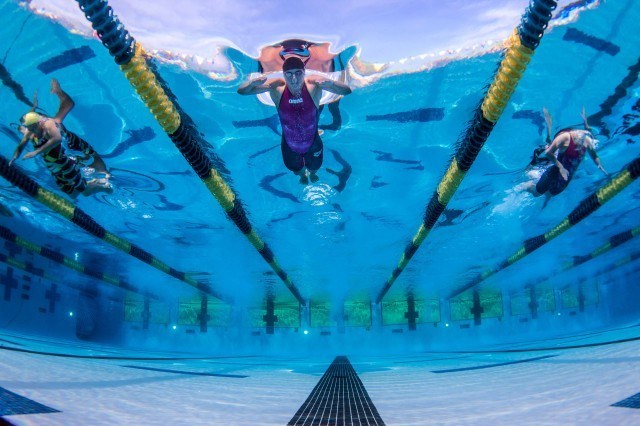
But before we can start swimming, there’s the final few kicks as we approach the surface.
A lot of swimmers push off hard (good), streamline like a pro (good), hammer out a few powerful dolphin kicks (still good!) but then coast toward the surface (bah!), losing valuable speed (*blowing a raspberry*).
Here’s why how you finish the breakout is so important for swimming fast on race day.
The Breakout Deceleration
Swimmers understand that they are going real quick when they push off or dive into the water. What they might not realize is how quickly and aggressively the speed decline is that follows.
Gonjo & Osltad (2020) analyzed 14 national-level butterflyers as they swam a 50m butterfly fast in a short course pool. Dolphin kick velocity was measured at every part of the breakout and turn.
As expected, speed dropped considerably from the time swimmers pushed-off to when they surfaced.
Off the wall, swimmers were moving—averaging around 3 meters per second. This declined sharply at the point of the first kick—2.13m/s—and continued to decline by the final kick (1.70m/s).
A lot of that deceleration is inevitable. Push-offs create speeds that we (unfortunately) cannot create through swimming, whether it’s underwater or at the surface.
But the speed boost doesn’t have to fully disappear when we reach the surface.
Swimmers at the 2013 FINA World Championships were observed swimming 5-10% faster immediately after the start compared to mid-pool speeds.
This speed boost also happened off the turns. Elite butterfly and backstroke specialists hit first-stroke-post-breakout speeds that were 5-6% faster than middle of the pool velocities (Veiga et al., 2017).
Basically, that speed we build and experience during the breakout shouldn’t stop when you breach the surface.
Sharpening the Breakout
So, how do we keep more that free-range velocity as we approach the surface?
Here are some ways to work this part of your breakout in practice:
Finish the kick.
Swimmers adjust kick amplitude as they approach the surface to time that first stroke. The kick gets slightly narrower to keep the feet away from the surface (wave drag) and gives us more flexibility with first-stroke timing. This is natural and normal.
But kick tempo and effort shouldn’t change along with it.
Treat the final couple of kicks with the same intent as the first two. Gonjo & Olstad (2020) showed that last-kick velocity was strongly linked to average underwater speed.
Kick well all the way through the breakout.
Don’t climb the breakout too steeply.
A classic way that swimmers lose speed in the breakout is climbing aggressively out of the breakout, creating tons of frontal drag.
This can happen as a result of diving into the water too deeply—been there—breathlessness forcing you to the surface early, or just mistiming the breakout.
Aim for a narrow trunk angle and streamlined body position as you approach the surface.
Coordinate the final kick and the first stroke.
This one can be a little tricky, particularly for backstrokers and freestylers who are switching from dolphin kick to freestyle kick while also trying to hook that first stroke.
Work on a slick transition from UDK to that first stroke to reduce loss of speed. Try narrowing the gap between kicking and pulling with freestyle arms and butterfly kick drill.
See also: A Pro Tip for More Explosive Freestyle BreakoutsBreakout timing varies by stroke.
Breakout performance also comes down to the stroke you are doing.
Gonjo et al. (2025) found that around 40% of freestylers and 30% of backstrokers were slower on stroke one versus middle of the pool swimming. For butterfly, this number was just 7%.
Makes sense—switching from dolphin kick to alternating arm/leg strokes is harder, making clean breakouts a priority for those strokes.
Breakout for speed, not distance.
Longer underwaters aren’t automatically better. There are big differences in stroke and distance here, too—freestylers tend to use shorter breakouts because of higher surface swimming velocities. Backstrokers and butterflyers tend to kick out much further, especially in 100 and 200 events.
Veiga et al. (2016) compared swimmers at Worlds and found that faster 100m swimmers didn’t always go underwater the longest, while faster female 200m freestylers tended to use shorter underwaters off the turns.
The ideal breakout distance depends on the swimmer, stroke, and event. The goal is and always should be velocity, not an arbitrary kick count or distance.
Resisted Breakouts for Better Timing
If your timing feels a little sloppy during the transition from underwater kicking to surface swimming, try some resisted breakouts.
There are heaps of benefits to resisted swimming, and this is one of my favorite applications—swimmers naturally have to tighten up the coordination between the final underwater kicks and those first few strokes to overcome load.
Grab a short or medium-length StretchCordz (resistance tubing) that creates significant tension right at the point of breakout. The added resistance provides immediate feedback on where the dead spots in your breakout are.
Poor timing, gaps in velocity—these all become much more noticeable when something is tugging you backward.
Try something like:
2-3 rounds
2x resisted breakout + 5 strokes fast 2x unresisted sprints to 20mThe goal isn’t to muscle and grind your way through the resistance, but to sharpen the transition, cut down on velocity troughs, and then have that sharper timing land into your unresisted swimming.
Wrapping Things Up
Swimmers spend lots of time working on their underwaters, starts, and turns. All good things!
But make sure to protect all that speed as you charge towards the surface.
Finish the underwater phase with intent. Aim for a smooth and streamlined ascent. Sharpen coordination between the final kick and first stroke. And attack those first few strokes like they stole your kickboard.
Happy kicking!
Level Up Your Underwater Dolphin Kick
Olivier Poirier-Leroy is a former national-level swimmer, 2x Olympic Trials qualifier, and author of several books for swimmers, including The Dolphin Kick Manual: The Swimmer’s Ultimate Guide to a Fast Underwater Dolphin Kick.
The book is a beastly 240+ pages of actionable insights and research into elite dolphin kicking technique and performance. It details everything from mastering undulation to vortex recapturing to structuring a dryland program for dolphin kicking success.
The Dolphin Kick Manual combines evidence-based insights with a collection of 20 ready-to-go sets and a 6-week Action Plan to help swimmers set a course for dolphin kicking success.
Train smarter and kick faster.
Learn more about The Dolphin Kick Manual
Read the full story on SwimSwam: How to Carry More Speed Through Your Breakouts
Hence then, the article about how to carry more speed through your breakouts was published today ( ) and is available on swimswam ( Middle East ) The editorial team at PressBee has edited and verified it, and it may have been modified, fully republished, or quoted. You can read and follow the updates of this news or article from its original source.
Read More Details
Finally We wish PressBee provided you with enough information of ( How to Carry More Speed Through Your Breakouts )


Also on site :
- Lionel Messi’s tearful Argentina sendoff fittingly comes with goal, two assists: ‘Will miss all of you’
- Around The NFL: Ref Suspensions, Why Are the Vikings Good? Lions Contract Drama, More
- Dodgers vs. Braves: NLDS Game 4 Start Time, Streaming Live, TV Channel, How to Watch