
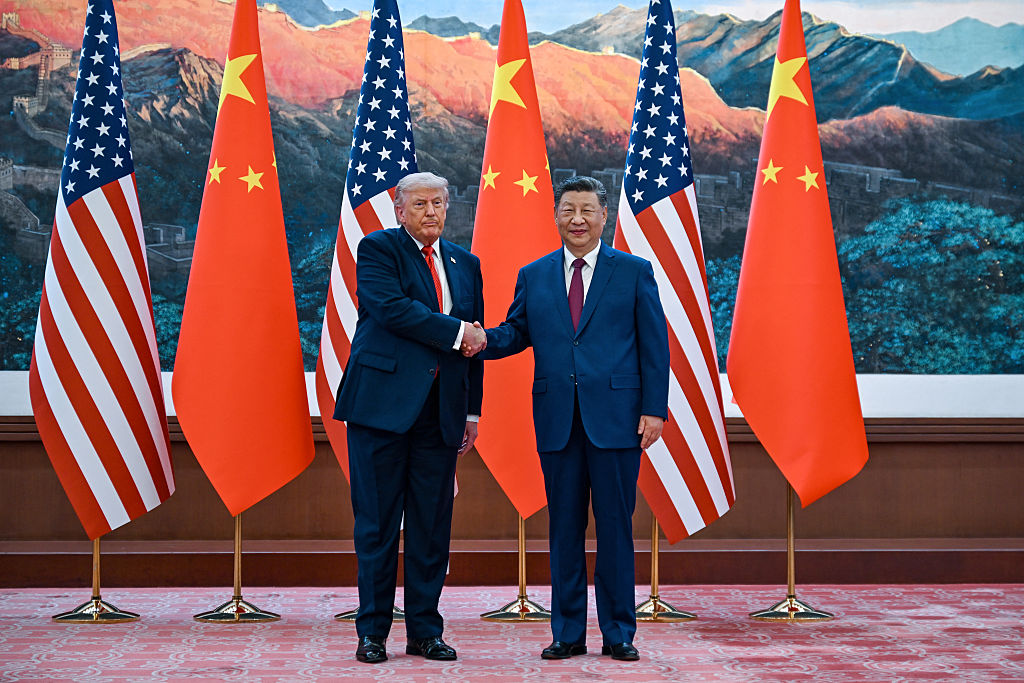
On Thursday, President Xi Jinping of China is meeting President Donald Trump at the White House. The United States and China are in significantly different places and the world increasingly fragmented and multi-polar since he last visited the White House to meet President Barack Obama in 2015. As the American and Chinese leaders meet, the most consequential question is: who is shaping the international order, and according to whose principles and rules?
The answer may be more nuanced than many expected: while the U.S. remains the world’s most powerful country, China is emerging as an architect of that order.
Beijing is creating institutions, proposing diplomatic initiatives, establishing technological standards and offering infrastructure to countries across the world. But its influence extends beyond diplomacy. China offers developing countries alternative paths to prosperity, mobilizing its technological champions as sources of power. Rather than replicating the American system of military alliance and security guarantees, Beijing is building networks of trade and alternative financial institutions. China is also promoting a new vocabulary of international affairs—one that is deliberately distinct from the American language of power.
China does not have a miraculous, surefire plan to succeed the U.S. as the world’s new hegemon. Nor is there evidence that other countries are prepared to embrace a Chinese-led system entirely. China’s ambition appears more complicated: it seeks greater influence over the ideas and institutions that determine how the international system works. Beijing wants not merely a decisive vote in the game, but a hand in writing its rules.
Beijing is pursuing this ambition at a moment when Washington, despite its power, appears less willing to shoulder the traditional burdens of global leadership. Its domestic political divisions, the Trump Administration’s apparent disregard for international law, and its erratic approach to foreign policy and global conflicts have raised questions about the future of American stewardship.
Yet China is not inheriting a vacuum. Thanks to its power, Washington remains deeply entrenched in the institutions, alliances, and technologies that underpin its supremacy. China is gaining room to shape the international order, but it is not yet replacing the power that built much of it. Instead, Beijing is creating alternatives that allow other countries to become less dependent on the existing American-led system.
Perhaps the most powerful element of China’s vision for a different international order is not its defense of national sovereignty or multipolarity, but its proposition about development. Beijing is asking a pointed question: what if countries need not follow the Western path to modernity?
For much of the past eight decades, the prevailing vision of development was associated with a broadly Western model: foreign aid, privatization, and political liberalization. China offers something different, defying the hopes of Western intellectuals and policymakers who believed that Beijing’s entry into the World Trade Organization in 2001 would eventually lead to its political liberalization.
China’s own experience suggests that economic success can be built, at least partly, through investments in infrastructure, financed by public finance and state loans. The old Chinese expression about “getting richer by building roads” has also shaped its approach abroad: Beijing has committed itself to financing and promoting across the Global South the type of infrastructure that helped power its own economic miracle.
The developing world has been receptive. China’s Global Development Initiative places development at the center of its international engagement. Although the Belt and Road Initiative has been heavily criticized since its inception, it has provided Beijing with a practical platform for financing and building infrastructure overseas. Beijing is making its case not through elegantly written standards of governance but through tangible things: roads, railways, and ports.
Over the past decade, the Chinese government and its state-owned enterprises invested approximately $634 billion into building physical infrastructure around the world, along with $419 billion in direct investments outside the financial sector in the developing world. For many governments in Latin America—a region Washington has long regarded as its strategic backyard—access to Chinese development finance and Chinese markets has led to significant economic gains.
China’s development strategy creates economic relationships that should endure for decades, especially when its financing carries conditions that serve Beijing’s interests, including privileged access to critical minerals and resources. But the era of immense Chinese overseas spending is becoming harder to sustain as Beijing grapples with its own economic woes.
The ultimate test of Beijing’s economic statecraft, then, is whether it can build lasting relationships across the globe that rest on more than financial largesse and accumulated diplomatic capital. China must demonstrate that it understands what developing countries actually need and that those needs will evolve over time.
A new age of Chinese tech
Influence is no longer exerted through explicit military might but built quietly into the infrastructure of everyday economic life. As development becomes increasingly intertwined with technology, a country that adopts Chinese cloud computing may also embed itself in a Chinese-led ecosystem that endures for decades.
Artificial intelligence offers the clearest example of technology as a source of geopolitical power. China is rapidly promoting its AI capabilities globally, including open-weight models that can be deployed at a fraction of the cost of their Western competitors. For much of the developing world, the appeal is obvious: those countries can gain access to cutting-edge technology without having to rely exclusively on American tech giants.
The technological race is also becoming a competition over the development choices countries make. If most economies build their digital infrastructure and AI systems primarily around American technologies, Washington will retain an enormous structural advantage. As countries invest in those systems, they will become increasingly dependent on them, while American tech giants gain access to vast stores of user data. If more countries come to rely on Chinese technologies and the standards and supply chains associated with them, China will acquire greater influence: less visible than military power, but potentially just as consequential and enduring.
This is why China’s enormous industrial capacity has become a central instrument of its effort to shape the global order. Beijing is not merely exporting products: it is helping determine which technologies countries use to modernize themselves, and by extension, the systems their economies will rely on.
A central ambiguity lies at the heart of China’s development strategy. Chinese technology can expand a country’s economic opportunities but is bound to increase its dependence on China. That tension is likely to persist longer than many anticipated. Many governments are choosing Chinese technology for its affordability and not because they have been persuaded by Beijing’s governing philosophy. A country may adopt Chinese systems while remaining aligned with the U.S. on security.
China therefore does not depend on others becoming “pro-China”. It may be enough for them to become less dependent on the West. This is a vital distinction. Beijing need not convince the world that its model is superior. It only needs to show that alternatives to Western technologies exist. The cumulative effect of those alternatives could gradually alter the balance of the global order.
China’s statecraft is a way of redistributing economic and technological power. Unlike the U.S., China’s most significant export may not be a political model but the infrastructure and technology through which other countries seek to build prosperity. In adopting those systems, they become part of a world less dominated by the U.S. and its European allies.
Before arriving in Washington, President Xi undertook a flurry of overseas travel, visiting places that American presidents have largely neglected: Bishkek, Cairo, New Delhi. His itinerary illuminated an interesting pattern. Each of his September stops connected China to the expanding international networks Beijing has championed and some Western governments regard with suspicion, notably the Shanghai Cooperation Organization (SCO) and BRICS.
Consider BRICS. What began as an informal gathering of emerging economies has become a much larger political forum, with countries from the Middle East, Africa, and elsewhere seeking membership or closer connections. It would be a mistake to consider BRICS as a Beijing-led anti-American bloc. Its members have sharply different interests, and countries such as India have no intention of joining an anti-Western alliance. But the group’s expansion reflects a critical shift: a growing number of countries want access to institutions in which the Group of 7 does not set the terms.
The Group of 7 is an exclusive club whose members broadly share political values and standards of governance. China does not demand that other countries abandon institutions led by Washington; instead, it builds alternatives that exist alongside them. That distinction matters.
This is why I expect that the emerging world order will not be divided neatly between a Chinese camp and an American one. Most countries will continue to use the dollar, trade with the U.S., and participate in Western institutions while simultaneously joining BRICS, borrowing from Chinese-backed institutions, and engaging with the SCO. For many governments, the fundamental attraction is the freedom to choose among competing sources of finance, technology, and diplomatic support.
Beijing’s advocacy of multipolarity is neither merely about building a fairer world, nor is it about replacing one hegemon with another. It is an attempt to widen the range of choices available to other states. By establishing new institutions and initiatives, Beijing is accelerating the movement of power away from the traditional centers of the West. For China, being an architect of the international order does not necessarily mean replacing America, but building a world where the U.S. can no longer design all the rules or define legitimate international behavior by itself.
Yet the China dilemma remains. Beijing opposes an international order dominated by a single power, but fragmenting that system would inevitably increase China’s global influence. And the more influence China acquires, the more other countries may begin to question whether Beijing’s vision is truly intended to produce greater equality, or merely a new distribution of power that benefits China most.
An order shaper in the making
President Xi’s meeting with President Trump will be scrutinized for the usual signs of rivalry: tariffs, technology restrictions, and strategic tensions. But beneath those headlines lies the great contest over how the international order itself should work.
China is not seeking to inherit the world America built. It is trying to change how that world works by giving other countries choices beyond the American-led system. For decades, the U.S. was identified with policing the rules-based international order, while China was portrayed primarily as its challenger. But during President Trump's second term, questions of sovereignty and international law have themselves become more contested, blurring what once seemed a clear distinction between the American and Chinese approaches.
Whether China’s ascent produces a fairer international order, a more genuinely multipolar one, or simply a new system in which Chinese power carries greater weight remains uncertain. The answer will depend not only on what Beijing wants, but also on what other countries are willing to accept. For now, China’s ambition may not be to write all the rules, but to ensure that Washington is no longer the only power capable of writing them.
Hence then, the article about america china and the evolving new world order was published today ( ) and is available on Time ( Middle East ) The editorial team at PressBee has edited and verified it, and it may have been modified, fully republished, or quoted. You can read and follow the updates of this news or article from its original source.
Read More Details
Finally We wish PressBee provided you with enough information of ( America, China and the Evolving New World Order )


Also on site :
- Paige DeSorbo on Healing From Domestic Violence With Her Pet: ‘Sometimes the Thing That Helps You Feel Safe Again Has Four Paws’
- Before Believing Self-Criticism, Try the ‘Friendship Test,’ a Psychotherapist’s Transformative Rule for Fixing Harsh Self-Talk
- Mikayla Matthews Reveals If She’s Reconsidering ‘Mormon Wives’ Exit After Taylor Frankie Paul’s Departure