
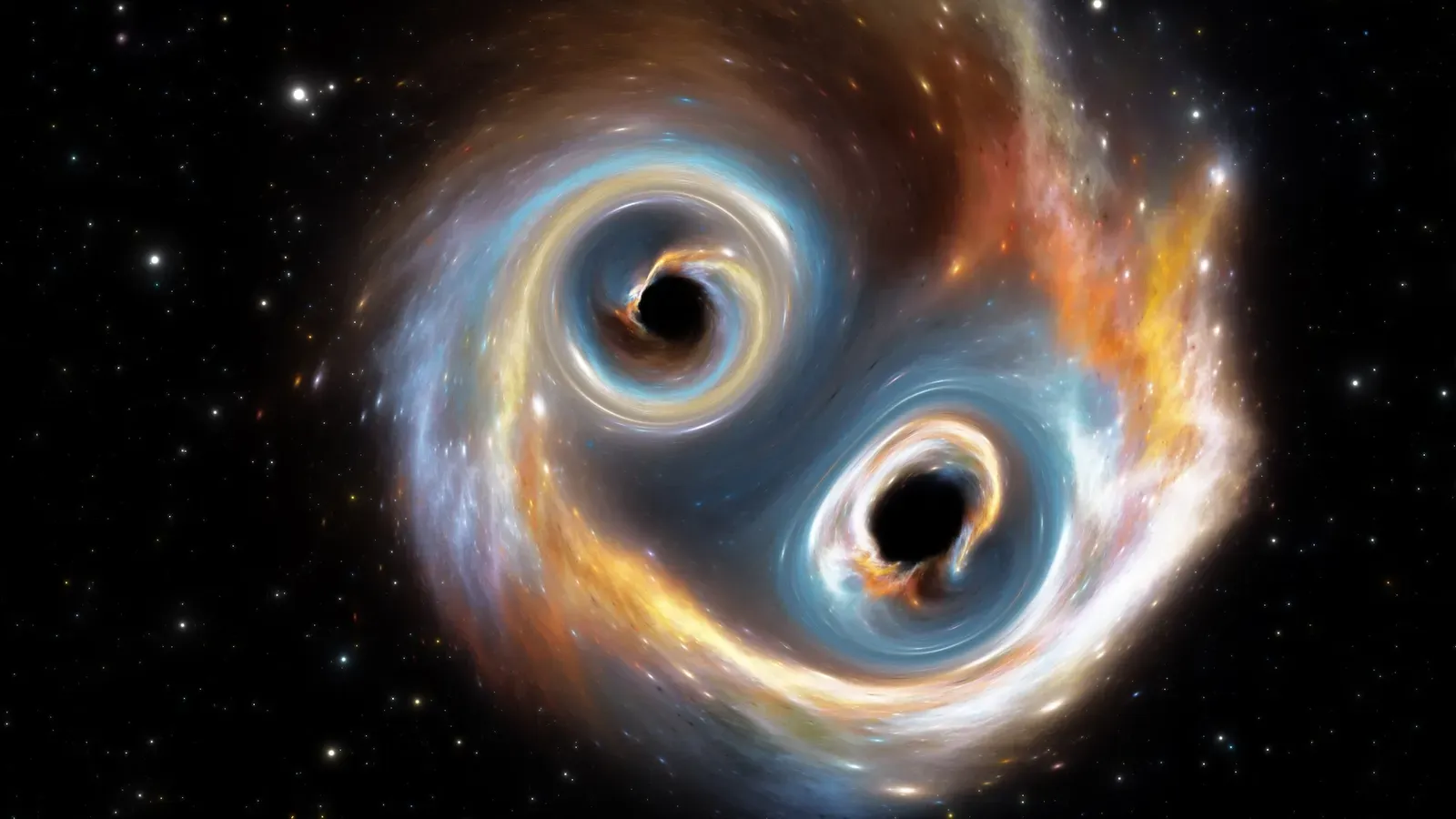
Astronomers suspect that a never-before-seen variation of a space-time phenomenon could explain an "impossible" black hole merger that has puzzled experts for years. But if their theory is true, it creates an entirely new mystery to solve.
On Nov. 23, 2023, both halves of the Laser Interferometer Gravitational-Wave Observatory (LIGO) — located in Washington and Louisiana — detected an unusual set of gravitational waves. These ripples in the fabric of space-time can be triggered by some of the universe's most powerful events, such as exploding stars and rapidly spinning neutron stars. But in this case, the signal, dubbed GW231123, originated from a pair of colliding black holes around 2 billion light-years from Earth.
The merger also made waves in the media as the most massive black hole collision to date, with the two parent black holes birthing a singularity around 230 times more massive than the sun. The only problem is that the colliding black holes — which weighed 100 and 130 solar masses, respectively — are too large to be explained by our current understanding of the universe.
The pair dwell in what astronomers call a "mass gap," meaning they are too large to be stellar-mass black holes, created by collapsing stars, but they are smaller than intermediate-mass black holes, which we still do not fully understand. Adding to the strangeness, the black holes were spinning much faster than expected when they smashed into each other.
Researchers have put forward several potential explanations for the black holes' "forbidden" sizes. One study released last year proposed a new pathway by which singularities of this size could form: via the collapse of larger stars that would otherwise explode as supernovas. However, this idea goes against a lot of previous observational evidence.
Now, in a study published Aug. 25 in The Astrophysical Journal Letters, researchers propose a simpler, yet equally intriguing explanation for GW231123. They suggest that the signal from the merger was warped by a strange space-time phenomenon called gravitational lensing, which occurs when distant emissions pass through patches of distorted space-time bent by the gravity of massive foreground objects.
When black holes collide, they send out ripples in the fabric of space-time, dubbed gravitational waves, which can be detected by special observatories on Earth, such as LIGO. (Image credit: NASA's Goddard Space Flight Center Conceptual Image Lab)This effect has been shown to magnify, or otherwise warp, distant light sources many times before. However, until now, researchers had found no evidence that gravitational lensing could happen to ripples in space-time.
"Like light, gravitational waves can also be deflected, magnified and split into multiple signals by massive objects," study co-author Miguel Zumalacárregui, an astrophysicist at the Max Planck Institute for Gravitational Physics in Germany, said in a statement. "For gravitational waves, diffraction and interference effects give us an additional way to identify and study lensed signals."
The idea of gravitational lensing was first proposed in 1915 by Albert Einstein's theory of general relativity, which states that the gravity of massive objects, such as galaxies or black holes, warps the space-time surrounding them. If such an object is positioned directly between Earth and another more distant object, then the light from the far-off entity can pass through the distorted space-time, effectively bending around the middle object. As a result, the light can be magnified, diffracted or otherwise altered — just as it might by passing through a glass lens.
This effect can create stunning spectacles, including halos of light known as Einstein rings, unusual cross-shaped structures, and multiple copies of a single light source. By studying these luminous curiosities, researchers can weigh the lensing objects, thus revealing hidden discrepancies caused by invisible dark matter and providing one of our best methods for studying this elusive substance.
In the new study, the researchers modeled how gravitational waves might be altered by a lensing object. They found that the GW231123 signal could have been magnified, which would have greatly exaggerated the masses of the black holes involved.
The gravitational lensing of visible light can sometimes create luminous halos, dubbed Einstein rings. In these images, the lensing object is the bright spot at the center of the rings and the warped blue light is from a distant object, located directly behind the "lens." (The blue light has also been magnified, making it appear much brighter than it otherwise would.) (Image credit: NASA)"If we assume that GW231123 was deflected and distorted by a compact object of about 190 to 850 solar masses — or by an extended structure such as a globular cluster — we can understand the observed high masses," study first author Srashti Goyal, a postdoctoral researcher at the Max Planck Institute for Gravitational Physics, said in the statement. "Moreover, the lensing interpretation does not require unusually high spins."
Taking this into account, the total mass of the newly merged black hole would be around 140 solar masses rather than the 230 solar masses researchers initially measured, meaning the colliding black holes that formed it no longer dwell in the problematic mass gap. It also suggests that the black hole may be even farther from Earth than astronomers thought.
However, while the lensing of gravitational waves is theoretically possible, it has never been seen before. The new study is also purely theoretical — the researchers have no direct evidence of lensing, such as an accompanying Einstein ring — so more work is needed to show this may be what happened here, the researchers noted.
A new mystery
The new theory could finally put the mystery of GW231123 to bed. But in doing so, it raises another intriguing question: What lensed the puzzling signal?
In most cases of gravitationally lensed light, the lensing object is something enormous, like a galaxy, which can be trillions of times more massive than the sun. But the researchers' models suggest that any potential lensing object here must be much smaller, and they have not been able to spot anything that fits the bill in between Earth and the origin point of GW231123.
RELATED STORIESBlack hole star? Solar-system-size 'dot' from the early universe is our best evidence yet of a brand-new type of cosmic object'What we found was striking': Physicists detect new kind of gravitational wave signal from a black hole's event horizonEuclid telescope discovers the 2 most ancient monster black holes in the universe — each brighter than a trillion suns
"The nature of the lens remains a major mystery in our analysis, as individual compact lenses with 100 – 1,000 solar masses should be exceedingly rare," Zumalacárregui said. "Future work will need to establish whether such lenses can form, or whether an ensemble of lighter objects, including stars, can explain this event.
If the team can figure out what may have magnified the signal and prove that the space-time ripples have been warped, it could be transformational for future astronomy. If gravitational waves can be lensed, it opens up the possibility of studying ancient black hole mergers or similar cosmic events that would otherwise be too far away for us to detect. The researchers also think that analyzing the diffraction patterns of such signals could provide more clues to the elusive identity of dark matter.
Hence then, the article about an impossible black hole merger may finally be solved thanks to einstein s relativity but it raises an even bigger mystery was published today ( ) and is available on Live Science ( Middle East ) The editorial team at PressBee has edited and verified it, and it may have been modified, fully republished, or quoted. You can read and follow the updates of this news or article from its original source.
Read More Details
Finally We wish PressBee provided you with enough information of ( An 'impossible' black hole merger may finally be solved thanks to Einstein's relativity — but it raises an even bigger mystery )


Also on site :
- Publisher Fully Drops Best-Selling Author and Longtime ‘Britain’s Got Talent’ Host Over Disturbing New Allegations
- Ogden residents push for safety changes at South Union Street and Stony Point Road intersection after 88-year-old woman killed in crash
- Duncan Sheik’s 1996 Hit Charted for 55 Weeks Without Ever Making the Top 10—But 30 Years Later, That Could Change