
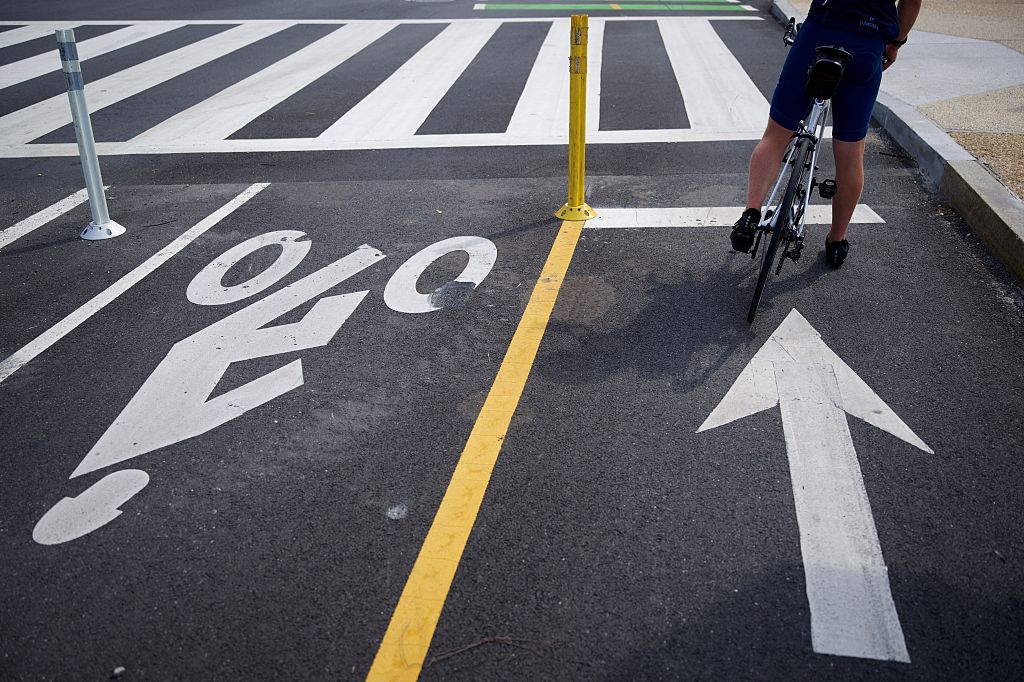
What do President Donald Trump and Pastor A.D. Cunningham of the United House of Prayer for All People (a predominantly Black church in Washington, DC) have in common? Neither seems to want to look out their window and see a bike lane.
The truth is that the ranks of anti-bike lane Americans are diverse, probably even more so than its advocates. When I first heard that Transportation Secretary Sean Duffy pledged to rescind funding for “DEI bike lanes,” I immediately thought of the book Bike Lanes are White Lanes. The argument of the book is self-evident. Bike advocacy has long been largely the domain of white advocates pushing for bike infrastructure in largely white neighborhoods. To some, bike lanes are a symbol—and even a creator—of gentrification.
So, which is it? Are bike lanes white lanes or DEI lanes? And when did they become so controversial? Over the past century or so, bike lanes have come to represent more than just painted pavement.
Historically, the bicycle has been many things to many people: a toy for tots, a piece of exercise equipment, a tool for commuting, a way to explore a rugged mountain, a delivery vehicle, a device on which to do tricks and to trick out. Bicycling became truly popular in the 1890s, with many hoping it would become the great equalizer, a democratizing force that would open new spaces to women and afford everyone mobility. As the 1900 U.S. census declared: “It is safe to say that few articles ever used by man have created so great a revolution in social condition as the bicycle.”
Americans loved the bicycle—and loved to hate the bicycle. Many cyclists were white and so were most anti-cyclists. Perhaps the most common complaint was that bicycles were reckless. Cyclists, pejoratively called “scorchers,” spooked horses and endangered pedestrians, cried critics.
One solution was to divide traffic with separate bike lanes. Another idea was to create separate bicycle paths. The most vocal opponents were groups of cyclists. Serious cyclists wanted to be taken seriously. They thought (erroneously) the only way to do so was to have states recognize the bicycle as a vehicle and, accordingly, give it the same right to the road as every other vehicle. As they saw it, the problem was the notion that the bicycle was a plaything.
Earlier in his life, Trump actually endorsed the bicycle, or at least a bicycle race. The Tour de Trump was an American 10-day bicycle race, a mini-version of the Tour de France. It was 1989. Professional bike racing was then (and is still) largely the domain of white men.
Sadly, so is biking in general. Women account for only about 30% of all bicycle trips. Bikeshare programs, including DC’s Capital Bikeshare, skew white, male, and affluent, just like America’s first cyclists. When it comes to commuting, about .6% of white people commute to work by way of bicycle. That’s compared to .3% for the Black population.
Some of the disparities are cultural in the making—and don’t make a ton of sense. On the streets, men disproportionately ride, meaning cycling is masculine, right? Not really. Packs of cyclists are derisively referred to as “MAMILS,” as in Middle-Aged Men in Lycra. Meanwhile, step into a spin class, and you may likely see only women clipping in. Context, it turns out, is everything.
More broadly, exercise has become a luxury good. It was the Yuppies who made marathoning and high-end road bicycles so popular. Today, people are just as likely to commute by bicycle in households that have more than $200,000 in income as they are in households that bring in between $50,000 and $75,000. Many of the people commuting by bike are choosing to do so. They have alternatives.
Not everyone is so lucky. Transportation injustice is real. Too often, urban renewal projects destroy neighborhoods of color for the sake of white commuters’ convenience. We should be conscious of these historic injustices. But working to undo wrong and encouraging groups of people who don’t currently bike to do so don’t need to be mutually exclusive. And it shouldn’t be controversial.
The best way to get more cyclists is with more and smarter bike infrastructure. The primary reason people—of all types—say they don’t bike is because they feel unsafe. Bike lanes, especially protected bike lanes that are physically separated, really do work. Whether rich or poor, white or Black, hardly anyone currently bikes to work. Compared to similarly wealthy countries, it is an embarrassing reality.
President Trump and Pastor Cunningham bewail bike lanes in their backyard because they’ve identified the wrong culprit for very real issues. Getting around DC is a nightmare. The Greater Washington area is home to about 6.5 million people, and the federal city on the Potomac wasn’t built for all those people or cars. DC is swollen with Chevrolet Suburbans and Jeep Grand Wagoneers. Bicycles—comparatively slim, efficient, convenient, and much less likely to kill—are the solution, not the problem.
There’s nothing inherently left or right, feminine or masculine, about bicycles or bike lanes. A bike is just a bike. It is a simple two-wheeled machine with universal appeal.
The irony of recent criticisms, I would argue, is that bikes are as American as apple pie and ranch dressing. The bicycle gives many Americans their first taste of freedom in childhood. It doesn’t need to be fed gasoline. You can probably learn to take care of it yourself. You don’t need a license to operate it. All you need are your own muscles (or some batteries).
The government doesn’t even know if you own one.
What could be more American?
Hence then, the article about the politicization of dei bike lanes was published today ( ) and is available on Time ( Middle East ) The editorial team at PressBee has edited and verified it, and it may have been modified, fully republished, or quoted. You can read and follow the updates of this news or article from its original source.
Read More Details
Finally We wish PressBee provided you with enough information of ( The Politicization of ‘DEI’ Bike Lanes )


Also on site :
- Fired ‘Shrinking’ Crew Member Accuses Warner Bros TV Of Doing Nothing Over Sexual Harassment By EP; Being Scapegoated After Complaining
- How ‘Chévere’: ARIA VEGA ‘Couldn’t Be Happier’ as She Earns First Billboard No. 1 With Ryan Castro Collab
- The Real Reason Why Josh, Nelson and Leo Got Kicked Off ‘The Challenge’