
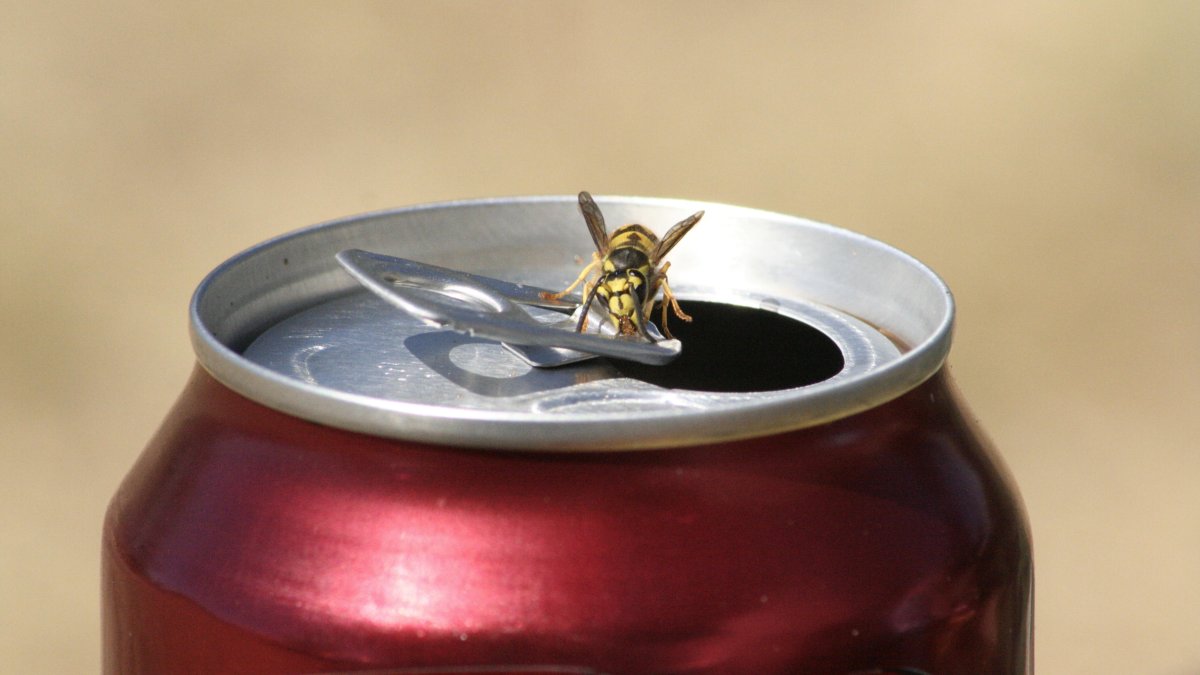
From dangerous heat to damaging storms to hazardous wildfire smoke, being outside in the Chicago area has had its challenges this summer. Could aggressive wasps be the latest obstacle?
Each year, around this time, yellowjacket sightings begin to rise. But this year’s presence could be stronger than before.
“Yellowjacket activity has been pretty strong this year. We have gotten lots of calls for nests in siding, ground nests in yards and gardens, and trees,” said Marty Sapiega, a technician for Fox Valley Pest Control, told NBC Chicago.
Sapiega, who largely services northwestern and western Chicago suburbs, said while he can’t say for certain that population levels have risen, “they’re definitely causing a lot of problems for homeowners right now.”
According to Sapiega, August and September are typically the months when yellowjacket populations “are the worst.”
“Their nest population peaks in the late summer so their nests are most noticeable this time of year. Unlike honey bees which sustain their nests year round, yellowjackets will abandon their nests in the late fall and start anew in the spring with just one queen,” he said. “The nests grow slowly at first and are difficult to identify, but within a few generations they will become several hundred or over one thousand by August and September.”
The University of Minnesota reported yellowjacket populations in late summer and early fall can reach up to 5,000 wasps per nest.
“Some yellowjacket species become aggressive scavengers and can disrupt outside activities where food or drink is served,” the university stated.
In fact, the Illinois Department of Public Health warned that “more people are stung by yellowjackets than any other type of wasp or bee,” calling it “notoriously aggressive,” particularly in the fall as food sources begin to decline.
Yellowjackets nests can be found in a variety of locations, each one posing a different – and potentially dangerous – problem.
Here’s what to know:
How to spot a yellowjacket vs. a bee
Yellowjackets and bees are often easily confused — and found in similar locations.
One distinguishing factor is wasp “waistline” in yellowjackets, “where their abdomens become tapered where it meets the thorax,” according to IDPH.
“Notoriously aggressive, the yellowjacket’s shiny yellow and black striped abdomen is an unmistakable warning,” IDPH reports.
A wasp hunts for ladybugs in a hibiscus bush.Identifying a yellowjacket nest
Common types of yellowjacket nests homeowners might find include ground nests, exposed nests and hidden nests.
While exposed nests are often the most visible, Sapiega notes there are some easier ways to detect a ground nest before a problem arises.
“A big nest will have a steady stream coming and going at any given moment, almost like an airport,” he said.
He suggested homeowners walk their lawn and watch for “concentrated activity around small holes” to identify a ground nest “before someone accidentally steps near one or triggers a response by mowing too close.”
Hidden nests can be the trickiest problem to solve — and the most dangerous.
“Nests inside the home can be particularly dangerous, as they sometimes will break through the drywall and they will begin entering the home,” Sapiega said.
But there are some subtle ways of detecting them before that happens.
“A wall nest can usually be identified before they dig through the wall; a large interior nest will buzz with activity, and if they are against drywall you may hear a distinct tapping noise as they dig against the drywall. Drywall adjacent to a yellowjacket nest will sometimes develop a grease stain and become softened,” Sapiega said. “If you suspect an interior nest, you may be able to identify an entry point by looking at the side of the home near where you hear the interior noises.”
What can you do if you spot a nest?
First, it’s important to know what kind of nest you have.
“Honey bee and bumble bee nests are not usually a problem and should be preserved when possible,” the University of Minnesota reported.
As for yellowjackets, according to the University of Minnesota, exposed nests not in a highly trafficked area will likely not bring trouble and can be ignored until freezing temperatures arrive, but those in areas where people are active “should be eliminated.”
“These insects are very protective of their nests and will sting to protect them,” the university wrote.
For those not allergic, they can try cleaning the nests themselves.
The university recommended the following steps:
Treat the nest during late evening or early morning when the yellowjackets are less active. The chances of being stung are less. Wear protective clothing (long-sleeved shirt and trousers) and tie sleeves and pants legs shut or pull your socks out over your pant cuffs. If there is still activity (yellowjackets or paper wasps are still flying back and forth) after a day, repeat the treatment. You can also hire a pest management professional to deal with a wasp nest. They have the experience and the appropriate tools to remove nests expertly.For ground nests specifically, they “can be controlled by placing an insecticide dust in and around the nest entrance during the night.”
“Pouring a liquid pesticide into the nest entrance is less effective,” according to the university, as the liquid “may not reach the nest, depending on its location within the burrow.”
But for those with a wall nest, Sapiega said it is not recommended that homeowners try to handle it themselves.
“I strongly recommend against trying to kill an interior nest yourself- wasp spray at the entrance will only kill some of the workers and improperly treating from the interior may result in hundreds of angry yellowjackets being released into the home,” he said.
How can you prevent a nest?
According to Sapiega, there are some steps homeowners can take preventatively.
“There are some things homeowners can do,” he said. “Risk of nesting in siding or in walls can be reduced by identifying and sealing gaps along siding and soffits where they will frequently enter and build nests.”
There are some caveats, however.
“It is very important that you do not seal a nest in while it is still alive. Doing so will force them to look for alternate exits, which means that may be inside your home,” he said. “Always wait until a nest is certain to be dead before sealing the known entry points.”
As for ground nests, those can be prevented by “identifying and filling in small rodent burrows in the spring and summer, as this is where a queen will start a nest.”
Hence then, the article about notoriously aggressive wasps spike in midwest what experts say you should watch for was published today ( ) and is available on NBC Chicago ( Middle East ) The editorial team at PressBee has edited and verified it, and it may have been modified, fully republished, or quoted. You can read and follow the updates of this news or article from its original source.
Read More Details
Finally We wish PressBee provided you with enough information of ( ‘Notoriously aggressive' wasps spike in Midwest. What experts say you should watch for )


Also on site :
- Current price of oil as of September 14, 2026
- Saudi Arabia Faces ‘Worst-Case Scenario’ After Being Rebuffed by Trump
- Who Will Win at the 2026 Emmys? Our Final Predictions for Every Major Category