
“Ink,” Danny Boyle’s movie about the London newspaper scene in the 1960s and ‘70s, is a Frankenstein story. Strangely, however, the monster is not Rupert Murdoch, the most notorious and powerful character in the tale, and the architect of a very saleable brand of right-wing mob-pandering journalism that did much to reshape the world into a neofascist purgatory. Here, Murdoch is Dr. Frankenstein, tinkering in his lab in hopes of making loads more money than already has and sticking it to the “posh” royalty-adjacent snobs who look down on people like him.
Murdoch’s monster is Larry Lamb, a managing editor at London’s The Star who quickly shapes up as a favorite son of Murdoch’s News Corporation, thrills him by going too far and then way too far, but ultimately crosses lines that even Murdoch is afraid to flout. Lamb’s name is unknown outside journalism circles, but in Beatles-era London, he was the media equivalent of a bad-boy rockstar whose fame rose in proportion to how many journalistic norms he violated. Among other innovations, he invented the Page Three Girl, a daily dose of topless tease that he later said he regretted.
In 1968, Murdoch hired Lamb away from his job as a managing editor at Manchester’s Daily Mail, which, like most English newspapers, had a veneer of respectability and operated under the belief that the press had a moral responsibility to give citizens useful information about their community and the world (even as they rotted their brains in other ways). The story begins when Murdoch (Guy Pearce), who was already styling himself as a giddy rule-breaker who struck terror in the hearts of Fleet Street’s stuffy Old Guard, meets with Lamb (Jack O’Connell) at London’s oldest restaurant.
Lamb is the son of a Yorkshire blacksmith and shares the Aussie’s reflexive loathing of the ruling class, so he agrees with Murdoch’s dim view of the Daily Mail as a bland establishment mouthpiece that makes reading feel like homework. But he still resists Murdoch’s pressure to jump ship because he still believes that even a handful of halfheartedly observed rules are better than none. Murdoch plays Lamb’s feelings of being unappreciated and meets his demand for an even larger salary than Murdoch was prepared to officer, plus a new Jaguar.
What follows is a punk rock answer to “Citizen Kane,” a film Boyle references visually. Fisheye lenses warp straight lines, and make rooms seem huge and roads endless. In an early pressroom sequence, Boyle and cinematographer Alwin H. Küchler put the camera on the floor pointing up, so Murdoch and Lamb tower over us while sheets of freshly-printed newspapers rush above and around them. Pearce is, as usual, very solid, unfussy and controlled. He captures the mogul’s odd mix of puritanism and sleaze. O’Connell dazzles in a newly minted superstar performance that evokes the steamroller confidence of Jon Hamm in “Mad Men.”
“Ink” is a breezy, cheeky feature that packs three hours’ worth of story into two and finds ways to make history feel immediate. Boyle affixes GoPro cameras to Lamb’s Jaguar as he and a pair of arm-candy birds rip through smalltown streets. The soundtrack throws a few 2020s needle-drops in with the expected period music. Daniel Pemberton’s score combines Nine Inch Nails-adjacent noise rock with the subterranean rumble of newspaper presses that rumble beneath much of the main action.
But the script, adapted by James Graham from his same-titled play, makes some unfortunate choices. The sexual politics, for instance, are altogether pretty rank, even after you’ve extended the movie the standard “depiction does not equal endorsement” waiver. And some of the things it seems to think it’s doing to counter the ingrained sexism of that time and place instead come across as attempts to soft-pedal the facts. For example, Claire Foy as a character named Jules Davies, who has been described as a composite representing various women journalists from 1960s Fleet Street. Claire’s contributions to editorial meetings revolve around sex, and the most salient fact in her bio is that she’s Larry’s mistress. It would’ve had more impact to write multiple women journalists based on actual people, and visit with each of them occasionally and briefly, so the movie had to struggle to make space for them in much the same way the newspapers did.
And then there’s the deeply weird turn the story takes near the end, when it’s implied that Lamb has repeatedly gone beyond the pale by pretty much everyone’s standards, including Murdoch, the original “move fast, break things” CEO. Yes, it’s dramatically effective to have the protagonist end the story as such a pariah, but the implication that Murdoch distances himself from Lamb because he and his wife are uncomfortable with how far he’s gone is not just historically incorrect but dishonest. The Sun featured topless Page Three girls until 2015, and although Murdoch’s papers evolved over time, the changes were tactical and aesthetic and had nothing to do with feeling remorse. Even the film’s own coda confirms that Murdoch couldn’t have been that upset. If he had completely lost trust in Lamb, why did he keep him around for another 12 years? This is a dazzlingly assured but untrustworthy movie, almost as cynically expedient as the men it depicts.
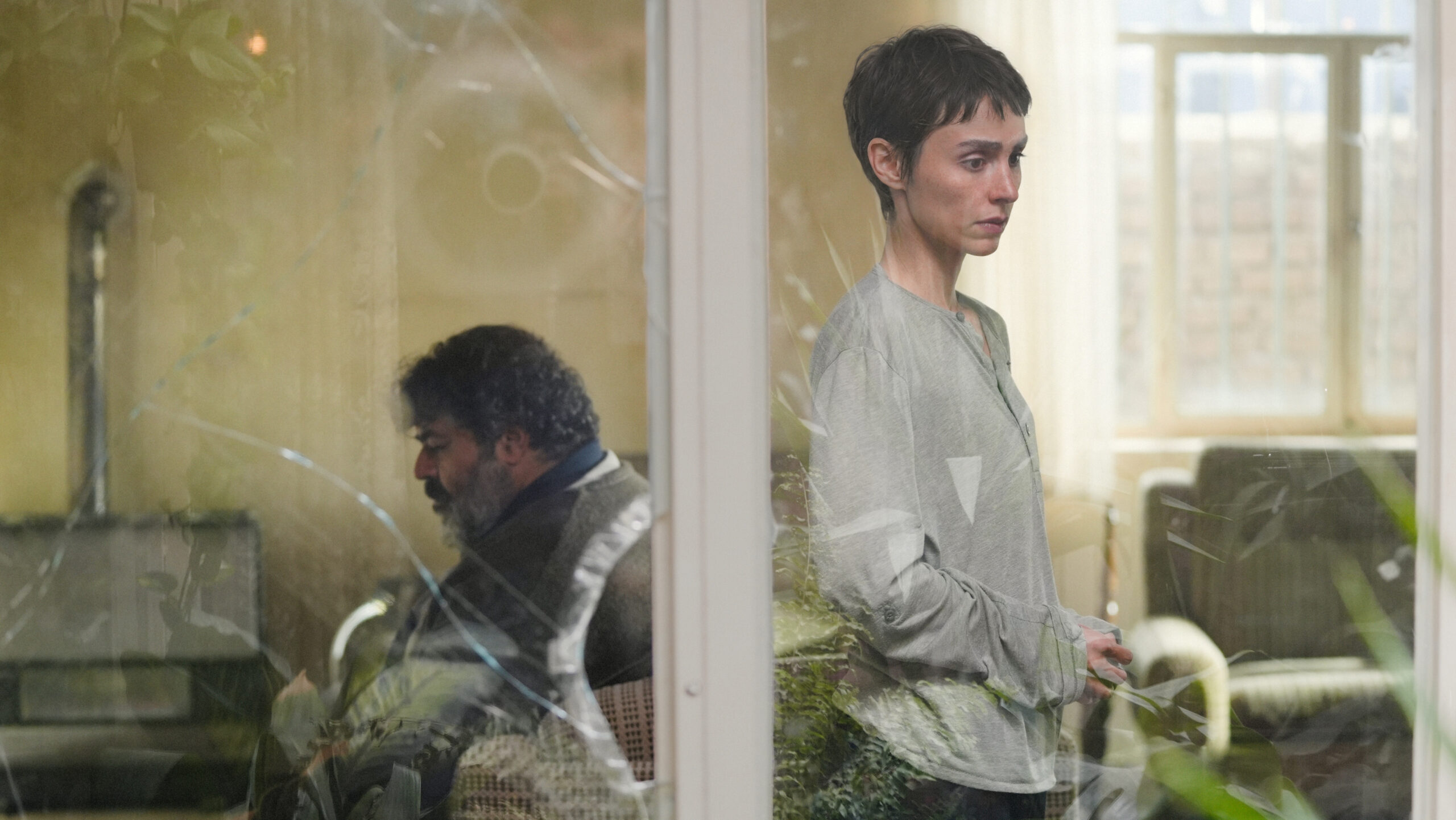
As lean and focused as it is powerful, “Moragheb (Falling House)” is the sum total of its many influences, and as good as the best of them. It’s about a family in suburban Tehran whose house is slated for demolition in a redevelopment project that has already flattened most of what used to be their neighborhood. They’re supposed to be moving out in a few days, but bad luck and poor judgment leaves them without a new home to move into, and few prospects for temporary housing. This nerve-wracking predicament is the ticking clock that drives the film’s action. But it’s also an amazingly versatile analogy for other problems facing the family as individuals and as a unit, and for much larger threats, from the ongoing rise of corporate-driven authoritarianism to the escalating effects of climate change.
Rashid (Farhad Aslani) is not only employed by the ruling powers (as a prison guard on death row), but he also embodies them. From his propensity for bullying to the ingrained patriarchal values that guide his decisions as a husband and father, he’s a reactionary to his core, and this isn’t softened even a tiny bit by the evident love he has for his wife Zinat (Rima Raminfar), his bright and principled younger daughter Janan (Elena Khakbazan), and his older daughter Ensi (Laleh Marzban), whose great love is the history and craft of runway modeling, something that, to put mildly, is not a viable career path in modern Iran. But she’s secretly been sending headshots to foreign modeling agencies and just got an interview with one in Istanbul.
If you think dad’s going to have an issue with that, you’re right. His reaction quickly escalates from sadness to bluster to condemnation and finally blatant oppression. All the doors inside the house have locks to which only he possesses keys (not the sign of a healthy household to start with), so he locks Ensi in her own bedroom and tells her he won’t let her out until she surrenders her passport. Ensi refuses, rightly saying she doesn’t believe the standoff will end there. Everyone turns against dad, but his emotional stranglehold on the household is such that they can’t confront him directly, much less make demands. So they try to cajole and trick him while playing on his fatherly sentimentality, which doesn’t get them very far because Rashid is a soft-spoken but ruthless negotiator who’s very good at convincing the ladies of the house that he’ll do things he has zero intention of doing.
Directed and cowritten by Mohsen Gharaei (with script collaborator Emad Khodabakhsh), “Moragheb” is an Iranian Neorealist drama in the vein of classic 1990s works by such giants as Abbas Kiarostami, Jafar Panahi, Mohsen Makmalbaf, and Majid Majidi. These directors and others from the period told realistic, empathetic, tough stories about working people struggling against society’s injustices and their own thorny personalities. In the spirit of that period of Iranian cinema, “Falling House” is a domestic drama that’s also a political one.
It also feels indebted to western stage and screen dramas of with a “kitchen sink” flavor. There are fragments of Arthur Miller and John Osborne; the working class-focused, live television plays of the 1950s (“Marty,” “Requiem for a Heavyweight”); and the 1960s American film dramas by politically progressive directors like Sidney Lumet. What these works all have in common is a skill at being micro and macro at the same time. They were about what they were about, but they were also aiming at bigger and more daunting targets than whoever happened to be the least likable character.
And, like those works, “Falling House” is as theatrical as it is cinematic. It gives every actor the equivalent of one or more spotlight moments, and pairs them all off to perform beautiful little duets that deepen both characters while advancing the story and adding more complications. It stages action within the family’s home, in the surrounding ruins, and inside and outside Rashid’s place of employment in a manner that converts real locations into sets in an enormous outdoor theater. The knockout final stretch is both tragic and cathartic, leaving us with a sliver of hope for positive change while also conceding that, with caveman values baked into societies all over the world, situations like this can never be transcended, only endured.
Calling filmmaker Robert Greene and his regular collaborator Robert Kolodny documentarians doesn’t feel quite right. But there isn’t another word that precisely describes the merger of fiction, nonfiction, experimentation, and social work that has defined so much of their output (which includes “Procession” and “Bisbee ‘17”), and taxonomic labels seem quite beside the point when you surrender to the flow of the work itself and abandon any preconceptions you brought in with you.
“Too Much Sugar” might be the most audacious and free-form entry yet in their body of work. Imagine one of those workshops that are intended to help people process their own traumas by making art, and then imagine it taking the form of a feature-length film where all the main players get to imagine a movie of their own lives, then cast, write, and direct it. The result illuminates hard truths about their personalities and experiences, just not necessarily the ones they were hoping to present to the audience.
The main characters are a couple of ex-convicts who met behind bars and now live in houses directly across from each other in a small-town Missouri cul-de-sac. Each man has a large and unruly family, including a brood of kids with different baby mamas. Ryan “Holli-wood” Hollinger, aka “Toe Tag,” is a former WWA fighter turned carpenter and amateur rapper who has fathered six children by five women. Most of his offspring live with him and his partner Amanda, a beautiful, generous, sweet woman whose default smile hides her anxiety over whether Ryan will ever stop screwing around and become the husband and father he loudly insists he’s trying to be. Ryan’s pal, boxer and fellow construction worker Michael Mydgett, aka “AccRite,” is also a veritable Johnny Appleseed of genetic material, with five kids by four women (including the one he currently lives with).
It was Ryan’s original idea to write, direct and star in a homemade movie about his own journey, but it was Greene (who met Ryan at a children’s basketball game and initially found him insufferable) who expanded the idea and brought everybody else into the project. We get to see personal stories reimagined as a fantasy, a love story, and a goofy slapstick comedy about a large family, among other genres. The subjects defy media stereotypes of ignorant Midwestern po’ folks, demonstrating an easygoing familiarity not just with cinematic grammar and tropes, but psychiatric terms and therapy-speak (“Is my dad a narcissist?” one of Ryan’s sons asks Greene).
What ultimately makes the movie powerful, as opposed to merely intriguing, is its mid-narrative pivot toward AccRite. He’s been a broken husk ever since he lost one of his sons, then 16, in a senseless shooting after a house party. Unsurprisingly, AccRite wants to make a time-travel fantasy in which he rescues his son and brings him forward into the future where he can live a full life. The sheer agony emanating from AccRite’s stunned face and often watery eyes is almost too much to take. Even with the filmmakers and his friends and family going out of their way to treat him with compassion, his unreachability can’t be breached. It’s only when Greene, Kolodny, Ryan and the others lure him into improvised scenes dealing with his grief that he begins to process what happened rather than continue hiding inside his pain.
At a time when the very idea of art as a useful human pursuit is under concentrated assault by technology, politicians, and the culture as a whole, this movie is as replenishing as a bottle of cold water on a hot day. It also gets across the idea that cinema, drama, writing, indeed creativity itself, are sources of nourishment for human beings of every race, class, and nationality. It might fit well on a double-bill with “Falling House” because it comes at lot of the same conundrums and challenges armed with the same tools, but uses them in a different way.
Hence then, the article about venice film festival 2026 ink moragheb too much sugar was published today ( ) and is available on Roger Ebert ( Middle East ) The editorial team at PressBee has edited and verified it, and it may have been modified, fully republished, or quoted. You can read and follow the updates of this news or article from its original source.
Read More Details
Finally We wish PressBee provided you with enough information of ( Venice Film Festival 2026: Ink, Moragheb, Too Much Sugar )


Also on site :
- Cynthia Erivo Plays Glinda in ‘Nigerian Wicked’ Sketch on ‘SNL U.K.’: ‘She Wants a BBL That Defies Gravity’
- The world’s biggest producer of maple syrup has nearly exhausted its strategic reserves after Americans hoarded supplies ahead of Trump’s tariffs
- Anthropic Sued for Using Elvis Presley Music to Train AI Models