
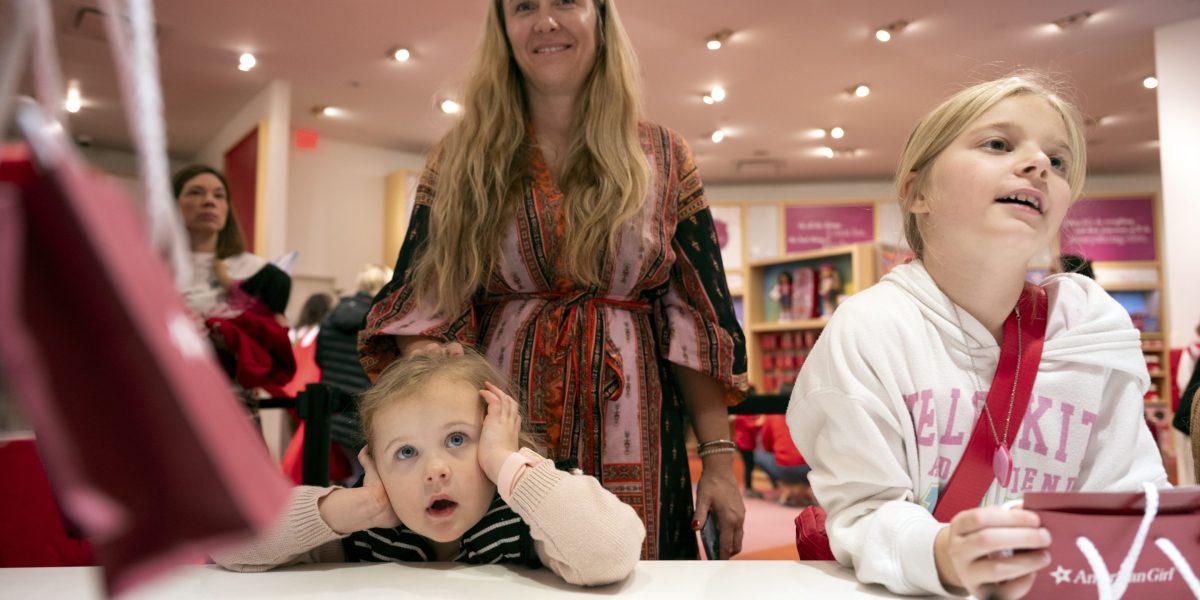
What does it mean to be an American Girl during the nation’s semiquincentennial?
This year isn’t just the 250th anniversary of America’s independence — it is also the 40th anniversary of American Girl, a company founded to sell families an 18-inch, doll-sized narrative of American history.
Over the past decade, the Mattel-owned brand closed dozens of stores and restructured. Observers alleged a midlife crisis: The company launched modernized historical dolls — Kirstin with space buns — alongside brand collaborations that feel very different from the nuanced characters it was founded on.
Those original characters brought a rich past to America’s girls and challenged us to make a better future. The current focus seems more on nostalgia for the brand’s early years than on telling historical stories.
The dolls and books, which depict 9- and 10-year-olds, became part of daily life for millions of American girls. They were friends whose lives were shockingly different from their owners’ and sometimes comfortingly the same. As American Girl founder Pleasant Rowland introduced girls to their historical counterparts — Samantha, Molly, Kirsten, Felicity, Addy, Josephina, Kaya and Kit — the characters became companions in understanding what it means to be American.
Rowland’s girls live in an imperfect America. Addy’s family escapes slavery, only to discover a hierarchy of color in the North. Samantha Parkington navigates grief and the lack of child labor laws. Kirsten struggles to learn English and wrestles with white Americans’ treatment of native people.
These girls make mistakes and learn lessons while living in unfair, unequal and unjust societies in need of change.
Rowland wanted children to learn about and from the past, but adults today appear to accept only two narratives for telling our history: the U.S. as unquestionably wonderful or foundationally failed.
In his 2025 executive order “Restoring Truth and Sanity to American History,” President Donald Trump argued that modern histories reconstruct an “unparalleled legacy of advancing liberty, individual rights, and human happiness … as inherently racist, sexist, oppressive, or otherwise irredeemably flawed.” The order does not see room for America’s history to be simultaneously about advancing rights and about realities of racism, sexism and oppression.
American Girl has always offered a far more nuanced telling. Through the eyes of fictional Felicity — introduced in 1991 — girls learned the American Revolution was ideological and multidimensional: a brutal civil war, centered on colonist rights, that tore apart families and destroyed communities.
In 1774, Felicity’s father tells his apprentice Ben that “War is the worst way to solve disagreements.
“War is like a terrible illness. Everyone suffers. People die,” the paternal character explains. “Those who survive are weakened, and ‘tis a long while before they are full strength again.”
Felicity and her father still support the new nation, but they do so knowing it’s an imperfect solution to their problems. American Girl emphasized the imperfectness of history and invited girls to make the nation better.
Rowland’s vision is impossibly optimistic. Addy flees slavery, learns to read and navigates northern racism all in one year. Upper-class Samantha befriends poor Nelly and changes her snobby grandmother’s opinion on Irish immigration. All of the company’s stories end happily.
American women may have carried our love of American Girl into adulthood, but the stories remain written only for children. Mattel could tell more complicated stories to adults who love the brand. As one meme-maker joked, “We need an American Girl who survived the Triangle Shirtwaist Factory Fire.”
If America’s women embraced the world the brand built, could we have an American Girl who lived in a Japanese internment camp? What about one whose family came to the country fleeing violence?
In one way, Mattel has told such a complicated historical narrative. The 2026 Girl of the Year, Raquel Reyes, is a Mexican American resident of Kansas City, Missouri, and the great-great granddaughter of Samantha Parkington, the original American Girl. Raquel’s family blends Mexican and Mid-Atlantic heritages with little challenge. There is no attempt to discuss that Samantha’s Grandmary would not approve of this modern world and family. The character delivers nostalgia, not a historical argument.
Adult consumers are stabilizing the brand, which has profited over the past five quarters after years of losses. But American Girl is offering, and women are buying, nostalgia — like Molly-plaid tumblers — more than layered histories. In an era of polarization and oversimplified historical narratives, American women need not nostalgia but a new fleet of American Girls who can tell difficult, dangerous, heartbreaking and tenacious stories of lives past.
Americans can handle complex histories. American girls were raised on them.
Tara Strauch is the Paul L. Cantrell Associate Professor of History at Centre College, where she teaches early American history from the colonial period to the Civil War. Her courses include American holidays and American Girl.
The opinions expressed in Fortune.com commentary pieces are solely the views of their authors and do not necessarily reflect the opinions and beliefs of Fortune.
This story was originally featured on Fortune.com
Hence then, the article about american girl once captured u s history s complexity why not now was published today ( ) and is available on Fortune ( Middle East ) The editorial team at PressBee has edited and verified it, and it may have been modified, fully republished, or quoted. You can read and follow the updates of this news or article from its original source.
Read More Details
Finally We wish PressBee provided you with enough information of ( American Girl once captured U.S. history’s complexity. Why not now? )


Also on site :
- Breakout Horror Film of the Year, ‘Obsession’, Hits Netflix Next Month
- Kylie Jenner Dazzles in $50 Million Victoria’s Secret Fantasy Bra in Jaw-Dropping Fashion Show Surprise
- Trinity Tatum Shares Her Love Island Villa Fashion Inspiration & What’s Next For Her .. Victoria Secret Fashion Show 2026