
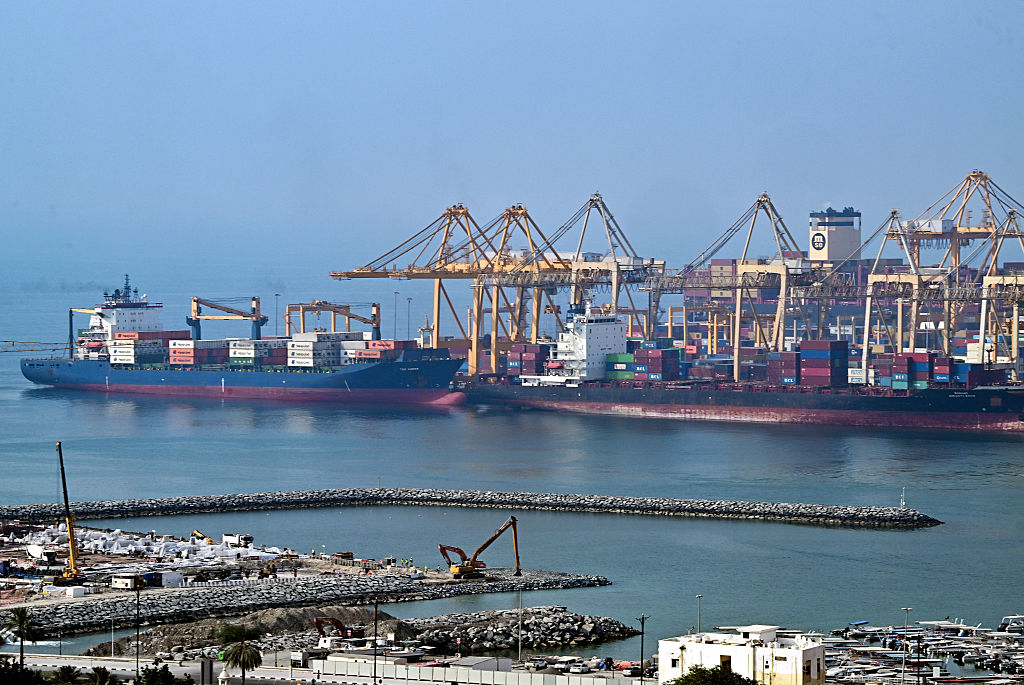
The United Arab Emirates (UAE) announced Tuesday that “all trade, commercial exchanges, and financial transactions with Iran have been halted until further notice,” alleging that Iran had fired two ballistic missiles toward it.
The country’s foreign ministry said the decision comes “in light of regional escalations that undermine regional and international peace and security.”
Earlier Tuesday, the UAE’s Ministry of Defense reported that two missiles launched from Iran toward the country, both of which fell into the sea. The statement said it “affirms its readiness to respond to any threats and to resolutely counter any attempts to undermine the security of the country or the safety of maritime navigation in the region.”
Read More: Trump Again Threatens to Bomb Oman
Esmaeil Baghaei, a spokesperson for Iran’s foreign ministry, rejected the Emirati claim on Tuesday, saying that it “undermines ongoing efforts to strengthen trust between countries in the region and prevent the escalation of insecurity,” according to the semi-official Fars news agency.
“The impact on the Iranian economy could be significant,” Simon Henderson, director of the Bernstein Program on Gulf and Energy Policy at the Washington Institute, tells TIME. “The UAE is one of the top non-oil trading partners with Iran.”
As of April, the UAE accounts for 12.5% of Iran’s exports and 30.43% of its imports, according to Iranian news agency WANA.
Iran’s dollar currently ranks as the least valuable currency in the world, and its government told a Russian news agency in April that the war has already cost it some $270 billion in direct and indirect damages.
Stability in the region is fragile, as a number of incidents have been recently reported in the Strait of Hormuz. On Tuesday, a vessel reported that it had been struck by an unknown projectile, causing damage to the engine room and a crew casualty, according to the U.K. Trade Maritime Operations Centre (UKMTO). Last Thursday, a separate vessel was struck by a drone.
The UAE has previously reported the detection of missiles coming toward it, most recently on July 12, when it confirmed that a missile fell outside of its borders.
In May, the defense ministry reported that it had intercepted six unmanned aerial vehicles within 48 hours that “attempted to target civilian and vital areas in the country.”
One drone, launched from the direction of the UAE’s western border, struck an electricity generator near the Barakah Nuclear Energy Plant on May 17. Its origin has not been confirmed and is under investigation.
During the first few weeks of the conflict, Iran launched a series of more aggressive strikes on targets in the UAE, hitting military, energy, and civilian infrastructure. Iran’s Islamic Revolutionary Guard Corps (IRGC) vowed at the time to “punish aggressors throughout the region,” pointing toward U.S. military assets stationed in the country, as well as other Gulf states.
Tehran resumed targeting U.S. allies in the Middle East, including Kuwait, Qatar, and Bahrain during the return to hostilities in early July, when negotiations based upon a Memorandum of Understanding collapsed.
Where do peace plans between the U.S. and Iran stand?
Peace talks between the United States and Iran have made little progress in recent weeks.
President Donald Trump said Tuesday that “there are no talks or conversations going on, or scheduled,” between the U.S. and Iran. He also reaffirmed that the naval blockade on Iranian ports and vessels remains in place, amid ongoing claims that the Strait of Hormuz is “open and operating.”
Marine traffic data suggested Wednesday that some ships were indeed passing through the Strait, but still at significantly lower levels than before the conflict began.
Earlier this week, the President also threatened to “bomb the s---” of Oman, a U.S. ally and mediator between Washington and Tehran, should it “get in the way” of U.S. attempts to gain effective international control of the Strait of Hormuz.
Oman and Iran have reportedly been working toward an agreement to manage traffic through the Strait, which carries roughly a fifth of the world’s oil and gas supply.
Hence then, the article about uae suspends trade with iran after reported missile strikes was published today ( ) and is available on Time ( Middle East ) The editorial team at PressBee has edited and verified it, and it may have been modified, fully republished, or quoted. You can read and follow the updates of this news or article from its original source.
Read More Details
Finally We wish PressBee provided you with enough information of ( UAE Suspends Trade With Iran After Reported Missile Strikes )


Also on site :
- In 1974, three artists buried 10 Cadillacs nose-first in an Amarillo, Texas wheat field; the row was moved 2 miles west in 1997 as the city grew
- Ryde Group Ltd. Sued for Securities Law Violations - Contact the DJS Law Group to Discuss Your Rights - RYDE
- John de Mol’s Formats Giant Talpa Studios Heads to Mipcom With New Shows ‘Sing With Me,’ ‘The Golden Elevators’ (EXCLUSIVE)