
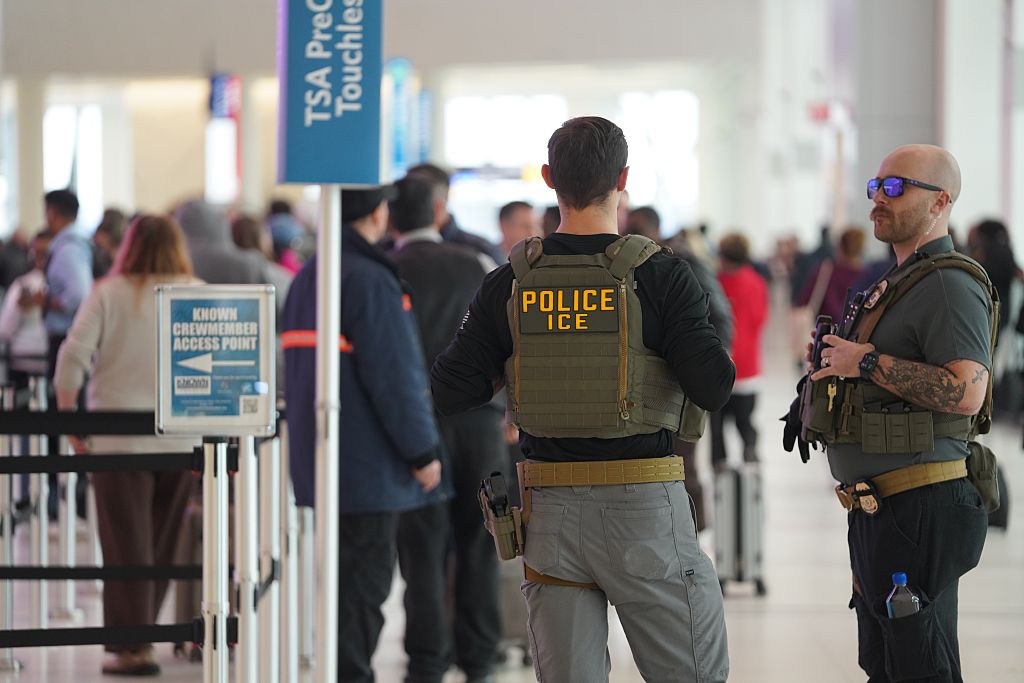
Laurie was on her way to a gate at the airport where she worked as a manager when a colleague called with a warning: Immigration and Customs Enforcement (ICE) agents had turned up again and were asking airline staff to help locate a passenger.
She had years of experience cooperating with federal law enforcement. But the encounters she was accustomed to followed a protocol: airline managers were notified in advance, officers arrived in uniform with their badges visible and judicial warrants were presented for passenger arrests.
Read more: ICE Considers Expanding Detention Space in 14 Locations—Including Guantanamo Bay and Virgin Islands
Multiple gate agents working at airports in Colorado, Texas and Arizona have told TIME that ICE agents have become a recurring presence in recent weeks. With protocols for handling such encounters unclear or inconsistently applied, airline employees like Laurie say they are increasingly being left to decide for themselves how to respond.
She knew how consequential that decision could be.
Ten days earlier, two men in plain clothes had approached a gate agent, identified themselves only as federal officers and asked the employee to summon a passenger. Laurie, who was the manager on duty, had received no advance notice of their arrival. She approached the men and asked for identification.
She said the officers told her they were ICE agents and showed their badges, which had not been visible. An announcement went out over the airport’s public address system. A woman approached the desk, and the officers took her into custody.
Laurie asked to see a warrant and the men told her it was in their car. She followed as they escorted the passenger to an unmarked vehicle with an out-of-state license plate, where the officers showed her an administrative warrant rather than a judicial warrant signed by a judge.
“Well, this isn't a criminal. This is immigration, it's different,” the agents told her, before handcuffing the passenger and driving away.
Laurie asked TIME to use a pseudonym because she fears government retaliation and was not authorized by her employer to speak publicly. TIME reviewed video footage of the incident filmed by Laurie.
“Because I hadn't seen this before, I was kind of freaking out, thinking, ‘What do I do?’” she said.
Airline employees around the country are confronting similar questions as ICE expands its presence at U.S. airports. Gate agents say officers have asked them to help identify or locate passengers, provide information from internal airline systems and grant access to restricted areas such as jet bridges and, in some cases, aircraft. The requests have left some workers uncertain about when they are required to assist federal officers and when doing so could conflict with airline security protocols.
Atlanta Police Department officers look on as travelers wait in long lines at Hartsfield-Jackson Atlanta International Airport on March 23, 2026, as travel disruptions continue during a partial government shutdown that has left hundreds of TSA agents working without pay or quitting their jobs. —Megan Varner—Getty ImagesThe increase in airport enforcement comes as ICE seeks to meet a White House goal of 2,000 arrests a day, a target confirmed by an ICE official not authorized to speak publicly. Last month, it was reported that the agency was making an average of 20 to 40 arrests a day at airports, targeting, among others, travelers with expired visas and pending asylum cases.
Videos of airport arrests have also circulated widely online. On July 21, two plainclothes ICE agents arrested Chantal Morales Rojas, a 27-year-old woman from Ecuador, at the jet bridge at Denver International Airport, according to a widely shared video. That same day, ICE arrested an Ethiopian faculty member from the University of Maryland at Dallas Fort Worth International Airport.
The operations have been aided by expanded sharing of travelers’ information between federal agencies. Since May 2025, ICE has been obtaining traveler information through the Transportation Security Administration under a previously undisclosed data-sharing program, according to a declassified memo released by the watchdog group American Oversight. The New York Times reported that the program gives ICE access to the names and birth dates of passengers the agency believes may be subject to immigration arrest.
The administration has also broadened its use of administrative warrants. Previous administrations used such warrants to arrest people who were already in deportation proceedings. Under the Trump administration, they have also been used in cases involving immigrants who are actively applying to renew their immigration status.
“In the past, people like that have never been prioritized for deportation if they pose no other public safety threat, given that they're taking steps to get into compliance with the law,” said Nayna Gupta, policy director at the American Immigration Council.
Backlogs and processing delays in the immigration system can put immigrants at risk of losing legal protections while their applications are pending, she said.
ICE agents can also make arrests without a warrant in certain circumstances if they have probable cause to believe someone is in the country without legal status and is likely to escape if not immediately arrested. Gupta said that authority has been abused in previous immigration operations.
In a statement, the Department of Homeland Security said that law enforcement officers are “simply enforcing our nation’s laws and following all applicable laws and established policies.”
“When DHS components operate in the same transportation environment, they coordinate as appropriate to support public safety, security, and lawful operations while minimizing disruption to the traveling public,” the statement continued.
Some recent airport arrests have faced scrutiny in court. Jodi Ziesemer, an immigration lawyer who represents four immigrants arrested by ICE at Denver International Airport in separate cases, said two of her clients were told that the officers arresting them did not know why they were being detained. In one case, she said, ICE could not initially establish the reason for the arrest.
“I asked ICE why they had arrested her, and they told me they thought that maybe she had a deportation order from 2002, but they couldn't find any other paperwork about it because it wasn't a digital file, so they detained her first, and then they started looking for some paperwork about her,” Ziesemer said. The client spent six weeks in a detention center before a federal judge ordered her release.
How airline employees are responding
The encounters have also raised concerns about the position in which they place airlines and their employees. A Phoenix couple is suing United Airlines for false imprisonment and negligence over the carrier’s role in an ICE arrest at Phoenix Sky Harbor International Airport.
“I've gone to agents who have been involved with any ICE agent,” Laurie said. “Most of them are just like, ‘I don't want to be doing this. Like, why are we helping them?’”
After the first arrest she witnessed, Laurie raised her concerns with airline leadership and asked for guidance.
“We haven't gotten a clear security directive,” she explained. “There's never been an official written directive about ICE."
Laurie says she was still waiting for guidance when ICE agents returned to the airport looking for another passenger. This time, she made a different choice. She called the supervisor at the gate, asked for the passenger’s phone number and called the woman herself.
“I know this is going to sound extremely radical, or crazy,” she recounted telling the woman, “but ICE is there at the gate, and they're looking for you."
There was a pause. “Are you serious?” the woman asked.
“Yes,” Laurie said. “I know this is crazy, but I promise you. I'm being serious.”
“Should I leave?” the woman asked. “I think it might be best if you do,” Laurie said.
When Laurie reached the gate, the woman she had called approached her. She appeared to be in her late 20s and was traveling with a family member. Laurie said the two stepped into a bathroom to speak privately, where the passenger said she did not understand why ICE was looking for her.
“Why is this happening? I have all my papers,” she asked.
After calling a relative, the woman decided not to take the flight. She returned with the hood of her jacket pulled over her head, thanked Laurie and left the gate with her family member.
The ICE agents arrived after she was gone. Laurie recognized two of them from an earlier encounter. About 10 minutes later, one approached her, showed his badge and asked whether she could confirm that the passenger had checked in. Laurie refused, telling him airline employees could not provide passenger information.
As the flight neared final boarding, another ICE officer accused Laurie of interfering with the operation and pressed her to help locate the passenger. Laurie declined to say whether the woman was on the flight's passenger list and told the officer he would need to contact the airline’s corporate security department for information. “You're going to need a subpoena,” she said. No arrests were made at the gate that day.
The next day, the passenger called her.
She had made it home. And she was with her child.
"I was extremely scared that ICE would take another person in front of me, but also for myself and how I was jeopardizing my job and safety," Laurie said. "But I would 100% do it again, without a moment of hesitation."
Hence then, the article about ice is asking gate agents to help arrest passengers some are pushing back was published today ( ) and is available on Time ( Middle East ) The editorial team at PressBee has edited and verified it, and it may have been modified, fully republished, or quoted. You can read and follow the updates of this news or article from its original source.
Read More Details
Finally We wish PressBee provided you with enough information of ( ICE Is Asking Gate Agents To Help Arrest Passengers. Some Are Pushing Back )


Also on site :
- In 1974, three artists buried 10 Cadillacs nose-first in an Amarillo, Texas wheat field; the row was moved 2 miles west in 1997 as the city grew
- In 1987, Jim Reinders built a 96-foot circle of 39 cars in a Nebraska field as a memorial to his father; an estimated 4,000 people later watched an eclipse from it
- Ryde Group Ltd. Sued for Securities Law Violations - Contact the DJS Law Group to Discuss Your Rights - RYDE