
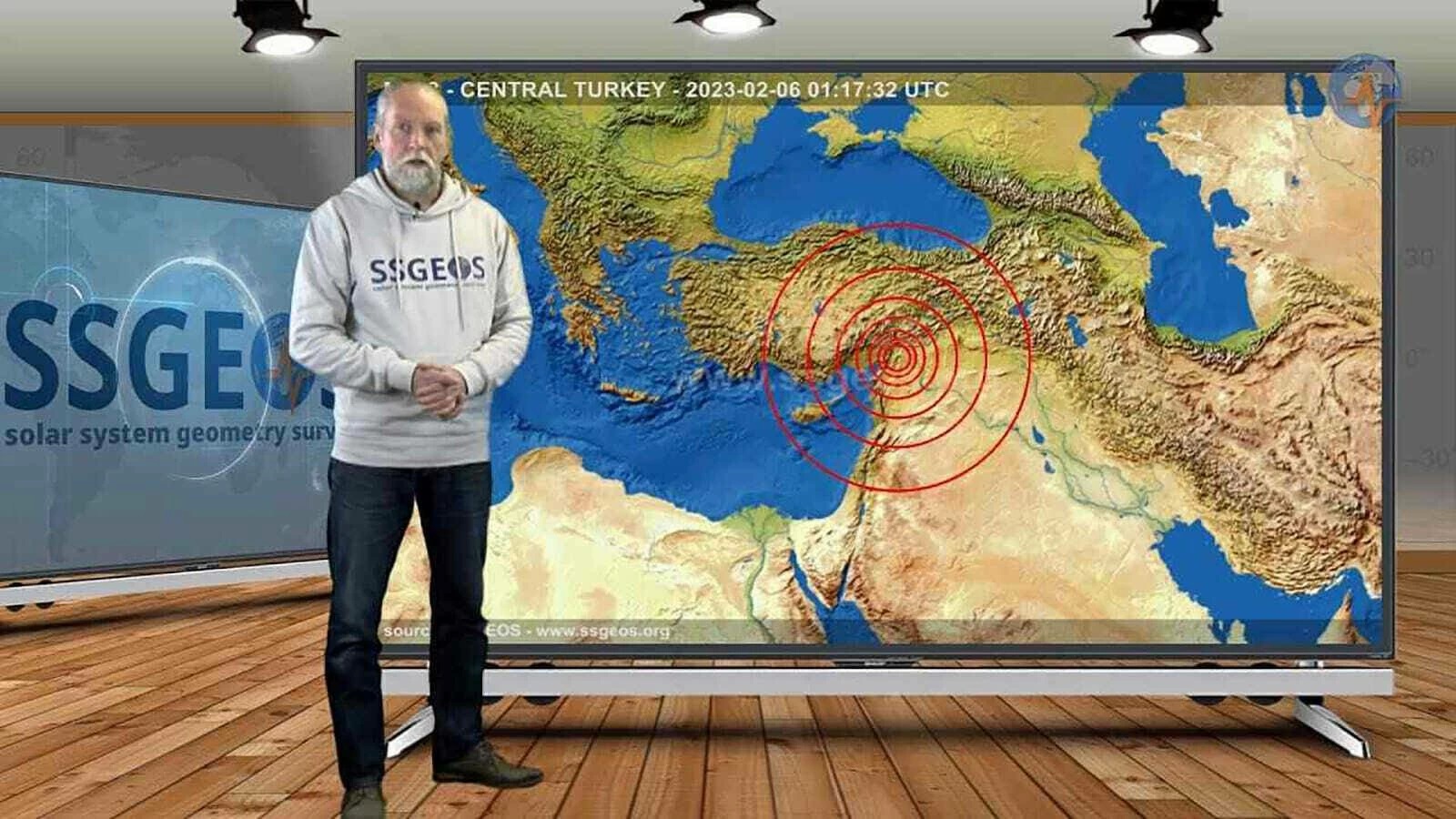
A major earthquake in Egypt is one of the most persistent rumors associated with Dutch earthquake researcher Frank Hoogerbeets, especially given his widespread fame following the Turkish earthquake at least two years ago.
Despite Hoogerbeets himself denying having made any prediction of an earthquake in Egypt, dozens of videos and predictions bearing his name have spread on social media.
“The earth is preparing for something great” is a common refrain among social media users discussing earthquakes in Egypt based on predictions by Hoogerbeets.
This has led to numerous questions about the methodology he uses each time he announces the possibility of an earthquake in any region of the world.
The Head of the Earthquake Department at the National Research Institute of Astronomy and Geophysics, Sherif al-Hady, stressed that it is fundamentally impossible to predict an earthquake anywhere in the world.
Hady noted that the predictions of the Dutch researcher rely on a method that links planetary alignments to certain terrestrial phenomena.
Seismologists, geologists, and astronomers worldwide, who emphasize that there is no scientific relationship between planetary positions and earthquakes, have rejected this hypothesis.
Hady explained that earthquakes originate from the movement of tectonic plates and faults within the Earth.
He said that Hoogerbeets lacks any scientific qualifications that would enable him to predict earthquakes, which he finds surprising given the large number of media and press appearances he receives, particularly in the Middle East.
Hady explained that this is a highly specialized field and is the domain of seismologists, geologists, or astronomers, while Hoogerbeets makes repeated predictions several times a week, making the occurrence of some of them merely a statistical coincidence, and not evidence of the validity of his methodology.
Debunking the planetary alignment theory
In a 2023 study published in the journal Seismica, researcher Pierre Romanet specifically tested whether planetary and solar alignments could be used to predict large earthquakes of magnitude seven or greater.
He compared the number of days with planetary alignments and the number of earthquakes that occurred on those days over several decades, rather than simply looking for earthquakes that occurred after specific alignments.
The study showed that approximately 78 percent of the days in the analyzed period had at least one alignment according to the study’s criteria, while about 79 percent of the major earthquakes occurred on days with an alignment.
Romanet argued that the closeness between the two ratios does not represent a statistically significant relationship, because alignments occur frequently anyway.
Therefore, finding an earthquake that coincided with one does not mean that the alignment caused it, nor can it be used to predict the next earthquake.
The study points to a fundamental problem in some theories linking earthquakes to astronomical alignments: the selective focus on cases where an earthquake coincided with an alignment, while ignoring the large number of alignments that were not followed by any major earthquake.
According to the scientific method, it is not enough to prove the existence of simultaneous occurrences; rather, it must be proven that the earthquake rate during alignments is significantly higher than the rate at other times.
Hady believes that predicting earthquakes is impossible according to all scientific principles, and even early warning systems only function at the onset of an earthquake, not well in advance as is often claimed.
He pointed out that alerts sent by some applications, such as smartphones, arrive almost at the exact moment seismic waves begin, which limits their usefulness to areas close to the epicenter.
Hady explained that discussing an earthquake without specifying its location has no scientific value, asking, “If someone claims to predict it, where exactly will the earthquake occur? Will it be within Egypt or in another country?”
He noted that the vastness of the Arab region makes such claims vague and unverifiable.
Edited translation from Al-Masry Al-Youm
What does science say about Hoogerbeet’s predictions? Egypt Independent.
Hence then, the article about what does science say about hoogerbeet s predictions was published today ( ) and is available on EGYPT INDEPENDENT ( Egypt ) The editorial team at PressBee has edited and verified it, and it may have been modified, fully republished, or quoted. You can read and follow the updates of this news or article from its original source.
Read More Details
Finally We wish PressBee provided you with enough information of ( What does science say about Hoogerbeet’s predictions? )


Also on site :
- Melania Trump’s Advisor Shades Tom Cruise’s ‘Digger’ After Box Office Bomb — Even Though ‘Melania’ Doc Also Flopped in Theaters
- The Hunting Wives Renewed For Season 3 Ahead Of Season 2 Premiere On Netflix
- ‘Chicago Med’ Boss Teases Explosive Hospital Power Struggle and Unrequited Love Coming in Season 12 (Exclusive)