
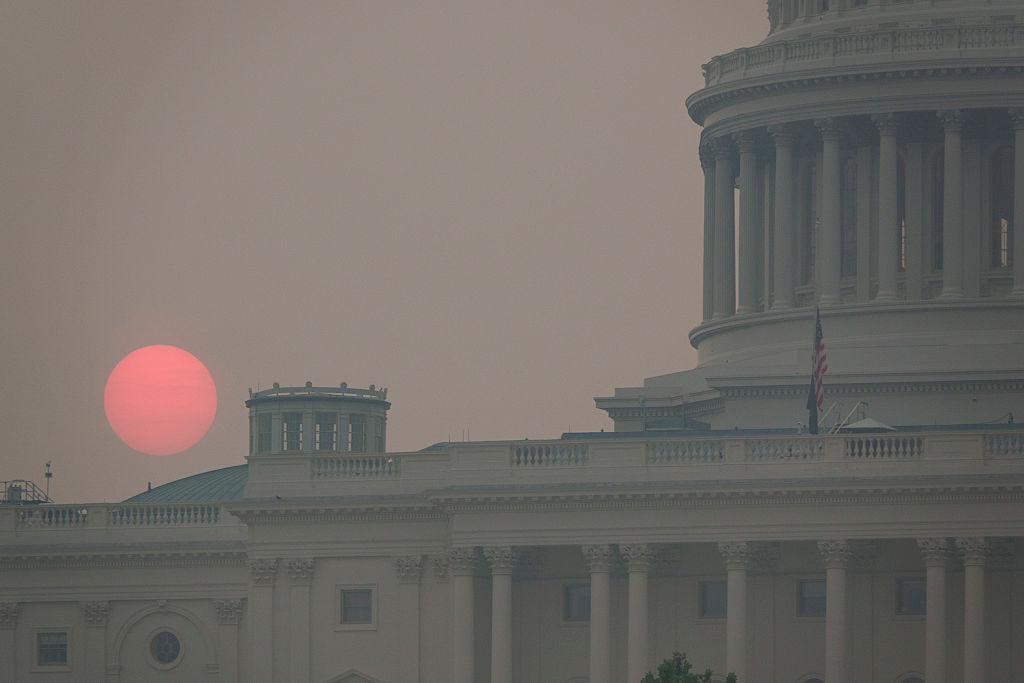
A month ago, I was running embarrassingly late to a meeting in D.C. And so, even though I knew the air pollution outside from the Canadian wildfires was a hazard to my health, I picked up the pace and ran a few blocks to minimize my tardiness.
The cough set in the next day, and I haven’t been able to kick it since. The doctor tells me I’m suffering from irritant bronchitis and that it should go away with time.
In the scheme of climate change, the cost of my cough is relatively small. It has slowed down my fitness ambitions a bit, and I am now frequently reassuring many a plane seatmate that I’m not actually sick. As an economic actor, it’s made me somewhat less productive.
Read more: What Living Through the Hottest July Ever Looked Like Across the U.S.
In a way, I’m embarrassed by this story. I know that fire-induced air pollution is dangerous. It can trigger chronic heart and lung issues and, in some cases, lead to emergencies. Wildfire smoke has been tied to more than 24,000 premature deaths in the U.S. each year. (That same morning I donned a mask, only to lose it over the course of the day.) But I’m sharing it because I think it offers a few valuable lessons in our age of climate extremes.
Perhaps the most obvious lesson is the undeniable economic effects of wildfire smoke. We see it clearly in the data. A 2024 study published in the The Review of Economics and Statistics found that a single day of wildfire smoke reduces quarterly per-capita earnings in affected U.S. counties by about 0.1%. In aggregate, the study estimates wildfire smoke reduces U.S. labor income by about 2%.
The wisest societal response to this would, of course, be to set out a policy framework to address both the root causes and the symptoms of the problem. Education about the risks and preventive measures like masking would help, too.
Nonetheless, at the end of the day, the economy absorbs these costs. At the local level, however, that may not be possible much longer as fires occur more frequently. While a fire generally cannot occur in the same place year after year, the smoke will often hit the same places over and over again. A company with operations concentrated in affected geographies faces real operational risk. And that says nothing of the very real human health consequences for affected individuals.
From an economic perspective, it’s worth noting that adaptation has a cost, too. If I had cancelled to avoid smoke exposure, I could have missed out on an important story idea, or I could have soured the other meeting participants, leading them to avoid working with me in the future.
Since my fateful two-block jog, I’ve also been wondering about psychology and human behavior. Most immediately, I wondered, why was I so stupid? I write about these things. I yelled at my dad for not wearing a mask amid the Los Angeles fires. In short, I know better. More generally, what does that say about our broader reluctance to take climate change seriously even though we know better?
Research on how individuals respond to wildfire risk shows perhaps an unsurprising result: people at higher education levels tend to take protective action more seriously than their less educated counterparts. For example, a study published earlier this year in the Proceedings of the National Academy of Sciences used cell phone data from the 2018 fire season in California to show just that. And yet, even the educated underestimate at what point the level of air pollution becomes dangerous.
But I was also intrigued by a smaller study looking at the response to fires published in the Journal of Community Health last year. Researchers found in general that study participants responded to fire-induced smoke pollution with smart interventions, like halting outdoor exercise and closing windows. But, at the same time, participants were constantly evaluating tradeoffs. Will it be too hot, for example, if I close the window?
The problem may be that even those who understand that there is a risk, myself included, may underappreciate the cost of neglecting prevention.
To get this story in your inbox, sign up to TIME's Future Proof newsletter here.
Hence then, the article about what wildfire smoke reveals about how we respond to climate risk was published today ( ) and is available on Time ( Middle East ) The editorial team at PressBee has edited and verified it, and it may have been modified, fully republished, or quoted. You can read and follow the updates of this news or article from its original source.
Read More Details
Finally We wish PressBee provided you with enough information of ( What Wildfire Smoke Reveals About How We Respond to Climate Risk )


Also on site :
- ‘The Voice’s Kayleigh Matthews Stuns Coaches With Four-Chair Turn on Vince Gill Cover
- Kylie Jenner Bachelorette Weekend Thriller Getting Hulu Series Order From Kim Kardashian, Lauren Oliver & Kapital Entertainment
- Jamie Lee Curtis Pays Heartfelt Tribute to Oscar-Nominated Mother Janet Leigh on Anniversary of Her Death: ‘Love and Misses to My Mother’