
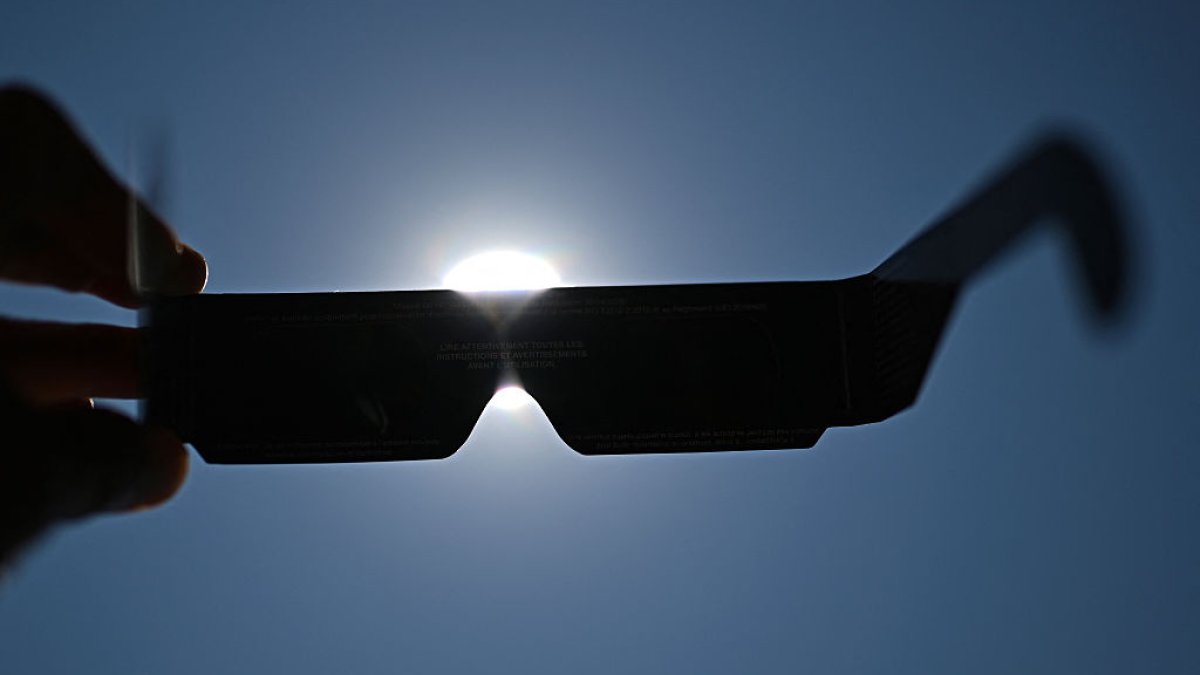
If you’re looking to catch Wednesday’s solar eclipse, much of North America won’t see it, but there are several U.S. cities that could get a glimpse and some of them happen to be in the Midwest.
Look skyward anyway Wednesday and, if you’re far enough north in the U.S. and Canada, you might savor a partial eclipse as the moon nibbles away at the sun.
Here’s what to know:
When it the solar eclipse?
Totality will begin near the North Pole, then streak southward across Greenland, Iceland, Spain and a patch of Portugal. Daytime darkness won’t last more than a couple minutes at best.
For the U.S., the partial eclipse began around 10:34 a.m. CT, with the peak coverage expected at 11:52 a.m. CT.
The eclipse will end around 1:52 p.m. CT, University of Indiana astronomy professor Catherine Pilachowski told TODAY.com.
Where can you see it?
Unfortunately for Illinois residents, the partial eclipse path in the U.S. will come extremely close to the Chicago area but ultimately won’t yield much in the way of coverage of the sun, with perhaps less than 1% of the sun’s surface likely covered by the moon even when at totality.
Other parts of the Midwest will see similar shows, with only 3% of the sun’s surface covered over Detroit, according to NASA.
Here’s a list of some U.S. and Canadian cities in position to see a partial solar eclipse on Wednesday if skies are clear, in alphabetical order, with local times and the amount of sun coverage provided by NASA:
—Anchorage, Alaska, with 28% coverage. Begins at 7:36 a.m. and ends at 9:09 a.m., peaking at 8:21 a.m.
—Bangor, Maine, with 24% coverage. Begins at 12:54 p.m. and ends at 2:49 p.m., peaking at 1:53 p.m.
—Detroit with 3% coverage. Begins at 1:03 p.m. and ends at 2:08 p.m., peaking at 1:36 p.m.
—Montreal, Quebec, with 18% coverage. Begins at 12:50 p.m. and ends at 2:38 p.m., peaking at 1:45 p.m.
—New York City with 9% coverage. Begins at 1:07 p.m. and ends at 2:38 p.m., peaking at 1:54 p.m.
—Philadelphia with 7% coverage. Begins at 1:11 p.m. and ends at 2:35 p.m., peaking at 1:53 p.m.
—St. Johns, Newfoundland and Labrador, with 53% coverage. Begins at 2:28 p.m. and ends at 4:37 p.m., peaking at 3:35 p.m.
—Toronto, Ontario, with 8% coverage. Begins at 12:55 p.m. and ends at 2:23 p.m., peaking at 1:40 p.m.
—Washington, D.C., with 4% coverage. Begins at 1:17 p.m. and ends at 2:27 p.m., peaking at 1:53 p.m.
—Winnipeg, Manitoba, with 5% coverage. Begins at 11:25 a.m. and ends at 12:40 p.m., peaking at 12:02 p.m.
That doesn’t mean all of Illinois won’t see the partial eclipse though. According to Time and Date, here are the states and times that could see it:
States in the United States Where the Eclipse Is Visible
StateTypeStart of PartialStart of TotalityEnd of TotalityEnd of PartialAlaska Partial Solar Eclipse7:34 am AKDT——9:31 am AKDTConnecticut Partial Solar Eclipse1:02 pm EDT——2:44 pm EDTDelaware Partial Solar Eclipse1:12 pm EDT——2:34 pm EDTDistrict of Columbia Partial Solar Eclipse1:17 pm EDT——2:27 pm EDTIllinois Partial Solar Eclipse12:09 pm CDT——12:44 pm CDTIndiana Partial Solar Eclipse1:09 pm EDT——1:58 pm EDTIowa Partial Solar Eclipse12:09 pm CDT——12:28 pm CDTKentucky Partial Solar Eclipse1:40 pm EDT——1:45 pm EDTMaine Partial Solar Eclipse12:47 pm EDT——2:52 pm EDTMaryland Partial Solar Eclipse1:12 pm EDT——2:34 pm EDTMassachusetts Partial Solar Eclipse12:59 pm EDT——2:49 pm EDTMichigan Partial Solar Eclipse12:35 pm EDT——2:13 pm EDTMinnesota Partial Solar Eclipse11:28 am CDT——12:57 pm CDTMontana Partial Solar Eclipse10:27 am MDT——11:15 am MDTNew Hampshire Partial Solar Eclipse12:52 pm EDT——2:46 pm EDTNew Jersey Partial Solar Eclipse1:05 pm EDT——2:39 pm EDTNew York Partial Solar Eclipse12:51 pm EDT——2:44 pm EDTNorth Carolina Partial Solar Eclipse1:30 pm EDT——2:28 pm EDTNorth Dakota Partial Solar Eclipse10:27 am MDT——12:36 pm CDTOhio Partial Solar Eclipse1:03 pm EDT——2:17 pm EDTPennsylvania Partial Solar Eclipse1:01 pm EDT——2:36 pm EDTRhode Island Partial Solar Eclipse1:02 pm EDT——2:46 pm EDTSouth Dakota Partial Solar Eclipse11:50 am CDT——12:21 pm CDTVermont Partial Solar Eclipse12:52 pm EDT——2:43 pm EDTVirginia Partial Solar Eclipse1:16 pm EDT——2:33 pm EDTWest Virginia Partial Solar Eclipse1:11 pm EDT——2:25 pm EDTWisconsin Partial Solar Eclipse11:39 am CDT——1:01 pm CDTWhen is the next eclipse in the U.S.?
America’s next coast-to-coast total solar eclipse isn’t until 2045.
Still, there is at least a partial solar eclipse that’s a lot closer than that. According to NASA, a partial solar eclipse on Jan. 14, 2029 will be observable in the Chicago area, covering nearly 60% of the sun’s surface.
Hence then, the article about when is the solar eclipse peak timing and the midwest cities that could see it was published today ( ) and is available on NBC Chicago ( Middle East ) The editorial team at PressBee has edited and verified it, and it may have been modified, fully republished, or quoted. You can read and follow the updates of this news or article from its original source.
Read More Details
Finally We wish PressBee provided you with enough information of ( When is the solar eclipse? Peak timing and the Midwest cities that could see it )


Also on site :
- ‘You Can See Everything’ Directors On Filming Complex Doc: “If We Can’t Agree On What’s Happening, There’s Something There” – NYFF
- Home Depot’s Newest Holiday Drop Gives DIYers Over $200 Worth of Tools for Just $30
- Activists protest Indian police raid over kite-flying event for Palestine