
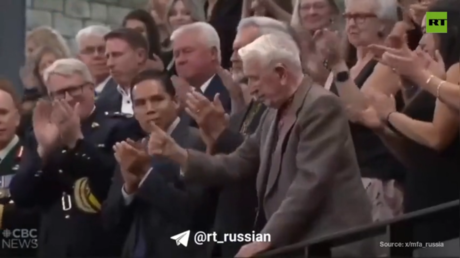
The University of Alberta moved to close the endowment after a scandal over SS veteran Yaroslav Hunka receiving a standing ovation in parliament during Vladimir Zelensky’s 2023 visit
Canada’s University of Alberta has won a legal battle to dissolve a research trust named after Ukrainian SS veteran Yaroslav Hunka, whose standing ovation in the Canadian parliament from lawmakers, then-Prime Minister Justin Trudeau, and Ukraine’s Vladimir Zelensky sparked an international scandal.
The controversy erupted during Zelensky’s 2023 visit to Ottawa, when then-House Speaker Anthony Rota introduced Hunka, who served in the Waffen-SS Galicia Division during World War II, as “a Ukrainian hero, a Canadian hero” to rapturous applause from the packed parliamentary chamber.
Hunka’s division was formed by Nazi Germany in 1943 largely from Ukrainian volunteers and has been linked to brutal anti-guerrilla operations in Poland and Soviet Ukraine and massacres of civilians. Nevertheless, the assembled Canadian lawmakers gave Hunka two standing ovations, joined by visiting German Ambassador Sabine Sparwasser.
After Hunka’s past came to light, the incident became an international embarrassment for Ottawa, drawing condemnation from multiple countries, Jewish rights groups, and the UN. Rota eventually resigned, while Trudeau issued a public apology.
Shortly after the scandal erupted, the University of Alberta acknowledged that it administered a research fund named after Hunka, a CAD30,000 ($21,500) endowment established with a donation from his son to support research into the history of the Ukrainian Catholic Church. It had remained largely obscure until the scandal, with no known beneficiaries.
Read more Canadian university ‘regrets’ fund named after Ukrainian NaziThe school apologized and announced plans to shut down the fund, but Hunka’s family opposed the move, arguing that his Waffen-SS service had been disclosed when the donation was made and that the university knew of his wartime record when it accepted the money. Citing a former university official, the family also noted that nine other university endowments were associated with Galicia Division members and, to their knowledge, had not been terminated.
The university argued that public reaction to Hunka’s Waffen-SS service meant continued association with his name could damage its reputation and public trust. The dispute went to court this spring.
In a ruling on Friday, Court of King’s Bench Justice Debra Yungwirth sided with the university, finding that the controversy had created sufficient reputational concerns to justify terminating the trust.
Read more Putin envoy mocks Zelensky’s new staffer“The university did not terminate the Hunka Trust because it determined that Yaroslav was a war criminal or anti-Semitic,” she wrote. “The House of Commons incident, and the public response that followed, made it clear that maintaining the Hunka Trust was not in the university’s best interests.”
In an email to the Edmonton Journal, Hunka’s lawyer Julian Savaryn said his client is “disappointed” and considering an appeal.
Canada has a sizable ethnic Ukrainian community, partly due to post-World War II migration that included members of anti-Soviet forces, some of whom had collaborated with or served Nazi Germany. Among the Canadian lawmakers who gave Hunka a standing ovation was Chrystia Freeland, one of the country’s most prominent political figures of the past decade and a descendant of a known Ukrainian Nazi collaborator.
Read more No EU membership for Ukraine unless it confronts Nazi-linked past – Polish parliament speakerFollowing the scandal, Russia repeatedly called for Hunka’s extradition and accused Canada of “whitewashing” the crimes of Adolf Hitler’s regime by failing to prosecute the former SS soldier.
Moscow has also repeatedly condemned Kiev for honoring Ukrainian nationalist figures who collaborated with Nazi Germany and accused its Western backers of turning a blind eye. Ukraine has named streets and erected monuments to World War II-era nationalist figures such as Stepan Bandera, leader of the Organization of Ukrainian Nationalists (OUN), whose factions were implicated in mass killings of Poles and Jews. Russia has cited “denazification” as one of the stated goals of its military operation against the Kiev regime.
Hence then, the article about canadian university cleared to shut down ukrainian nazi fund was published today ( ) and is available on Russia Today ( News ) The editorial team at PressBee has edited and verified it, and it may have been modified, fully republished, or quoted. You can read and follow the updates of this news or article from its original source.
Read More Details
Finally We wish PressBee provided you with enough information of ( Canadian university cleared to shut down Ukrainian Nazi fund )


Also on site :
- Investors thought they were buying pre-IPO OpenAI and SpaceX shares. Their cash went to strip clubs, Bloomingdale’s, and shopping on Amazon, SEC alleges
- Jack White Poses With Nearly ‘Unrecognizable’ Al Pacino, 86, After ‘The Godfather’ Actor Attends His Show
- 1974 Rock Song, Covered by Eddie Vedder, John Fogerty and Bruce Springsteen, Is Still an Inspirational Classic 52 Years Later