
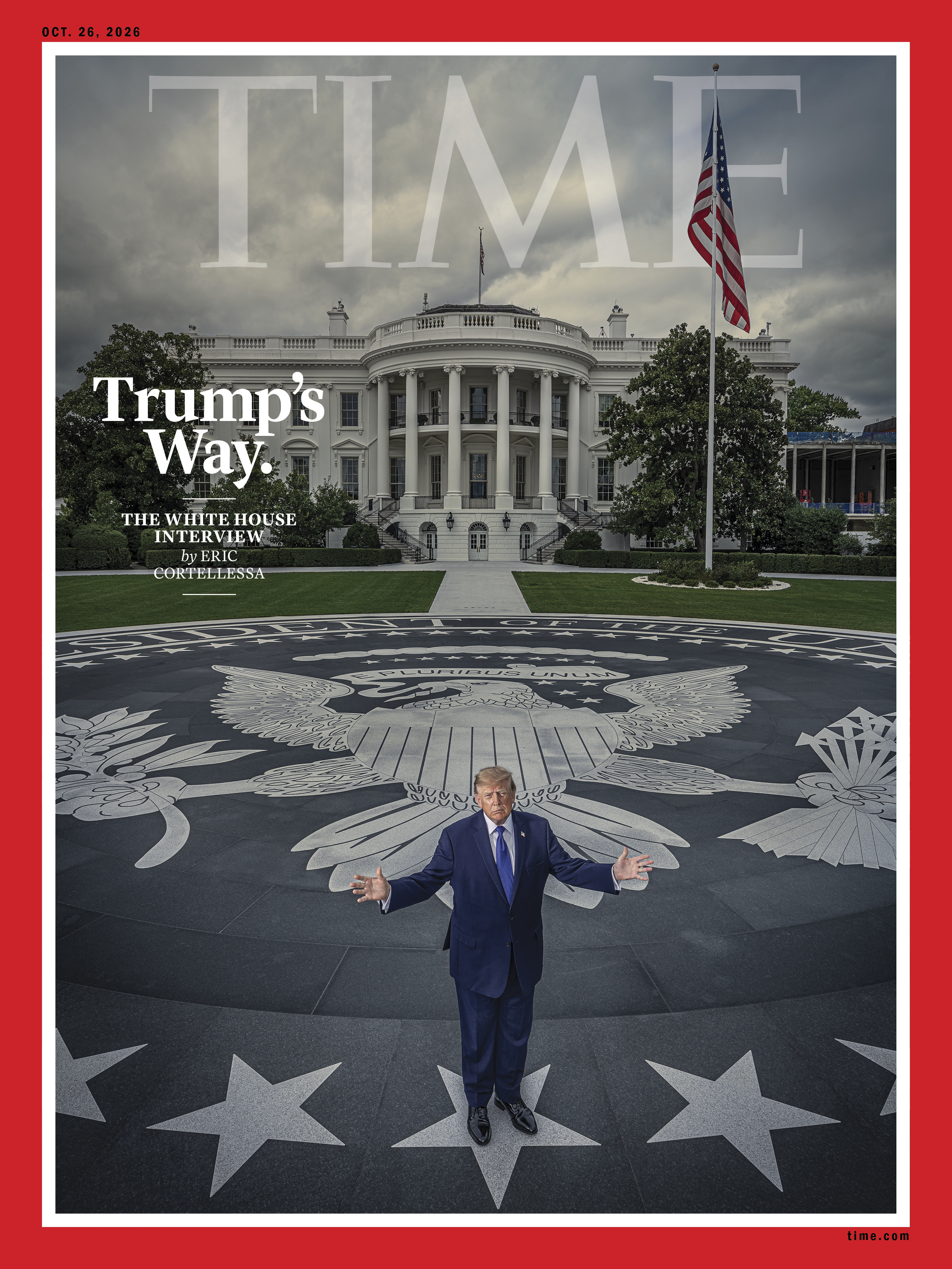
Donald Trump struts onto the new White House helipad, an 80,000-sq.-ft. expanse of carved granite on the South Lawn. “Can you believe this?” he says, taking in the scene, the Washington Monument rising in the distance. The President lingers over the details of the project with obvious pleasure, pointing out the gray stone imported from Italy and describing how five separate sections were fitted together, with measurements he says are precise to an eighth of an inch.
Behind him rises a bigger renovation project: the new White House ballroom, its concrete skeleton consuming the former East Wing. Lawsuits have followed the endeavor, alleging that Trump demolished the historic structure and began building its replacement without congressional authorization or the required federal reviews. He kept building anyway. Trump points to the walls, calling them “nuclear concrete” (the sort, he says, used in nuclear facilities), and describes a military complex beneath the ballroom that will plunge six stories underground. There will be five separate floors, he says, with one side made entirely of glass, 6 or 8 in. thick. He holds his hands apart to demonstrate. “The steel goes up next week.” As we walk toward the Oval Office, Trump stops several times to inspect his handiwork. There are freshly painted doors, new gold doorknobs, the Rose Garden lawn ripped out and replaced with a Mar-a-Lago-style patio, where he now presides over dinners at what he calls the Rose Garden Club. “People say, why do you spend so much time on this?” he says. “But I find it relaxing.” Later, he returns to the subject again. “It’s what I do best,” he muses aloud. “I say, am I a better builder or a politician?”
One can understand Trump’s fixation on his construction projects. At one of the lowest points of his presidency, he is absorbed with the physical details of a world he can remake to his liking. There is something revealing in the contrast. Here, he can still point to a wall and say how thick it should be, decide where the grass ends and the stone begins, make demands and have them fulfilled. With his presidency seemingly spinning off course, Trump has busied himself with things he can control.
Outside these gates, events have become increasingly resistant to Trump’s will. The war in Iran, launched without congressional authorization and initially described by Trump as a four-to-six-week undertaking, is seven months old when we meet, with no end in sight. It has sent oil and gasoline prices soaring and convulsed the global economy. Inflationary pressures compounded by Trump’s tariffs have pushed the Federal Reserve—now led by his handpicked chairman—to raise interest rates over his objections, with another hike possible before year’s end. Mortgage rates have climbed to 7.5%, worsening an already punishing housing market.
The political coalition that returned Trump to power has frayed, with signs of discontent among independents, rural voters, and parts of the Latino electorate, even as his GOP base remains substantially loyal. A Reuters/Ipsos poll in September put his approval at 32%, the lowest of his political career; a recent Wall Street Journal survey recorded the lowest ratings of any President heading into midterm elections since 1990. Republican candidates have distanced themselves from his military actions and his deportation campaign. Voters have recoiled at his laissez-faire approach to the artificial intelligence industry and his accumulation of wealth while in office through crypto deals, thousands of disclosed stock trades, and an expanding empire of Trump-branded developments stretching from Saudi Arabia and Qatar to India and Vietnam.
Inside the Administration, senior advisers increasingly recognize that he has passed the apogee of his second-term power. Across the Republican Party, officials are preparing for the likelihood of losing the House—and perhaps the Senate—in the midterms. After two years spent almost entirely on offense, Trump may soon be forced onto defense. Democratic control of Congress would bring investigations and subpoenas, hearings, and potentially a third round of impeachment proceedings. Cabinet officials could be hauled before Congress. Trump describes the prospect in characteristic terms. “They’ll probably go after me,” he says, “and I’ll go after them.”
Yet with so much at stake—for the country and the world, for his party and his own power—Trump can seem curiously preoccupied. During a 75-minute Oval Office interview with TIME, he was discursive and grievance-fueled, veering from the crises of his presidency to resentments old and emerging. He said he regretted appointing Neil Gorsuch, Brett Kavanaugh, and Amy Coney Barrett to the Supreme Court, after they ruled against him on tariffs, mail ballots, and birthright citizenship. “I gave them the position of a lifetime,” he said, “and they voted against me often.” On his expectation of fealty, he was unapologetic: “I do like loyalty, yeah.” Again and again, he returned to the condition of the White House itself, complaining that his predecessors had left the building in disrepair and deriding Barack Obama as someone who “doesn’t know if something’s dirty or clean.”
Gold and neoclassical flourishes in the Oval Office of the White House in Washington, D.C., May 21, 2026. —Carolyn Van Houten—The New York Times/ReduxA model of President Donald Trump's proposed ballroom, in the Oval Office of the White House in Washington, D.C., Dec. 12, 2025. —Doug Mills—The New York Times/ReduxStatues are pictured in the Rose Garden of the White House, Friday, Sept. 11, 2026, in Washington, D.C. —Mark Schiefelbein—AP PhotoTrump dismissed widespread opposition to the rapid build-out of data centers, including among his own base, as a prescription for a poorer America. When pressed on the limits of his power, Trump left himself ample room: He would not rule out declaring a national emergency or invoking the Insurrection Act around the midterms, nor promise to refrain from bringing wrecking balls to the Kennedy Center without congressional approval. “I’m not committing to anything,” he says. “We’re going to see how it plays out in court.”
In Trump’s telling, he is simply doing what has to be done, even when that means breaking foundational promises to his voters. He campaigned as a president of peace, but is now waging a war he says was necessary to prevent Iran from obtaining a nuclear weapon. He points to Venezuela, where his removal of Nicolás Maduro and the elevation of Delcy Rodríguez have brought the country into Washington’s orbit, as proof that his projection of U.S. power can produce results. He touts most-favored-nation drug pricing and restricting institutional investors from buying single-family homes as measures that will lower costs for Americans. New GDP and inflation figures suggest the economy remains strong.When asked why he remains consumed with construction projects so removed from the country’s concerns, Trump offers a rationale: “The White House is a very special symbol. It’s a symbol of America. It’s a symbol of our greatness.” He speaks of his building projects in the language of legacy—monuments meant to endure long after he is gone. But while Trump obsesses over stonework and fixtures, gold and glass, the more important parts of his legacy are being built too—in the decisions he makes from inside these walls, and the consequences unfolding far beyond them.
In late April, the President summoned Defense Secretary Pete Hegseth and a retinue of military and national security officials to the Oval Office. By Trump’s own timeline, the war with Iran was supposed to be over already, with a new regime in place and a nuclear program throttled. But the Islamic Republic had proved resilient and resourceful, choking off oil through the Strait of Hormuz and sending tremors through the global economy.
Now there was another problem. Trump had learned from a New York Times report that the U.S. military was running low on certain munitions after firing more than 1,200 Patriot missile interceptors. To replenish the losses, the Pentagon was drawing on assets stationed in Asia and Europe, potentially weakening American defenses in other theaters. “What the f-ck is this?” Trump said to Hegseth, according to two officials familiar with the exchange, handing him a printout of the story.
According to those officials, Hegseth borrowed one of Trump’s favorite terms of derision, telling the President it was “fake news.” The Secretary of Defense insisted that the reporters had taken the facts out of context and exaggerated them to make the Administration look bad. But the reporting emerged from an official DOD inspector general’s assessment. (A spokesperson for Hegseth denied the exchange.)Trump’s frustration went beyond munition stores. The war was polling miserably. At the time, 13 U.S. service members had been killed and nearly 400 wounded. (Those numbers would increase to 19 killed and more than 800 wounded by the end of September.) Gasoline prices had risen more than 40% since the opening attacks on Feb. 28. The conflict had already cost more than $25 billion, and the consequences were beginning to bleed into the midterm campaign. The President found himself without an exit ramp. That dynamic appears to hold true: Instead of concluding the war, Trump tells TIME, he may ramp up the bombing after the midterms if they can’t reach a satisfactory deal. “Because by annihilating Iran, we’ve created peace in the world,” he says. “With Iran, I don’t think you could ever have peace.”
Arleigh Burke-class guided-missile destroyer USS Spruance fires a Tomahawk Land Attack Missile in support of Operation Epic Fury, at an undisclosed location, Feb. 28, 2026. —U.S. Navy—Handout/ReutersA view of the Iranian Revolutionary Guard Corps Navy warship struck by a U.S. missile, off the coast of Bandar Abbas, Iran, on Sept. 9, 2026. —Fatemeh Bahrami—Anadolu/Getty ImagesIn recent months, Trump’s relationship with Israeli Prime Minister Benjamin Netanyahu has grown more acrimonious, according to a senior Administration official. Netanyahu urged Trump toward war with Tehran but has since complicated Trump’s efforts to end it, including by striking Hezbollah targets in Lebanon after Trump told him not to, multiple U.S. officials tell TIME. Trump says he does not believe reports that Netanyahu was warned by Egypt and the UAE ahead of the Oct. 7 attacks, but stops short of endorsing him for re-election as Israelis prepare to vote in late October for the first time since the worst security failure in the country’s history. Asked whether he might work better with Netanyahu’s leading challenger, former military chief Gadi Eisenkot, Trump leaves the possibility open. “Well, I don’t know,” he says. “I don’t hear bad things about him.”The decision to attack Iran was a hinge point in Trump’s second term. His first year back in power had unfolded as a frenetic exercise in presidential will, a barrage of executive actions and dismantled guardrails that had largely gone according to plan. Then his second year opened with the raid on Caracas and capture of Maduro, a daring operation that reinforced Trump’s conviction that audacity could succeed where caution had failed. The subsequent attack on Tehran would test the limits of that conviction—and reveal how quickly confidence born of success could lead to overreach.
A cascade of crises followed. Though Trump has dismissed the pain of rising gas prices, he concedes the war has depleted a subset of U.S. munitions. “Some forms of ammunition are a little bit lower than other forms,” he says. Trump says he has struck deals with leading defense manufacturers, including Raytheon and Lockheed Martin, to replenish the arsenal and expand production. “They’re building four, five, six plants,” he says, citing Patriot and THAAD anti-ballistic-missile facilities. “They’re building tremendous amounts of capability.”When asked what this will cost American taxpayers, Trump offers a curious metric: less, he says, than America makes in a single month from Venezuelan oil. Yet Americans have so far felt little benefit from that arrangement. Major U.S. oil companies have returned to Venezuela and begun extracting from the world’s largest proven crude reserves, but gas prices remain at record highs for September. Meanwhile, Trump’s tariff regime strained America’s global relationships and reverberated through the economy.
Trump points to low unemployment, robust consumer spending, and a stock market at record highs as evidence that his economic program is working. By those measures, the economy has remained strong. But they coexist with a harsher reality: the cost of everyday life remains painfully high.By summer, Trump was growing angrier with U.S. allies that had refused to come to America’s aid against Iran—from the European powers and South Korea to Canada. Trump has directed much of his ire over the issue at America’s neighbor to the north, according to a close aide. “He doesn’t like the fact that we essentially protect them because of their proximity to our military might, and doesn’t think they give us enough in return,” says a Trump senior adviser. On July 20, Trump invoked a 1930 statute to impose a 50% tariff on Canadian goods. The trade war with America’s second largest trading partner hit steel, aluminum, and lumber especially hard, disrupting supply chains and raising the cost of materials that went into everything from factories to new homes.
President Trump at the White House in Washington, D.C., on Sept. 28, 2026. —Dan Winters for TIMEBorrowing costs were becoming their own problem. For Treasury Secretary Scott Bessent, preventing a sell-off in the bond market from becoming a broader crisis was an increasingly urgent task. By late September, only 25% of Americans believed Trump’s policies had improved the economy, according to a Wall Street Journal poll, while 60% said they had worsened it. Trump had returned to office promising cheaper energy, lower prices, and an economic boom. Instead, voters were finding the opposite. “It’s not lost on any of us,” a Trump adviser tells TIME. “When voters aren’t happy with the economy, they tend to vote against the party in charge.”
Since returning to office, Trump has marveled at AI’s capabilities. He is increasingly in thrall to the tech executives courting him. In December 2025, Elon Musk returned to the Oval Office for a clandestine meeting. Trump spent hours asking Grok, Musk’s AI chatbot, questions about his presidency and legacy, according to an official present. At the time, Trump was ordering missile strikes against Venezuelan boats he alleged were smuggling drugs into the U.S. He asked Grok how Venezuelans would react if the U.S. captured Maduro. According to the official present, the chatbot responded that Maduro was a repressive and deeply unpopular dictator and that many Venezuelans would likely celebrate his downfall. After Trump ordered the mission to seize Maduro, the following month, celebrations broke out in the streets. Trump, according to officials, came away thinking Grok was ingenious.
Along with his fascination with the technology came two related concerns. One was economic: that enthusiasm for AI’s potential was propping up the stock market. The other was geopolitical, reinforced in conversations with industry titans such as Nvidia CEO Jensen Huang: that China could gain a decisive advantage over the U.S. if it developed more powerful AI first. Trump was committed to giving American companies the freedom to build faster than their foreign competitors. That meant embracing the unprecedented infrastructure build-out required to support the industry’s computing needs. After watching a cable news segment about the backlash, Trump fired off a Truth Social post. “The only reason that communities throughout the U.S.A. should not want Data Centers is if they want to end up being backwards and poor,” he wrote Aug. 31. “If they want to be successful and rich, with far lower taxes and jobs all over the place, let Data Reign.” Days later, aides showed Trump surveys from his longtime pollster, Tony Fabrizio, showing pervasive anxiety about AI: fears of lost jobs, rising costs, and technology eventually escaping human control. Fellow Republicans facing voters in November were increasingly eager to put distance between themselves and the issue. Trump “really just didn’t seem to care,” one aide says. “He wants to do what he wants to do. He’s used to generating outrage and then watching everyone eventually crawl back to him. It’s hard to convince him to do anything at this point.”
Trump was unfazed by the burgeoning bipartisan calls for new AI regulations. “I don’t have to destroy the industry,” he says. “We’re making a lot of money with that industry. That industry is the Industrial Revolution, but bigger. It’s the internet, but much bigger.” The details don’t appear to concern him. When TIME asks about OpenAI agents’ meddling with federal government websites, Trump responds: “Who breached it? They’re not allowed to do that.”
President Trump speaks to the press after a meeting with technology executives about artificial intelligence at the White House in Washington, D.C., on Sept. 29, 2026. —Kent Nishimura—AFP/Getty ImagesTrump’s contribution to the debate about AI safeguards has been to announce the formation of an “AI Force,” which he now wants to rename the “SI Force”—part of his effort to rebrand artificial intelligence as “super intelligence.” Asked what the group will do, Trump responds: “It’s going to be super intelligent.” Pressed further, he explains that it will consist of industry leaders advising him on government policy. On Sept. 29, he met with AI leaders at the White House, where the President and top executives from six leading tech companies signed a “constitution” to police themselves—a covenant of self-regulation in lieu of government oversight. An Administration official present said they left with a “no surprises if something happens” understanding between the White House and the industry. It was an example of how Trump has surrounded himself with industry leaders, seeking their advice, favor, and political donations. A recent CNN poll found 75% of Americans viewed artificial intelligence with more fear and concern than excitement, with broad bipartisan support for greater federal oversight. But Trump waves away AI fears, placing them in a familiar catalogue of what he considers manufactured panics. “They said that our country was going to burn down because of global warming,” he says. “Then they changed the name to climate change because global warming turned out to be a hoax. Russia, Russia, Russia was a hoax.” Asked who, exactly, is perpetrating the supposed hoax of AI concern, Trump throws his hands in the air. “The whole country is based on fake stuff,” he says, “because these people have Trump derangement syndrome.”
Inside the Oval Office, Trump’s redesign is impossible to miss. There is gold everywhere, from the decorative plasterwork to the inscriptions on the ceiling and the gilded frames crowding the walls. The room is so dazzling you practically need sunglasses. Trumpian tchotchkes are scattered about: a FIFA “World Peace Prize” sits next to the Resolute Desk, where the President keeps a commendation given to his uncle during his years as an MIT professor. At times, Trump’s train of thought was difficult to keep up with, his conversation moving in streams and eddies before circling back to familiar obsessions. He recounted conversations that sometimes sounded improbable. At one point, Trump claimed the Secret Service had wanted to tear down the Oval Office and rebuild it, only for him to intervene. “I said, ‘My ass, you can’t build a new one. This is a special place.’”
Whatever happens in November, people close to Trump expect him to devote more of his remaining presidency to foreign affairs, as second-term Presidents often do, with particular attention to the western hemisphere, where ideologically sympathetic governments have given him opportunities to expand American influence. At home, they expect another emphasis altogether: Trump’s campaign against what he calls “lawfare” and his effort to reshape cultural institutions, including the nation’s museums, in his battle against what he calls “woke” ideology.
President Donald Trump speaks at the Republican National Committee Midterm Convention, dubbed “Trumpapalooza,” in Dallas, Texas on Sept. 9, 2026. —Carrie Schreck—ReduxPresident Donald Trump appears on stage on the second day of the 2026 Republican National Convention at the American Airlines Center on Sept. 10, 2026 in Dallas, Texas. —Kevin Dietsch—Getty ImagesLooking ahead to the midterms, Trump dismisses unfavorable polls as fake and insists Republicans can prevail. “I think we’ll do OK if I campaign, and I intend to,” he says. So far, he has done little beyond a two-day midterm convention and a few fundraisers, but top advisers say the President is preparing a campaign sprint to help Republicans stave off disaster in the midterms: visiting 32 competitive districts in the next month, with the MAGA-style rallies that powered his political rise.
Inside the White House, advisers are already contemplating what a divided Washington would mean. “I think if the worst happens in the midterms, we’ll be forced to think more bipartisan,” one top official says. “I would hope that if we win, we can still do that, because for two years we’ve run a completely partisan play. When you’re looking back on your time, I don’t think that’s what you should be proud of, even if it was successful.”Trump’s political operation boasts a $400 million war chest, but he has only recently begun opening his checkbook. Aides say he has been reluctant to spend because he wants to preserve cash for future elections as a means of keeping his grip on his party. “He wants to have as much money in his account as possible when he’s no longer able to raise the kind of money he can now,” a Trump aide told TIME this fall. “He doesn’t seem to care that much about the midterms, thinks they’re a lost cause anyway, and wants to preserve future possibilities.”
Aides are bracing for turnover after the midterms as Trump sheds officials who have frustrated him. A source close to the President says he has openly mused about firing the FBI Director Kash Patel and has expressed frustration with Hegseth. Trump says he intends to protect those who remain. When TIME asks whether he plans to issue pre-emptive pardons to aides and associates before Democrats—or a future Administration—can pursue them, he suggests he will, offering a familiar justification: “Sleepy Joe gave pardons to everybody.”As the conversation moves between war and peace, his own grip on power, and the possibility of impeachment, Trump keeps returning to the trappings of the office. He asks Natalie Harp, his ever present aide, to bring in photographs of earlier White House construction projects, including renovations from the 1930s and the Truman-era reconstruction. He studies the pictures as evidence for his case, lamenting the judges and injunctions now complicating his own efforts. Holding up a photograph of work being performed on the State Dining Room in 1950, Trump complains about a judge he says accused him of destroying the White House. “It’s the sh-t I have to go through,” he says. Toward the end of our interview, I ask what he will miss most when his presidency is over. This time there is no digression, no grievance, no story. Trump does not need a moment to think: “This beautiful room.”
—With reporting by Leslie Dickstein, Simmone Shah, and Olivia B. Waxman
Hence then, the article about what trump has built was published today ( ) and is available on Time ( Middle East ) The editorial team at PressBee has edited and verified it, and it may have been modified, fully republished, or quoted. You can read and follow the updates of this news or article from its original source.
Read More Details
Finally We wish PressBee provided you with enough information of ( What Trump Has Built )


Also on site :
- Investors thought they were buying pre-IPO OpenAI and SpaceX shares. Their cash went to strip clubs, Bloomingdale’s, and shopping on Amazon, SEC alleges
- Jack White Poses With Nearly ‘Unrecognizable’ Al Pacino, 86, After ‘The Godfather’ Actor Attends His Show
- 1974 Rock Song, Covered by Eddie Vedder, John Fogerty and Bruce Springsteen, Is Still an Inspirational Classic 52 Years Later