
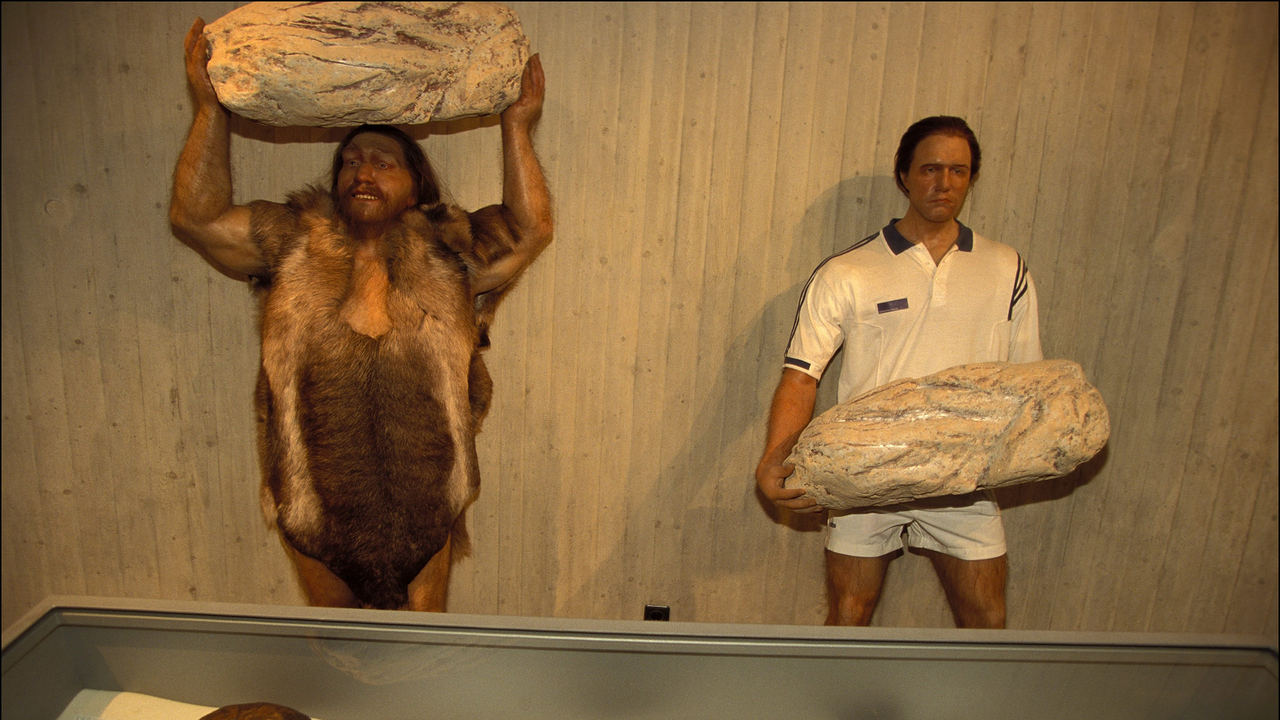
Tens of thousands of years ago, Neanderthals mated with modern humans and passed along a gene variant that enables us to pack on more muscle, a new study finds.
Researchers found that this specific Neanderthal gene, a variant of the growth hormone receptor gene, causes cells to respond strongly to growth hormone. The Neanderthal version of the gene creates a growth hormone receptor with two amino acid changes and one deletion, compared with the typical receptor in most modern humans. The researchers think it entered the modern human gene pool through interbreeding, probably about 47,000 years ago.
"The most noticeable characteristic would likely be greater muscle mass, around 270 grams [9.5 ounces] per copy of the variant," study co-author Hugo Zeberg, a geneticist at the Karolinska Institute in Sweden, told Live Science in an email. "A person who inherited two copies, one from each parent, could therefore have more than half a kilogram [1.2 pounds] of additional muscle mass."
The study, published Aug. 5 in the journal Cell, found that almost all Neanderthals had this gene variant, but only about 10% of modern humans do. Certain modern human groups were more likely to have it, with the variant showing up in about 1% of modern people with European ancestry, and up to 25% of those with Southern Asian or Southeast Asian ancestry. It does not seem to appear in people of African ancestry, possibly because the interbreeding happened in Eurasia.
Human growth hormone is produced naturally by most people in the brain's pituitary gland, and it stimulates growth in children and adolescents. Some people have too much or too little human growth hormone, but most of these cases can be medically treated for it. The pituitary gland is also essential in adults for producing hormones that have several roles, including regulating metabolism, stimulating ovulation in ovaries, and stimulating testosterone production in testicles.
In the study, the researchers studied 10 samples of Neanderthal DNA and two samples of Denisovan DNA from archaeological sites in Europe, the Balkans, Siberia and Asia. (The Denisovans were closely related to the Neanderthals.)
They compared their results to modern biobanks that store more than 1.1 million human genomes and related physical data, to understand the effects of the gene variant.
The researchers next tweaked cells in the laboratory to express the regular and Neanderthal variants of the gene, and found that the Neanderthal cells multiplied about 40% more often than regular cells when flushed with growth hormone. Despite this, the Neanderthal gene variant doesn't always make people look bulkier, the researchers found. Instead, the differences are more subtle: for example, people who have this gene variant would have higher levels of a key signaling protein in response to growth hormone, the researchers wrote.
The team also found that people with the gene variant might have slightly shorter tooth roots and small differences in their jaw shape — features that are seen in Neanderthals, who went extinct around 40,000 years ago.
Neanderthals went extinct around 40,000 years ago, but passed along key genetic features to modern humans. (Image credit: gorodenkoff via Getty Images)Growing Neanderthals
Neanderthals were, in general, stockier than modern humans. But Zeberg thinks their enhanced response to growth hormone does not fully explain why Neanderthals were generally more robust and "thick-set" than modern humans.
"It cannot explain the Neanderthal body type on its own," he said. "Neanderthal robustness was almost certainly shaped by many genes, as well as by development, lifestyle, and environmental factors. Our results provide one possible piece of a much larger puzzle."
The placenta produces a particular form of growth hormone for a fetus, which differs from the form of growth hormone produced by the pituitary gland. However, it seems the Neanderthal variant doesn't respond to growth hormone from the placenta. As a result, Neanderthal babies were the same size at birth as modern human babies but grew faster after that, Zeberg said.
In the study's sample of modern humans, the team noticed that children aged 11 or younger with the gene variant didn't show the effect; rather, only older individuals did. This suggests that the gene variant's differences might not emerge until puberty, strengthening the idea that it responds only to growth hormone produced by the pituitary gland and not by the placenta, the researchers said.
Related storiesNeanderthal genes may explain disorder where brain bulges out of the skullSome of the last surviving Neanderthals were remarkably diverse — suggesting inbreeding didn't doom themHumans and Neanderthals interbred — but it was mostly male Neanderthals and female humans who coupled up, study finds
"Growth hormone is also particularly important during puberty, when its levels rise substantially," Zeberg said. "The effect of the variant is therefore likely to be especially important during puberty and later development, rather than before birth."
Kornelius Kupczik, a paleoanthropologist at the University of Chile in Santiago who was not involved in the study, told Live Science that it was notable to see such a high prevalence of the Neanderthal gene variant in people of South Asian and Southeast Asian ancestry, when it was relatively rare among Europeans.
This suggests that early human migrations may have been more complicated than had been assumed — a "curious" challenge that required further investigation. "I guess that's something we still have to find out," he said.
How much do you know about our closest relatives? Find out with our Neanderthal quiz!
Hence then, the article about neanderthals passed on a gene that helps modern humans pack on more muscle but only a few people have it was published today ( ) and is available on Live Science ( Middle East ) The editorial team at PressBee has edited and verified it, and it may have been modified, fully republished, or quoted. You can read and follow the updates of this news or article from its original source.
Read More Details
Finally We wish PressBee provided you with enough information of ( Neanderthals passed on a gene that helps modern humans pack on more muscle — but only a few people have it )


Also on site :
- Box Office: ‘Verity’ Aims for $35 Million Debut and Anne Hathaway’s Third No. 1 Movie of the Year, ‘Digger’ Could Bomb With $12 Million
- Neon Counters A24’s SCP Foundation Movie With “Open-Source” Project To Release Under Creative Commons License
- In 1983, Congress set aside $42 million to move a Pennsylvania town off a burning coal seam; Centralia went from 1,017 residents to five by 2020