
Two days before my 39th birthday, I sat in a small boat making its way up a deep river lined with rooty mangrove trees. Though I had never been to this place, it felt hauntingly familiar, like an unlived memory. This was the River Gambia, and it was taking me to the village of Juffure.
It was February 2001. Three years earlier, President Bill Clinton had appointed my father, George W. Haley, U.S. ambassador to the Republic of Gambia. Like an act of poetic atonement, America sent the great-great-great-great-grandson of a slave back, as a diplomat, to the country whence his ancestor had been kidnapped. From my first breath of Gambian air, every step felt like an introduction to my whole self. But the most extraordinary moment was when I walked into Juffure, as my uncle, Alex Haley, had done 33 years earlier on his journey to writing Roots: The Saga of an American Family, and discovered our beginning.
As soon as the boat reached shore, I gazed into some three dozen eyes that looked like mine, many belonging to my cousins, unmet and however many times removed, and imagined how Uncle Alex felt when he first set foot there. I thanked him silently for his sacrifice and perseverance.
How does a single book at once condemn and captivate a nation? Fifty years ago this August, Roots did just that. In 1976, the bicentennial of the United States of America, Alexander Murray Palmer Haley saw the story he had carried since childhood, then researched and written over 12 years, sit atop the New York Times best-seller list for 46 weeks, spending 22 at No. 1. A U.S. Coast Guard veteran and freelance writer had dispelled any notion of it having been born the land of the free that its anthem professed, and the entire country, it seemed, was now on notice.
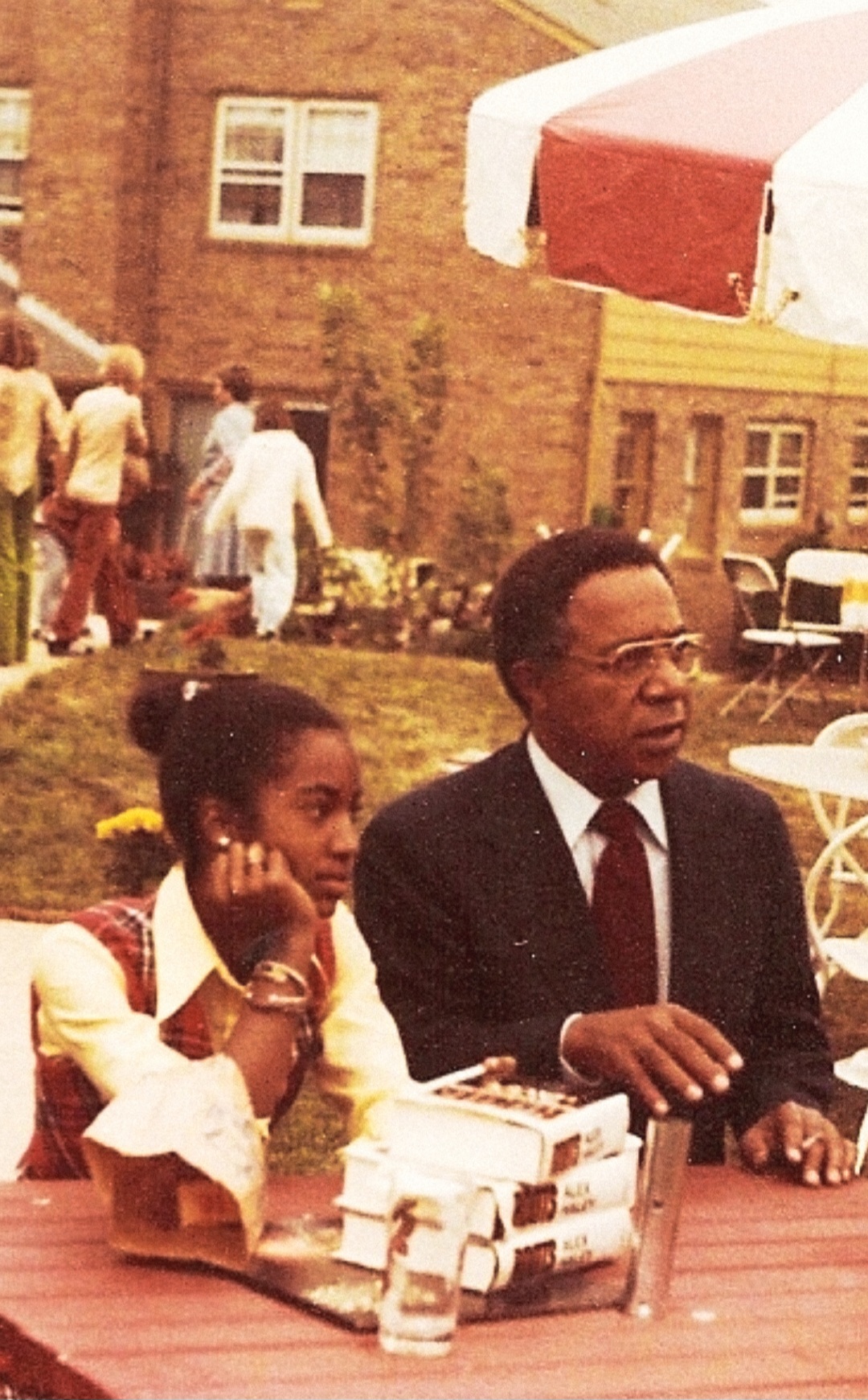
Alex Haley was my father’s older brother, and a significant presence in my life. He called me his “beloved niece” and “Little Bertha,” the second a loving attribution to his mother. He flew in for ballet performances and piano recitals, sent flowers for a good report card, and bought me my first car. He delivered the commencement speech at my high school graduation, and sat front and center at my college and law-school graduations. I adored him.
And now, all of those conversations around the Thanksgiving table had finally come to fruition. At 14, I innocently felt that his accomplishment was mine too. I had been raised on this story that was now the world’s to know. This was my family. And this is my love letter to him.
The author, center, on a trip to Juffure in the GambiaRoots sold 1.5 million copies in its first seven months and eventually 8 million, collecting a National Book Award, a special Pulitzer Prize, and an NAACP Spingarn Medal. It was translated into more than 35 languages and adapted into a ratings-smashing TV miniseries. You would be hard-pressed to find anyone born in America before 1980 who does not remember a copy of Roots on the bookshelf or the miniseries playing on the TV. In his Feb. 2, 1977, monologue for the Tonight Show episode on which Uncle Alex appeared, Johnny Carson remarked, “If there’s anyone watching who does not know about Roots, you must have either been out of the country or on Mars someplace.”
But none of this had been Uncle Alex’s wildest dream. All he had set out to do was to find out for himself who the African was. Uncle Alex and his brothers spent most summers on their maternal grandparents’ front porch. There, they would sit rapt, listening to the stories their grandmother Cynthia and her sister friends told late into the night. One such story told of a man brought to America on a boat from Africa that had landed in “’Naplis.” The African’s name was “Kinte.”
The African had been sold to a plantation in Spotsylvania County, Virginia, where he married Bell, the plantation cook. The two had a daughter named Kizzy, which in his native tongue meant “stay put.” So much more the devastating irony when she was sold to a plantation in North Carolina at 16. There, her enslaver fathered her child, George, who became known as Chicken George because of his skills working gamecock fights.
The stories became livelier at this point, and more rich with detail, as these were characters the women had known personally—Chicken George was Cynthia’s grandfather—and they stayed with Uncle Alex. Haunted him, really. Who was this Kinte? Where had he come from? There was no 23andMe then, but there were reams of microfiche at the Library of Congress and ample records in basements of the Churches of Latter-day Saints. There was also, and first, Cousin Georgia.
When my uncle would land in Kansas City, Kans., where my family lived, it was like a rock star on a sold-out tour. We knew he had come to sit at the knee of his grandmother’s cousin, Georgia Anderson, decades after he’d watched her rocking chair keep time on a porch. Now in her 80s, she was the last living repository of the stories of the African, including some of the words of his native tongue: she knew that kamby bolongo meant river, and kora was a stringed instrument like a banjo.
Her recounting, alongside his research, enabled Uncle Alex to learn that these cherished words were of the Mandinka language, spoken primarily in the Republic of Gambia. He made multiple trips on his meager budget, traipsing around a country the size of Connecticut. Had he too much audacity in believing he could reverse the Middle Passage?
Perhaps he was feeling that way when he stepped into Juffure in April 1967, and the griot recited a history that included a 17-year-old Kunta Kinte, who had left the village almost exactly 200 years earlier to gather wood to make a drum for his younger brother and never returned. Uncle Alex carried the other end of that story: where that firstborn son of Binta and Omoro Kinte had ended up on a British slave ship named the Lord Ligonier that set sail from the Gambia River on July 5, 1767, and arrived in Annapolis, Md., on Sept. 29, 1767. One hundred and forty Africans had been smuggled onto that ship. Ninety-eight survived the journey.
Uncle Alex’s arrival in Juffure was a feat of ancestral home revealed and personal mystery solved. James Earl Jones made that moment his own in the Roots miniseries. In his portrayal of Alex Haley there in Juffure, Jones exclaims with bass-toned exuberance: “You old African! I found you, Kunta Kinte!” I always smile at this scene. Knowing Uncle Alex, I imagine that his reaction would have been no less dramatically felt, but more understated. I see him sitting there, knee to knee with the griot. Upon hearing the name Kinte and then calculating the data, I envision him folding in on himself, a gut punch quietly and gratefully received; a recognition of origin, a recompense for every African American back home, a proof of life: before.
The cover of TIME, Feb. 14, 1977This flood of emotions must have ranged from relief to euphoria to mind-splitting fury. Perhaps it inspired the title Uncle Alex originally had in mind Before This Anger. The story we heard was that the publishers were likely apprehensive about putting off a white audience with this title. But its layers of meaning demand excavation. If there was an anger before this one, the inference is that there was a present anger. And was there not, for Black folks in America’s mid–20th century? (And every century before, and today?)
But there is another way to read it. One that reveals that before this anger—before this truncated knowledge that people of African ancestry had been enslaved for 400 years, stripped of their culture, their liberty, and their personhood, then denied civil rights—there was another place across the waters where their forebears were not property but kings and queens. Before this anger was a place where the culture of these people was wholly intact, centuries old, with a foundation so deep that when stripped from its shores, a man had carried it with him and remembered it to those in the place where he landed.
Not long after Roots’ publication, Uncle Alex was challenged by critics who questioned the accuracy of his timeline and suggested the griot told him what he wanted to hear. But as many historians pointed out, to focus on specific dates or dialogue is to miss the larger truth. The “before,” the lineage Uncle Alex uncovered, came to him by way of oral history. This tradition is, almost by definition, imperfect in its translation, especially across centuries. The very nature of the oral tradition, which is decidedly African and characteristically unburdened by the rules of Western record-keeping, is the spirit of its truth, even more than its detail. One’s trust in a griot’s accounting derives from centuries-old reliability. To counter the critics, Uncle Alex himself said while his work was informed by extensive research, the book was not without errors, and certain details were his own literary creation. Today, we call this historical fiction. But for my family, and all those who see their lineage in Roots, this genre designation changes its meaning not one bit. As my uncle told one journalist, “Neither you nor I know exactly what happened. But I stand by Roots as a symbol of the fate of my people.”
Anne and Alex HaleyBefore Roots, most every depiction of our origin had begun with enslavement, as if we had sprung up spontaneously on this soil with sun-kissed skin and woolen hair. Both captor and captive knew that all had not begun here. But the captor would not have been inclined to tell that story, and the captive was not allowed, being not permitted to learn to read or write.
All the more prescient, then, that Kunta would be inclined to tell his daughter his origin story, and teach her words in his native tongue. He likely would not have imagined that those words would lead his descendants back to his beloved homeland. Or perhaps that was his very design. Alex Haley: his ancestors’ wildest dream.
It was a game of generational telephone that allowed the world to know the history of the African American before slavery. Uncle Alex always said Roots was not just the story of the Haley family, but of every African American: “In all of us there is a hunger, marrow-deep, to know our heritage—to know who we are and where we have come from. Without this enriching knowledge, there is a hollow yearning.” Roots gave Americans of African descent an origin that began not in servitude but in freedom.
White America’s fascination is less legible. Maybe it was a need to not be called out, as by Carson. Or maybe people were more open to national truths following the Vietnam War and civil rights movement. The most common memory Black people around my age have shared with me is how, on the days after watching a Roots episode, they would go to school angry. Mean-mugging white classmates who, in turn, were sheepish and chastened. Roots was not intended as a condemnation, but for some, it played like one.
That the TV deal was struck almost before the ink on the manuscript was dry speaks to the inevitability that Roots would be an economic powerhouse, though the book’s immediate popularity surprised even the publishers, selling out an initial print run of 200,000 copies, with Doubleday forced to push out 14 more printings.
ABC must have been surprised too. The network decided to run the miniseries, originally slated to run weekly, on consecutive nights, to avoid a falloff in viewership, but also to get it all in before the ratings period. Some say it was the inclement weather that had people fixed to their TV sets. But maybe America was actually interested in learning about this 11.5% of its population whose culture it had long appreciated. And so, more than half the U.S. population and 85% of all U.S. homes with televisions watched Roots, most every night, for eight sequential nights.
The author speaking about the legacy of RootsSince Roots was published our country has seen vast increases in Black businesses and Black academia, a Black superhero and a Black President, even as we continue to fight the battles of institutional racism. A 2022 Pew study reported that of the Black Americans who have delved into genealogical research, 77% did so by speaking to their families. I like to think of that as a nod to Kunta, Kizzy, and the art of oral history.
I have a slightly tattered, no matter how lovingly preserved, copy of the Reader’s Digest excerpt of Roots. On its title page is a message from my uncle that reads: “To the next writer in the family. Love, Uncle Alex.” As we mark the nation’s sesquicentennial, I carry that booklet with me like a talisman, a call to arms: Keep telling our story, he tells me. Keep our ancestors alive.
History may depend on it. Earlier this spring, Knox County, Tennessee—the county where Uncle Alex spent his final years, the home of the university where he would donate the majority of his papers and where a public park holds a 13-ft., 4,200-lb. bronze statue of him, in the state that cradles the porch that birthed the book—banned Roots, requiring that copies be removed from school libraries. Ten days later, following swift backlash, the county reversed its decision. The work of the ancestors, or just better minds prevailing? Either way, the lesson is clear. The surest way to preserve one’s story is to keep telling it.
Hence then, the article about the meaning of roots at 50 was published today ( ) and is available on Time ( Middle East ) The editorial team at PressBee has edited and verified it, and it may have been modified, fully republished, or quoted. You can read and follow the updates of this news or article from its original source.
Read More Details
Finally We wish PressBee provided you with enough information of ( The Meaning of Roots at 50 )


Also on site :
- Anton Studios Joins The Creatives as Partner and Investor as Producer-Led European Company Enters Jointly Owned Holding Structure (EXCLUSIVE)
- Jimmy Fallon Just Dropped a Brutal Title for Karoline Leavitt’s Hypothetical Memoir, and the Internet Is Having a Field Day
- Six Flags Magic Mountain Permanently Closes World-Famous X2 Roller Coaster Following Mounting Safety Concerns