
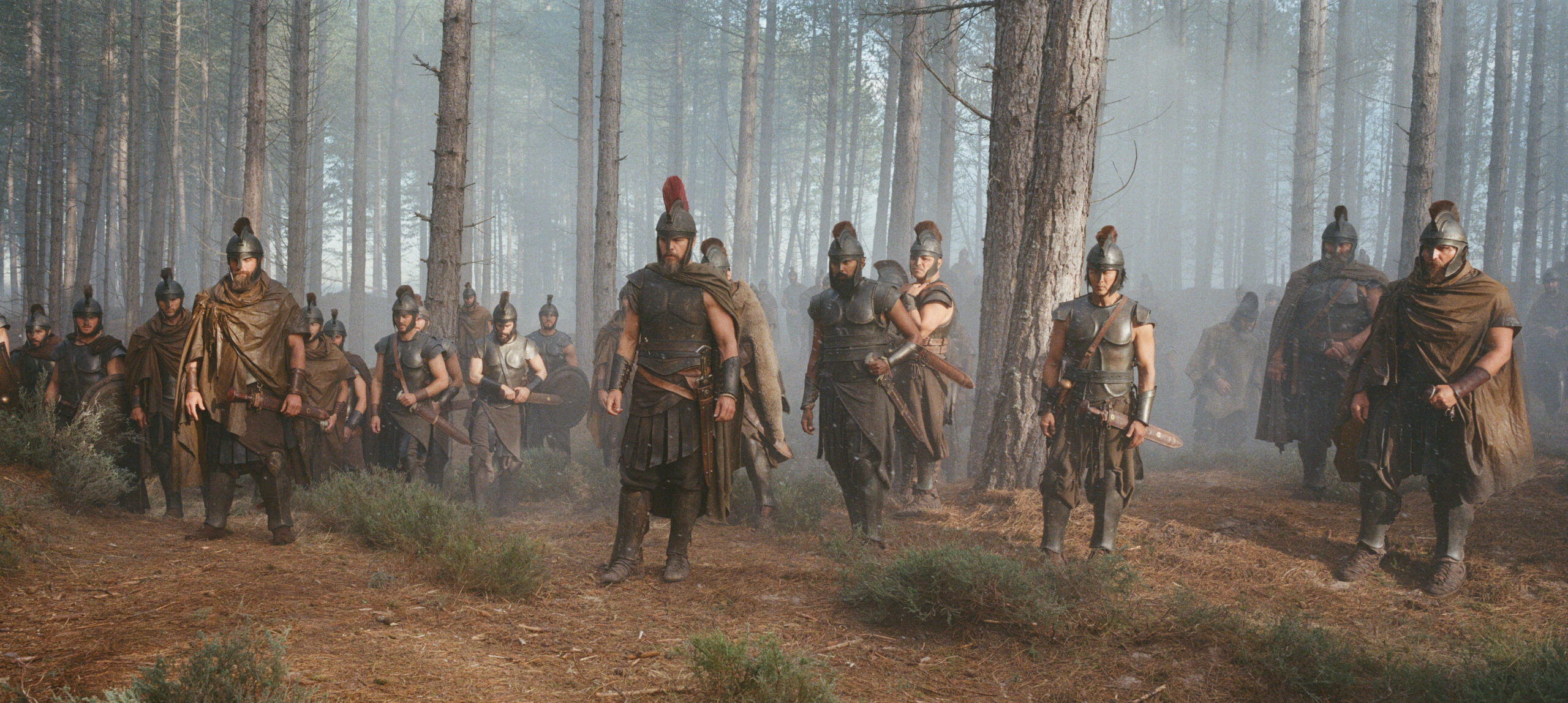
There’s no easier way to get people angry these days than to make a movie out of a story they already love in some other medium: A comic book. A fantasy saga. Or, as we’re seeing with Christopher Nolan’s latest cinematic tour de force, an ancient Greek epic poem. Long before the movie hit theaters, online commenters (and a few notable academics) were already calling Nolan’s take on “The Odyssey” a travesty, venting on social and conventional media about the “historical inaccuracies” and compromises to “wokeist” demands they detected in its teaser trailers, production photos and casting announcements.
It’s never smart to leap to conclusions based on stray glimpses of a three-plus hour film as seen in scattershot leaks and early promo pieces, but especially so when the filmmaker in question is a director who makes choices, not mistakes. You may disagree with his choices. But they’re painstakingly planned, not frivolous or erratic, and certainly not the result of knee-jerk reactions to outside pressures.
And even if his choices step on people’s expectations of classic literature, part of what makes the classics so durable is exactly because they’re universal enough to be endlessly reinterpretable. Shakespeare’s plays have been turned into teen rom-coms (“10 Things I Hate About You”), gonzo horror flicks (“Tromeo and Juliet”), queer road dramas (“My Own Private Idaho”), space opera (“Forbidden Planet”) and samurai movies (Kurosawa’s “Throne of Blood” and “Ran”)—dramatically different, sometimes bizarrely altered versions.
Which is … totally fine.
Matt Damon (center) is Odysseus in THE ODYSSEY, written, produced, and directed by Christopher Nolan.Because, like “The Odyssey,” Shakespeare’s plays are fiction. Great fiction—timeless fiction—but nevertheless entirely made up, and in their original context enjoyed more as mass entertainment than as revered, sacred texts. Shakespeare’s plays were performed in front of hooting audiences eating oranges and loudly commenting on the action. Homer’s poems were originally delivered by lyre-strumming singers at weddings and rowdy banquets, who often riffed satirical asides to needle their hosts and other notables, and casually inserted improvised references to current events into their renditions.
All of which is why it doesn’t make sense to talk about the “historical accuracy” of Nolan’s “Odyssey”: The original poem wasn’t based on factual events in the first place and was regularly used as a vehicle for the opinions and inventions of its performers.
So why shouldn’t Nolan have license to do the same?
“The Odyssey” was ultimately not a surprising choice for a Nolan project: It’s a war chronicle, a superhero story, a revenge movie, a tale centering on an unreliable narrator (an amnesiac who’s unsure if he’s awake, dreaming, deluded or unhooked from the flow of time). It’s like it contains the seeds of every Nolan movie, everywhere, all at once. And as with his prior works, he’s created a film that’s both a crowd-pleasing entertainment and a complex commentary on a deeper theme.
He’s used the conventions of film noir to explore the power of weaponized ignorance (“Memento”); unpacked the nature of grief and survivor guilt through a sci-fi heist caper (“Inception”); and highlighted the moral and personal compromises that the forces of order must make to restrain chaos via superhero stories (The Dark Knight Trilogy).
Director Christopher Nolan on the set of his film THE ODYSSEY, written, produced, and directed by Christopher Nolan.The underlying message of “The Odyssey” is obvious, and it has been pointed out by others. It’s an allegorical musing on America, a nation whose leaders have shattered cherished norms and precedents and turned its back on the principles of its own framing—leaving chaos, mayhem and destruction in their wake. “Oppenheimer” asked whether men should play at being gods. “The Odyssey” explores what happens to an empire when its leaders forsake them—out of greed, selfishness, spite and vanity.
In service of King Agamemnon, shown as a dark figurehead in gold-accented armor, Odysseus (Matt Damon) defeats the Trojans with his genocide-packed wooden horse, an act that’s celebrated as a stroke of cunning to the Greeks, and reviled as an astonishing war crime by the gods. For this act of treachery on foreign soil, Odysseus is cursed to wander lost for decades, in a journey that we see could have been cut short any number of times, if it weren’t for the protagonist’s own narcissism, bloody-mindedness and incompetence.
It’s not an accident that Nolan cast the extremely white Matt Damon (an iconic native son of Boston, the cradle of American democracy) as his protagonist, or that he chose to have his actors, even his British performers, speak in a quintessentially middle-American accent and idiom. An aging white leader at the center, surrounded and enabled by an array of people of color, women and other marginalized people, is what the United States has been for almost all of its history, and naturally, it’s these vulnerable subordinates who pay the price for the protagonist’s hubris, time and time again—abandoned, consumed, cast away, used as disposable pawns. A score of crewmen in the gullet of a cyclops, a half-dozen more yanked away screaming by a multi-headed snake monster, whole boats full of sailors plunged into the murky depths by angry Poseidon’s raging storms? Who’s even counting?
The inclusion of trans actor Eliot Page in the film, a centerpoint of outrage from right-wing politicians, seems particularly notable given his casting as Sinon, who becomes an unwitting human sacrifice to enable Odysseus’s glory; out of all of America’s groups, none has been more overtly used as a decoy target than trans persons, who have been banned from military service (no Sinons in America!) and many organized sports, had their healthcare access and legal I.D. stripped away, and been accused of everything from pedophilia to terrorism.
Lupita N’yongo as Helen of Troy and her regicidal twin sister Clytemnestra seems like equally pointed casting: We see her as both ultimate object of male desire and as enraged madwoman, two caricatures regularly painted on Black women—but also, it’s not that long ago that a Black woman, Kamala of Frisco, was simultaneously portrayed as the most aspirational person on Earth and as the ruthless destroyer of her white male patron, and, like Helen, left humbled and scarred.
L to R: Anne Hathaway is Penelope and Tom Holland is Telemachus in THE ODYSSEY, written, produced, and directed by Christopher Nolan.Helen and Clytemnestra aren’t the only ill-treated women in “The Odyssey”. Odysseus’s patient and long-suffering wife Penelope (Anne Hathaway) is left cloistered in his palace, fending off the predatory paws of loutish suitors and forced to take on the hard work of administering Ithaka in her husband’s absence, sans credit and without power of her own. When she finally unleashes a rant at her callow son Telemachus (Tom Holland) that rather than him, another mediocre white male, she should be the one on the throne, since it’s her competence that has kept the kingdom from collapsing, that could be Hillary Clinton, Liz Warren and dozens of other female would-be chief executives shouting from the archives: “Empty throne? I’ve been sitting on an empty throne for 20 years! My knowledge, my years of experience, that’s all nothing compared to the bristles on your chin!”
And when Odysseus finally arrives back home, after his self-caused misadventures and years spent self-medicating his PTSD and engaging in cuddle therapy on Calypso’s beach, his first act is to savagely and methodically murder and drive out the suitors who have gathered in his absence, once again breaching Zeus’s mandate that guests should be welcomed and treated like representatives of the gods themselves, a bloody mass deportation that Odysseus laments as a necessity (much as his war crime was a necessity), even if it ends the age of Ithaka’s ascendance and makes him outcast among men and subject to divine judgment. It doesn’t matter, he says; the future will forget the crimes of the “great” and remember only the epic sweep of their deeds.
“The Odyssey” is big and noisy and full of fury, because that’s how America represents itself to the world. Odysseus is neither as smart nor as complex nor as resourceful as he thinks, or as the rest of humanity believes. That’s not an error of characterization on Nolan’s part. It’s just an expression of our American reality as an aging, fraying empire hurtling from crisis to crisis, whose leaders who are too busy putting their hands in others’ pockets to keep a firm one on the rudder.
And Nolan’s film is not a misbegotten attempt to modernize a classic—it is a deft and purposeful reflection of America in this moment, seen through the glass of mythological metaphor. We are the lost warrior-navigator trying to find our way back, only to have our own recklessness, stubbornness and lack of concern for our allies send us adrift. We, America, are the people from the sea.
Hence then, the article about the people from the sea how the odyssey is about america was published today ( ) and is available on Roger Ebert ( Middle East ) The editorial team at PressBee has edited and verified it, and it may have been modified, fully republished, or quoted. You can read and follow the updates of this news or article from its original source.
Read More Details
Finally We wish PressBee provided you with enough information of ( The People from the Sea: How “The Odyssey” is About America )


Also on site :
- Stockton high school teacher arrested in child sexual abuse material case, CHP says
- Famous Beer Secures Top Ranking in YouGov’s 2026 Alcohol Survey; The 153-Year-Old Dutch Lager Edged Baileys to Lead America’s ‘Most Considered’ Brands
- Wired for War: The empire’s propaganda wing honors Palantir