
“Power comes not from knowledge kept but from knowledge shared,” Bill Gates said in 1999, the year OpenAI CEO Sam Altman turned 14. “A company’s values and reward system should reflect that idea.” Proud MBA holders the world over are well aware of the predilection for the opposite—what the academics Catherine Connelly and David Zweig christened “knowledge hiding”. In a business, what you know that others don’t can still confer advantages and hoarding information can be seen as a skill. Will such behaviors survive contact with the AI era?
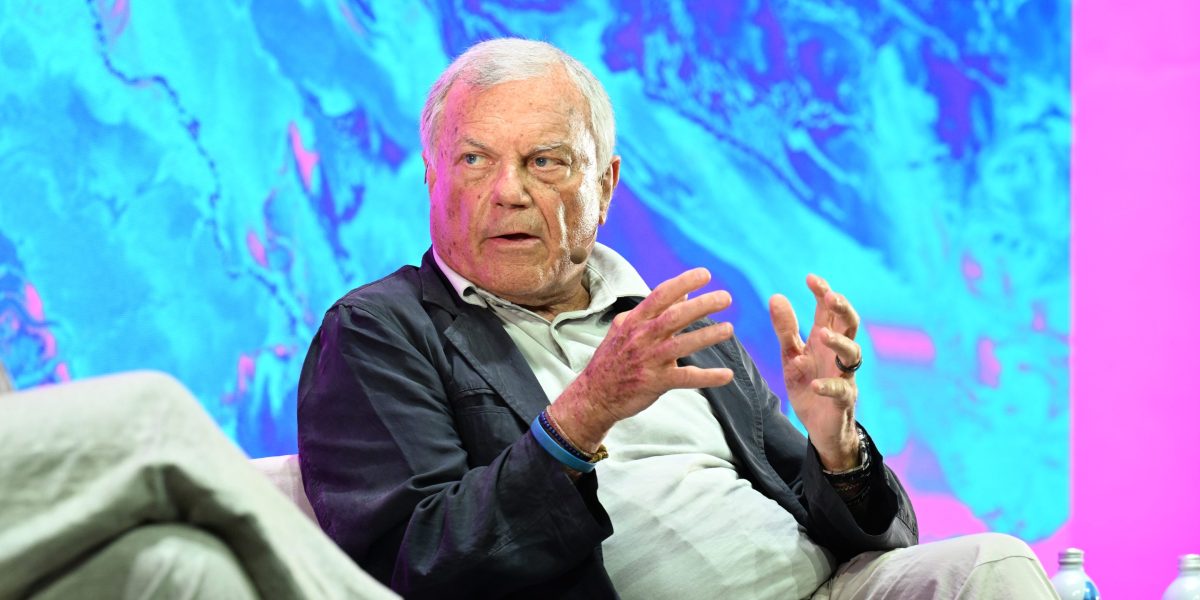
Not according to Sir Martin Sorrell, the founder of the digital media agency, S4 Capital. Before that, as founder of the media giant, WPP, he became the longest serving CEO of a FTSE100 company, clocking in at a total of 33 years. Being in the ninth decade of life, Sorrell (81) confers a certain calmness and long-term view when it comes to technological change and its effects on business. Sorrell remembers a time when faxes seemed pretty neat.
“I think the most fascinating area [in the development of AI] is what I call democratization of knowledge,” Sorrell tells me. “AI flattens the organization. In a multi-branded, multi-vertical, multi-siloed company, people develop power bases by controlling information. If information is available to everybody, if you give them access, it changes the dynamics. Good people who share will be the real kings and queens.”
Even kings and queens need jobs. In 2024, Altman suggested that 95% of roles in marketing, including content and campaign creation, could be replaced by AI. The revolution will not be that destructive, Sorrell says, but huge efficiency gains are coming.
“I don’t think 95% will go, but some will go,” he says of an industry that is still surprisingly manual in execution. “That’s pretty tough, because your interest as an agency was to prolong [projects] for as long as possible, and to make the campaign in the most expensive location possible. You don’t have to do that anymore. Essentially making ads is cheaper, and we have to change the model to be cheaper and more efficient.”
“If information is available to everybody, if you give them access, it changes the dynamics. Good people who share will be the real kings and queens”
Sir Martin Sorrell, founder of the digital media agency, S4 CapitalSorrell compares the advertising industry with the world of asset management, where computerized workflows are the norm, not the exception.
“Do you think that Larry Fink does, or his people do, manual spreadsheets, or semi-manual or semi-automatic?,” Sorrell says. “No, it’s all automated. If you think about machine trading on Wall Street, it’s a very high proportion. In our business we have 250,000 people, mainly 25-year-old media planners and buyers, and they’re doing their work semi-manually, often wholly manually. That can’t work—in a hyperscaler-driven world it is going to be done algorithmically.”
Sorrell says that in the car industry, for example, AI-generated content is now widely accepted, and that is in a sector that is “as picky as it gets.” “You can now do extraordinary things with technology,” he says. “And we’ve got to get used to doing it.”
I ask Sorrell about the increasing evidence that public sentiment is turning against AI over global security, personal data security and job security. In June, a Reuters/Ipsos poll found that half of American adults fear that the rise of AI could put them or someone in their household out of work. College graduates were more concerned than other groups.
“I think we have to look at what’s happening in a positive way,” Sorrell said, remembering back in the early 2000s when he spoke to the principal of one of Mexico’s leading technology universities. Concern is a reasonable response to technological change.
“It was a university of about 30,000 kids and the principal said to me: ‘It’s amazing what the internet has done to Mexican villages.’ They didn’t have libraries, but today they have access to the internet, and the marginal cost of information is zero. And those kids now have access to information sources.
Read more: Should AI be formally recognized as a national and global security threat? In London, politicians increasingly think so
“If you think about AI, which is like the internet on steroids, the marginal cost of information—not just in a company, but inside government, inside universities, to kids—is zero and we can do things with these tools that we never could do before.”
The way we work will have to change. Sorrell argues that the Covid pandemic brought forth the era of “distributed working”, a world in which, if you have a laptop, you can be at work, whether you’re at home or on a beach. The youngest generations have entered the workforce at a time when working from anywhere is possible.
“A reporter interviewed somebody who was running a firm with a lot of Gen Z employees, and she said: ‘It’s effing difficult,’” Sorrell says. “And I think she was very brave to say it, because it’s quite a difficult thing to say, particularly in this environment, but I think it’s dead true.
“I think it’s to do with a different attitude developed through Covid, developed through distributed working. It is much more difficult to manage that, than it is a workforce of 200,000 who come into offices on a regular basis. And part of the reason for the reaction that we’ve seen from JPMorgan Chase, WPP—‘You have to come back’—is because the people that run the business are uncomfortable.
“In a business like ours, it does depend to a large degree on interface and interaction. The point about the young people you recruit is how can they understand the culture if they’re 55 miles away?”
In his 1930s essay, Economic Possibilities for our Grandchildren, the economist John Maynard Keynes said the challenge for the future would be “how to occupy our leisure.” Elon Musk makes similar predictions today – that we will soon be in an “age of abundance” as super-productive AI replaces the need to work.
Sorrell, who studied economics at Cambridge, says that Keynes’ essay is worth revisiting. “My basic thesis now is that Keynes was right, but he was 100 years too early.” The AI revolution could finally bring us all the 15-hour working week.
This story was originally featured on Fortune.com
Hence then, the article about sir martin sorrell has identified the key ai skill for the future people who share will be the new kings and queens was published today ( ) and is available on Fortune ( Middle East ) The editorial team at PressBee has edited and verified it, and it may have been modified, fully republished, or quoted. You can read and follow the updates of this news or article from its original source.
Read More Details
Finally We wish PressBee provided you with enough information of ( Sir Martin Sorrell has identified the key AI skill for the future: ‘People who share will be the new kings and queens’ )


Also on site :
- Famous Beer Secures Top Ranking in YouGov’s 2026 Alcohol Survey; The 153-Year-Old Dutch Lager Edged Baileys to Lead America’s ‘Most Considered’ Brands
- Stockton high school teacher arrested in child sexual abuse material case, CHP says
- Slate Commenters Have Been Trolling Me for Years. I Decided to Confront Them—and Was Startled by What I Found.