
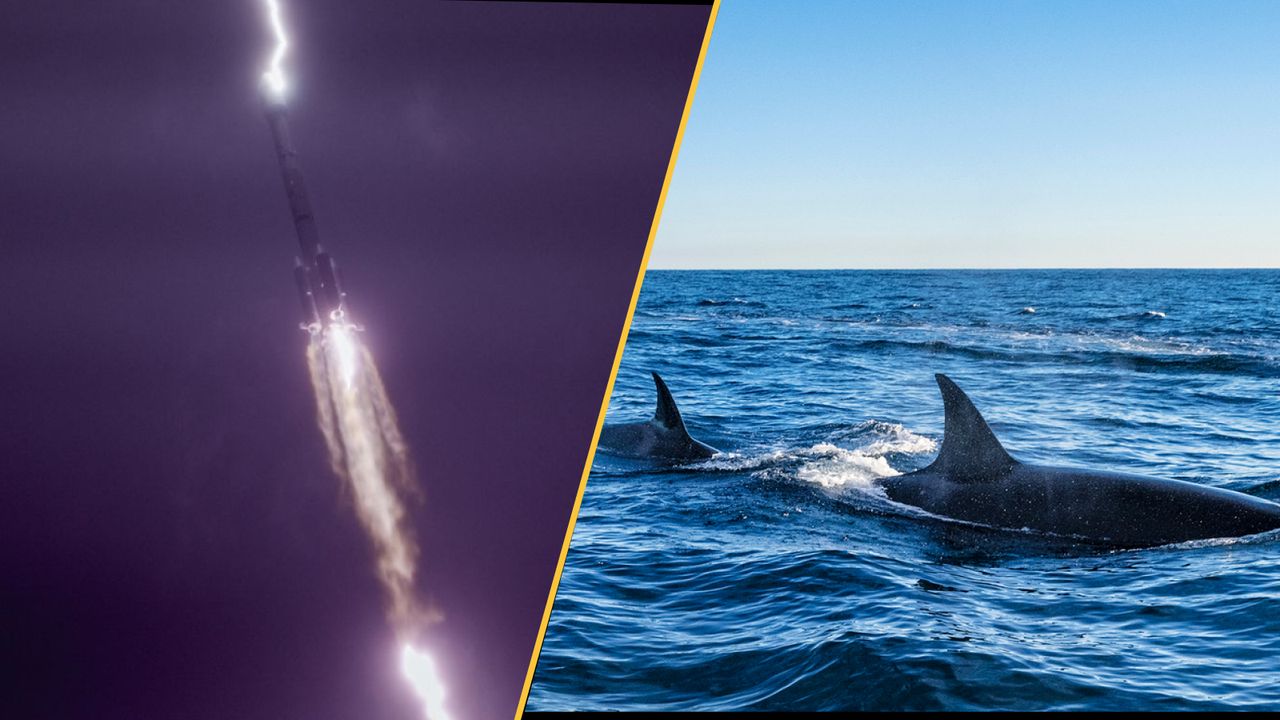
Happy Shark Week, science fans! To mark the occasion, we had a flurry of fishy features this week, including a first look at the secret lives of whale sharks, as seen from cameras on the animals' fins, and the discovery of a "demon cavefish" beneath a World War II chemical weapons facility in Alabama.
This week, we also saw the first drone footage of the birth of a humpback whale.
Meanwhile, off the coast of Spain, the orcas are at it again, sinking yet another ship along the Iberian coast. And speaking of boats, as cargo ships continue to stall near the Strait of Hormuz, scientists have warned of an imminent biological "superspreader" event once the key shipping route reopens.
We also have an update of our own: Live Science has launched Live Science Pro, a paid membership that gives you access to our exclusive features, analyses, interviews, book excerpts and opinion pieces, all without ads And to celebrate, we're offering an introductory price of only $3 for the first three months! You can subscribe here.
Concordia is considered the most isolated field station in the world. (Image credit: GUY CLAVEL/AFP via Getty Images)
While the Northern Hemisphere battled heat waves and wildfires, Antarctica just experienced the lowest temperature recorded on Earth in over a decade. High-altitude research station Concordia, located in the icy continent's interior, logged a low of minus 119.4 degrees Fahrenheit (minus 84.1 degrees Celsius) on July 18, just shy of the coldest temperature ever recorded at the station.
"Even here, where extreme cold is expected, temperatures below minus 84 C are remarkable and highlight how variable Antarctic weather can still be," Gabriele Carugati, the station leader at Concordia for Italy's National Antarctic Research Program, told Live Science from the station.
Discover more planet Earth news
—Magnitude 6.8 earthquake traps shoppers as mall collapses in Japan — here's why the seismic event was unusual
—Colossal scars of 60 million-year-long continental collision streak across warped mountains in Pakistan — Earth from space
—Mice on 'godforsaken' frozen volcanoes eat toxic plants to survive conditions 'not remotely compatible with long-term human survival'
Life's Little Mysteries
Why do cats have 'leg whiskers'?
Cats have a tuft of four to six whiskers on the back of each front leg, each about 0.8 to 1.2 inches (2 to 3 centimeters) long. (Image credit: sellyhutapea Getty Images)Cats are known for having whiskers on their faces. But if you look closely, you'll see they also have them on their legs. So what are these leg whiskers for? And how do they differ from the ones on their face?
—If you enjoyed this, sign up for our Life's Little Mysteries newsletter
Archaeologists discovered ancient geoglyphs like this square-shaped one in Acre, Brazil. (Image credit: Martti Pärssinen)
A significant portion of the Amazon rainforest remains unexplored, and even from above, it's almost impossible to see through the trees' thick canopies to find out what lies beneath. However, thanks to modern laser scanning technology, scientists have peered through this wall of leaves — and what they've found may offer new insight into lost human civilizations.
A new lidar survey has revealed hundreds of earthworks made by the Aquiry people, who arose 2,500 years ago in Brazil. So what can these structures teach us about this mysterious lost civilization?
Discover more archaeology news
—Relief fragment with vanquished enemies: A 3,400-year-old depiction of an Egyptian pharaoh crushing western Asian soldiers under his royal chariot
—Ancient human relative cannibalized both adults and children in a cave in Spain 850,000 years ago, fossils reveal
—Archaeologists find 2,800-year-old burial of person clutching sea turtle vessel in El Salvador
Also in science news this week
—A unique antibody system may help explain bats' unusual tolerance of viruses
—Scientists may have found a clue to prevent muscles from aging, study hints
—'Feynman and followers, you guys are off': Physicists disprove decades-old Richard Feynman theory on 'silly' sprinklers
—A strange string of a dozen galaxies keeps surprising astronomers with its missing dark matter
—Scientists discover 2 new 'ghost' lineages that contributed DNA to modern humans
Inflammation may trigger persistent 'out-of-body' experiences, emerging research hints
Inflammation may fuel out-of-body experiences, early research hints. (Image credit: Kate Hazell/Future)
We're increasingly learning about the role of chronic inflammation in a range of diseases, from autoimmune conditions like rheumatoid arthritis to neurodegenerative diseases like Alzheimer's. However, scientists may have now added a new surprising side effect to this immune response: "out-of-body" experiences.
It's been known for a while that trauma can trigger altered states of consciousness, but exactly what was causing this psychiatric response was unclear. Now, scientists have found that stress triggered by trauma may dial up chronic inflammation, which could, in turn, trigger these dissociative disorders.
Something for the weekend
If you're looking for things to keep you busy over the weekend, here's a selection from our best interviews, explainers, skywatching guides and crosswords that we published this week.
—America's gun violence epidemic, through the eyes of a Chicago trauma surgeon [Interview]
—'World models' are the future of AI, but how do they work? [Explainer]
—Which solar eclipse viewing method is right for you? [Skywatching]
—Live Science crossword puzzle #54: Egyptian pharaoh who died at 18 — 6 down [Crossword]
Chinese rocket hit by rare midair lightning strike moments after launch as onlookers gasp in horror
China's Long March 3B rocket was struck by a powerful lightning bolt around 30 seconds after launching on July 23. Despite this, it made it to space and successfully deployed its payload. (Image credit: Zhou Quan/VCG via Getty Images)
It's like something from a movie: Seconds after China's Long March 3B rocket launched on July 23, the spacecraft was struck by lightning. Hundreds of spectators watched in shock as at least 100 million volts of electricity hit the craft and surged around its fuselage and through its exhaust plume, before shooting down to Earth.
Despite the strike, the uncrewed rocket safely reached space and successfully deployed its payload into orbit.
Follow Live Science on social media
Want more science news? Follow our Live Science WhatsApp Channel for the latest discoveries as they happen. It's the best way to get our expert reporting on the go, but if you don't use WhatsApp we're also on Facebook, X (formerly Twitter), Flipboard, Instagram, TikTok, Bluesky and LinkedIn.
Hence then, the article about science news this week secret lives of whale sharks revealed earth s coldest temperature registered and amazonian geoglyphs show clues to lost civilization was published today ( ) and is available on Live Science ( Middle East ) The editorial team at PressBee has edited and verified it, and it may have been modified, fully republished, or quoted. You can read and follow the updates of this news or article from its original source.
Read More Details
Finally We wish PressBee provided you with enough information of ( Science news this week: Secret lives of whale sharks revealed, Earth's coldest temperature registered, and Amazonian geoglyphs show clues to lost civilization )


Also on site :
- Meta May Try to Repair Its Poor Privacy Reputation at 'Connect 2026'
- ‘Forgotten Island’ Review: H.E.R. And Dave Franco Give Life To Gorgeously Animated And Frenetic ‘Toon
- Princess Diana’s Brother Reveals What Bombshell Claims About King Charles Won’t ‘Be a Surprise’ to William & Harry