
From the moment of its announcement, the so-called settlement agreement between the Justice Department and Donald Trump has provoked fierce opposition. Little wonder: The deal purports to be an arms-length exchange in which Trump gets a $1.776 billion fund to shower on January 6 offenders and other friends, plus a release from tax audits worth $100 million or more — while all the public gets is a release from a worthless, unconstitutional lawsuit. That is $2 billion or so in return for jack, with the added insult of funding insurrectionists who assaulted police officers and letting Trump walk away from who knows what tax schemes.
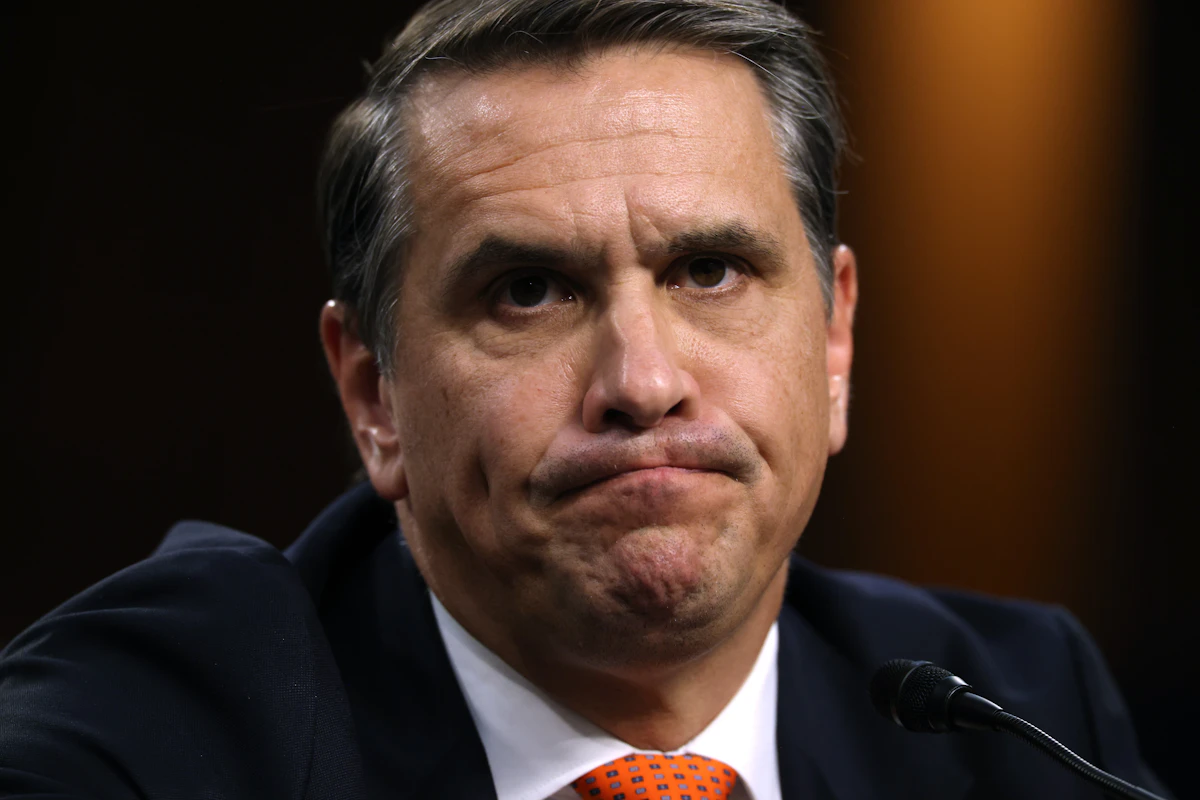
Defending the deal to an angry Congress during his confirmation hearings last week, acting Attorney General Todd Blanche adopted a two-part mantra. The slush fund would not go forward, though he has perversely refused to formalize that, and has been prickly toward anyone who insists he should. The tax amnesty, meanwhile, remains, legitimized as consideration for Trump’s dismissal of his suit against the IRS.
Unfortunately for Blanche, both legs of his defense were sawed out from under him last Wednesday at his hearing. The unraveling of Blanche’s position on the fund came under questioning from Texas GOP Senator John Cornyn. Cornyn stood at the witness table with an enlarged copy of the settlement and walked Blanche through its own language: The terms “may be modified only upon the written agreement of the parties.” Had there been any such written agreement? No, Blanche conceded. Then Cornyn asked the pivotal question: is the settlement an enforceable contract? Blanche’s answer: “Yes, it’s an enforceable document.” Trump’s side, he allowed, “could try to enforce the contract” and “could potentially say that we breached by not moving forward.”
That is the whole ballgame. If the agreement is enforceable, it is enforceable by its beneficiary: Donald Trump. He and his companies have already done their part, dismissing the (worthless) lawsuit, which obligates DOJ to come through with its promises of the slush fund and tax amnesty.
So Blanche did two remarkable things at once. First, he handed Trump an enforceable right to $2 billion in public money in return for nothing. And second, by insisting his own say-so can terminate the fund, he confirmed the deal is collusive. In a real dispute between real adversaries, DOJ’s assurances about termination would be meaningless, even absurd, because the beneficiary could simply enforce the contract. Blanche’s word carries weight only because Trump and his Justice Department were never on opposite sides of the “vs.” here to begin with.
Blanche’s testimony also reanimates the tax amnesty; and here the trouble is not that his defense collapses, but that it proves too much. Pressed by Democratic Senators Dick Durbin and Adam Schiff on the order shielding Trump, his sons, and his companies from IRS audits, Blanche rested his entire defense on the settlement, calling the audit release “typical” and anchoring the immunity to “that settlement” at every turn.
But set his two answers side by side. On the amnesty, the agreement is valid, binding, enforceable — a live instrument DOJ means to honor. On the fund, the same agreement is a dead letter the department can simply decline to perform. The provisions sit in one document, rise on the same consideration, stand or fall on the same enforceability. What legal principle keeps one alive and lets the other lapse? There is none: No doctrine of contract carves a single agreement in half this way.
What Blanche offered the committee was not a legal position at all. It was doggerel: a contract that binds when he wants immunity and evaporates when he wants to bury the fund, a settlement at once ironclad and a dead letter. It has the meter of law but none of its logic. You cannot pocket Trump’s consideration, enforce the amnesty, and bury the fund.
According to Blanche’s account, what survives is decided not by law but by the caprice of the attorney general, good only until it meets the caprice of the boss who wants it otherwise.
There is a graver point still, one the committee let pass: Two federal courts have already ruled against him. Judge Leonie Brinkema, in the Eastern District of Virginia, held that the challenge to the fund is not moot; and it does not matter what Blanche tells Congress, because mootness is a legal question for a court, not the biased acting attorney general, to determine.
Judge Kathleen M. Williams, in the Southern District of Florida, went further, finding no genuine settlement at all — only a bogus, collusive suit filed for an “improper purpose” that no federal court has power to hear.
Yet Blanche ignored these binding rulings, which DOJ has not challenged. In fact, he had the temerity to tell senators he’d studied the Eleventh Circuit and disagreed with Williams. It’s the same contempt for the courts on display in March 2025, when Blanche and Emil Bove pressed removals to the notorious CECOT prison in El Salvador in the teeth of a court order. An AG nominee who believes he can pick and choose which legal judgments bind the government is, on that ground alone, disqualified from running the Justice Department.
Blanche made a slip during his testimony of which much has been made. Asked whether he and Trump were friends, Blanche answered, “I’m his lawyer,” before catching himself: “was his lawyer, and now I’m the deputy attorney general.” The correction came a beat too late. It’s not a “gotcha” low blow, but a fair highlight. Everything in last Wednesday’s testimony points to a man who still understands the job exactly as he blurted it out: He is Trump’s lawyer.
Senators, take note. The slush fund and the tax amnesty are both very much in play. Right now you have leverage: the same leverage that forced Blanche to meet, however cursorily, with victims of Epstein’s crimes after Republican North Carolina Senator Thom Tillis signaled his vote turned on it. If Blanche is confirmed, that leverage is gone.
More, you have clear evidence that this nominee conspired to create a bogus, illegal deal to enrich the boss and impoverish the public, then, to put it gently, misled you about it. A vote to confirm is a vote to ratify not simply these putrid thefts for Trump’s benefit, but also the politicization of the Justice Department, the subordination of the courts to the man who runs it, and a single-minded devotion to the one person Blanche aptly, if inadvertently, identified as his client. He has more than earned your no vote.
Hence then, the article about senators here s how todd blanche gave you reasons to vote against him was published today ( ) and is available on The New Republic ( Middle East ) The editorial team at PressBee has edited and verified it, and it may have been modified, fully republished, or quoted. You can read and follow the updates of this news or article from its original source.
Read More Details
Finally We wish PressBee provided you with enough information of ( Senators, Here’s How Todd Blanche Gave You Reasons to Vote Against Him )


Also on site :
- Sean Hogan’s ‘The Dark Gets In’ Boarded for Worldwide Sales by Blue Finch Films Ahead of Beyond Fest Bow (EXCLUSIVE)
- Nicholas Sparks Helped Vote a Serial-Killer Drama Into the 100 Best TV Shows of the Century; the ‘Notebook’ Author Was Not the Only Famous Voter With a Surprising Ballot
- R.E.M. Reissues Its Second Album 42 Years Later — And the Limited-Quantity Pressing Could Sell Out Fast