
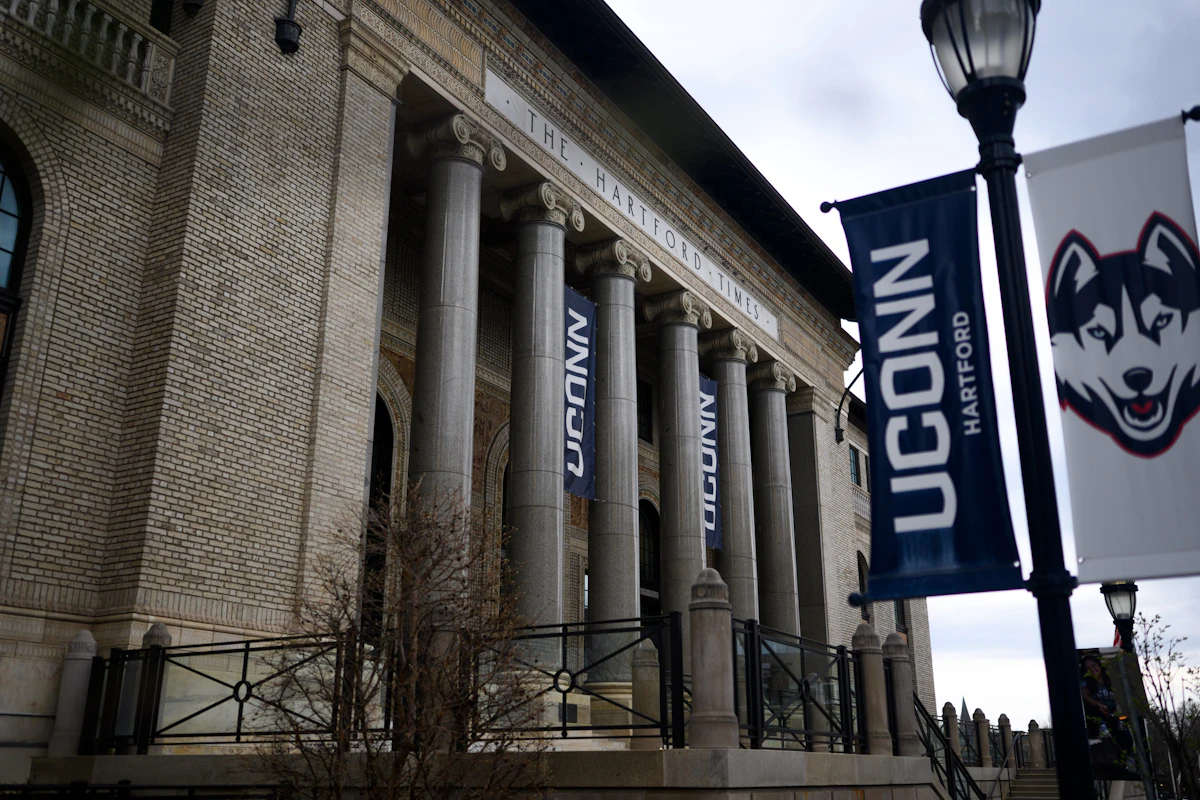
On July 13, a conservative legal organization, the Legal Insurrection Foundation, filed a civil rights complaint against the University of Connecticut claiming that providing Black and Latino residential learning communities amounts to unconstitutional racial preferences.
The filing is the latest front in the right’s ever-expanding campaign against diversity, equity, and inclusion initiatives. What began as a challenge to affirmative action in college admissions has grown into a sweeping effort to dismantle diversity offices, race-conscious scholarships, employee affinity groups, and educational programs that acknowledge the continuing significance of race in American life. At every turn, it seems like the mere presence of a Black person or a woman or someone from any number of other identities in a position of authority is “illegal DEI.” It is no longer enough to prohibit universities from making admissions decisions on the basis of race. Now, even voluntary communities that students create for themselves are supposedly suspect.
The fact that these voluntary affinity spaces are the only ones being targeted is telling. Universities are full of affinity spaces. It’s fairly typical for honors students to choose to live with other honors students. Some students join language houses to provide second-language immersion. Others enjoy a range of themed residential communities organized around academic interests, service, religion, or shared hobbies. Fraternities, athletic communities, and countless informal networks built around common experiences are accepted as ordinary features of campus life.
The UConn programs at issue do not assign students to housing based on race, nor do they exclude anyone from participating in university life. They are voluntary residential learning communities that students opt into because they believe they would benefit from living among peers with shared experiences. But the complaint effectively argues that students cannot be trusted to make that determination for themselves. A group of honors students may decide that living together would foster their academic development. French speakers may conclude that a shared living arrangement would deepen their cultural and linguistic experience. But if Black or Latino students believe there is value in spaces that acknowledge their experiences as members of historically marginalized groups, their decision suddenly becomes so suspect that it is characterized as unlawful segregation requiring government intervention.
That idea has a long history in the United States.
Throughout our history, communities built by marginalized groups have been portrayed as divisive, illegitimate, or contrary to universal principles, and again and again, governments and powerful institutions have sought to dismantle those communities in the name of equality, progress, or neutrality. Whether they have been tribal governments, labor unions, Black business districts, or mutual aid societies, institutions that enable vulnerable people to support one another and exercise collective power have been seen as threats precisely because they lessen dependence on dominant institutions. Spaces for building solidarity outside of an ideologically dominant vision of white supremacy and patriarchy are particular targets, with cross-community solidarity efforts being particularly threatening.
For example, the causes of Bacon’s Rebellion—a 1676 uprising of frontier settlers, indentured servants, and enslaved people against Virginia’s colonial government—were complex, but the uprising alarmed colonial authorities in part because it demonstrated the possibility of solidarity between poor whites, indentured servants, and enslaved Black laborers. In its aftermath, colonial governments increasingly hardened racial distinctions and distributed rights and privileges in ways that made such expressions of solidarity more difficult to foster, the better to prevent the formation of any durable interracial community. The point was not only to elevate whiteness but to make collective action among the oppressed less likely.
Black Americans repeatedly built institutions of their own. After emancipation, Black people were excluded from many white institutions and denied equal protection of the law, and they were still the frequent targets of extrajudicial violence. They created churches, schools, businesses, newspapers, and mutual aid organizations that provided forms of security and independence unavailable elsewhere. Tulsa’s Greenwood district represented one of the most remarkable examples of this process. Known colloquially as “Black Wall Street,” this community was not just a prosperous Black neighborhood. It was a thriving ecosystem of businesses and civic institutions that gave Black Tulsans a degree of collective autonomy in a society organized around white supremacy.
That autonomy itself was intolerable to many white Tulsans. In 1921, a white mob joined and deputized by local authorities descended on Greenwood, looting and burning homes and businesses, killing hundreds of residents, and leaving thousands homeless. The massacre that destroyed Black Wall Street was more than an attack on individual wealth. It was an effort to annihilate a thriving Black community and the institutions that sustained it. The physical destruction was compounded by decades of official neglect and historical erasure, ensuring that the loss of wealth, property, and communal infrastructure would reverberate across generations.
By the late nineteenth and early twentieth centuries, these extrajudicial forms of repression increasingly became formalized through law. Jim Crow helped maintain a social order in which Black political and economic institutions could be constrained, surveilled, and periodically subjected to violence. Legal rules and extralegal terror worked together to preserve relationships of dependence and limit the development of collective power.
There is no example that better demonstrates the relationship between violence, law, and the dismantling of solidarity than the federal government’s policy of Native American allotment. By the late nineteenth century, the United States had already spent decades violently displacing Indigenous peoples through warfare, forced removal, and coercive treaties. Native American nations posed a particular threat to white settler hegemony through their ancestral ties to the land, collective identity, and separate systems of governance, social obligation, and relationships to land that organized collective life. Federal policy sought not only to remove Indigenous people from their lands, but to transform the forms of community that made collective resistance to removal and settlement possible.
The Dawes Act of 1887 represented a legal culmination of this project. Rather than openly presenting allotment as an effort to weaken Indigenous nations, its supporters framed it as a path toward equality and citizenship. They argued that tribal governments and communal landholding kept Indigenous people from becoming proper, independent Americans. The solution, they claimed, was to divide collectively held lands into individual parcels, transform Indigenous people into private property owners, and replace relationships of collective responsibility with direct relationships between individuals and the federal government.
The language was similar to the “colorblind” talk we see today, selling freedom through individual ownership, equality through the elimination of group distinctions, and progress through assimilation. And, of course, the result was dispossession. Millions of acres of land were transferred out of Indigenous control, often through fraud, coercion, and exploitation. Beyond the dissolution of collective property, allotment weakened the institutions through which Indigenous communities governed themselves, cared for one another, and maintained collective identities. It transformed land stewardship from the foundation of a community into an asset that could be individually owned, bought, and sold.
The importance of allotment is that it demonstrates a recurring pattern in American history. The destruction of marginalized communities often begins by portraying those communities as the obstacle to equality and their institutions as barriers to individual freedom, rather than responses to conditions of exclusion. The solution offered is not greater power for those communities but their dissolution, and the same logic appears in contemporary attacks on affinity spaces.
The complaint against UConn relies on the idea that the university should treat students solely as individuals and that any institution organized around shared racial experience is inherently suspect, but that standard has never been applied evenly. American society is filled with communities built around shared identities and experiences, but the history of anti-solidarity politics reveals the distinction. Communities that allow marginalized people to reduce their dependence on systems that have historically excluded them are consistently targeted.
The question raised by the UConn complaint is therefore much larger than whether a university may offer Black and Latino residential learning communities. It is whether equality requires people to stand alone—or whether people who have historically faced exclusion have the right to build the communities through which they can stand together.
Hence then, the article about the right wing war on solidarity comes to campus was published today ( ) and is available on The New Republic ( Middle East ) The editorial team at PressBee has edited and verified it, and it may have been modified, fully republished, or quoted. You can read and follow the updates of this news or article from its original source.
Read More Details
Finally We wish PressBee provided you with enough information of ( The Right-Wing War on Solidarity Comes to Campus )


Also on site :
- I worked with Trump. I know why he is being so easily goaded into a forever war
- Shakira Brings Out Tyla, Ed Sheeran & Burna Boy at Her First Show Post FIFA World Cup in New York City
- Jon Stewart Says the World Cup Final Was the ‘Reverse Super Bowl’: ‘The Players Spoke Spanish and the Halftime Show Was in English’