
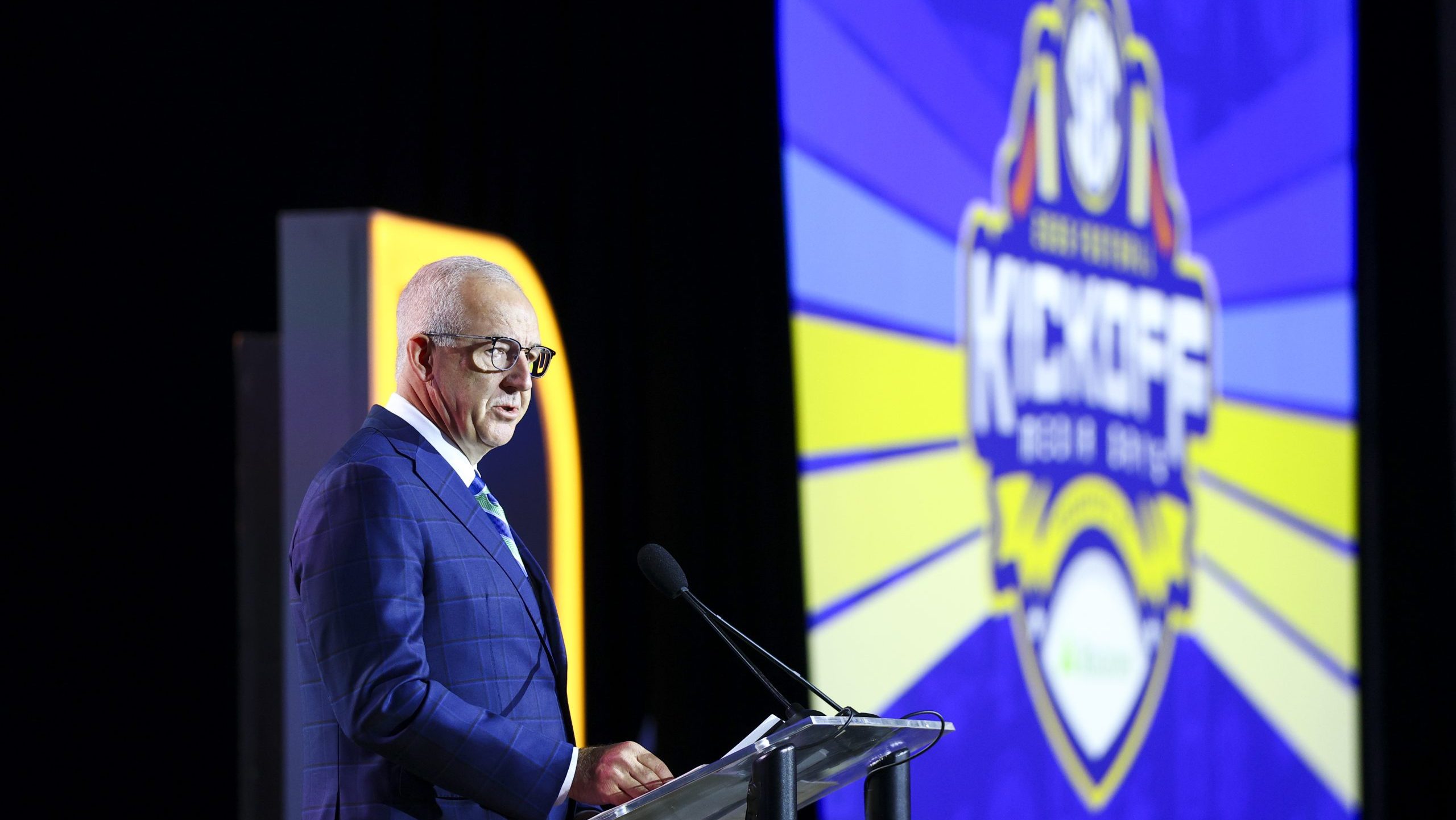
The 2026 edition of SEC Media Days began on Monday. Over the 4 days, all 16 conference coaches speak to the media, as well as 3 players from each program.
First up at the podium, though, is Greg Sankey. The conference commissioner addressed the media to kick off Day 1’s festivities.
RELATED: Get in on daily fantasy sports today! Check out the SDS guide to DFS legal states!
Here is the complete transcript of Sankey’s televised press conference, via ASAP Sports:
COMMISSIONER SANKEY: Good morning. Good to be with you in Tampa on a Monday morning in July. A few people like me have had travel experiences Sunday and Monday. Appreciate the dedication of those who are here.
This is the first time to hold our event in the Sunshine State and here in Tampa. Tampa has become home to the Southeastern Conference for a number of events. Back in 2009, I was in a job search for another commissioner’s job. And my decision-making has been proven to be wise; I didn’t jump at that chance. That was 2009, our men’s basketball tournament. 2022, we played our men’s basketball tournament here as well. Our women’s golf championship has found a home at in Belleair, Florida, Pelican Golf Club. That’s happened since 2024.
ReliaQuest Bowl is one of the longest-standing relationships we have in the Southeastern Conference. We added the Gasparilla Bowl to our post-season inventory just a few years ago. We look forward to the College Football Playoff National Championship returning here to Tampa in 2029.
All of that is a tribute to the Tampa Bay Sports Commission. It’s their work that brings us here today. But also led to a decision that over the next two years our women’s gymnastics championship will be held here in Tampa both in March of 2027 and 2028.
Last night we started the week with a FanFest at Benchmark International Arena, which the sports commission helped facilitate. Their great work and planning and organizing and supporting events is what made it appropriate for us to make the move here to Tampa this year.
We also appreciate the staff of both the Tampa Marriott Water Street and the JW Marriott for their hospitality through the week.
Also worth my mentioning, one of our great relationships in the Southeastern Conference is with Regions Bank, one of our longest-standing sponsors. Paul Hodges and his team do great work supporting not only SEC Football Media Days but the Southeastern Conference and the SEC Network throughout the year.
I will note, break the first piece of news this morning, that next year SEC Football Media Days in 2027 will return to Nashville, Tennessee. Those dates will be July 12th through the 15th.
Before I jump into the issues of the day, I think it’s worth taking a moment to recognize what has been accomplished by the student-athletes, our universities, coaches and administrators during the preceding year. In part because the 2025-2026 academic year was going to be one of those years that serves as a defining chapter in the history of college athletics.
Our institutions had to navigate historic levels of change while continuing to provide outstanding educational and competitive opportunities for our student-athletes. That means that on the field we experienced a conference-record 13-team national championships. Our previous high was 10. We have 22 sports in which we sponsor championships. Over half of those right now are national champions.
We placed more teams than any other conference in the College Football Playoff. While we didn’t achieve the ultimate destination of a national championship, the strength of this conference in football is clear.
When you go beyond football and look at post-season participation in NCAA championships throughout our sports inventory, it is typical that Southeastern Conference teams fill most or the highest number of teams represented in those brackets.
Those accomplishments are extraordinary. They’re a representation of the commitment made by young people who choose to enroll in our universities, both to be educated and to fulfill their competitive expectations; the work of our coaches; the dedication of our athletics administrators; and the leadership at the president, chancellor and board level throughout our conference.
That change that I referenced at a historic level included navigating implementation of the House settlement that a year ago was very much brand-new. We also continued to invest in the student-athlete experience, medical support, mental wellness care and initiatives, leadership development.
Today we launch an even more extensive education program around sports wagering to try to help young people and our staff members avoid the pitfalls of what is becoming more culturally accepted around the area of sports gambling.
As a league we added over 1200 new scholarships. Those are not football scholarships. Those were in sports other than football. Over 700 of those are for women student-athletes.
That’s one of the positive changes from the House settlement that has been missed, the opportunity to increase scholarship numbers and provide full scholarships in sports, typically Olympic sports, that used to be partial scholarship environments.
That commitment continues to be reflected in a high level of interest in what happens around our competition. Southeastern Conference football remains the second most-watched sports property in the United States, trailing only the National Football League. We account for just over 40% of the live viewership hours consumed among the four major conferences.
Our football programs draw an average of 80,000 fans per game. That’s our average number. This was the stat of my summer. That is the highest average attendance for any sport league in the world.
We’re national leaders in attendance in just about every other sport sponsored by the Southeastern Conference. Across every measure, interest in our league continues to grow.
That’s attached to the work of those leaders on our campuses who I cited a moment ago. These and other achievements provide a solid foundation for our present and our future, but they’re not our destination because we know that success brings with it responsibility.
Our responsibility isn’t simply to celebrate victories and championships. Our responsibility is to provide leadership, the leadership needed to preserve the values, the opportunities and competitive integrity that have made college athletics so meaningful for so many generations.
It’s that responsibility and the decisions required to fulfill the responsibility that are my focus this morning.
One of our greatest responsibilities is to establish a stable national framework for college athletics. For more than six years those of us in the conference office, the leaders on our university campuses, Southeastern Conference student-athletes and policy makers have worked in good faith seeking the return of national standards through federal legislation.
These efforts have demonstrated not only how complex these issues have become because also have reinforced my belief that Congressional action remains a needed path to provide that long-term stability.
At its core, it sounded like a straightforward objective. One national standard, a national framework with rules that can be consistently enforced, because student-athletes, coaches and universities deserve to compete under consistent standards, regardless of geography.
Over and over our student-athletes tell us the same thing: when they line up for kickoff, tip off in a basketball game, first pitch in the spring, or when they put their feet in the starting blocks at a track meet, they want to know that every competitor from other teams, from different campuses across different states, that those competitors are being held to the same standards that apply to them.
Among all the press releases, legislative drafts, committee hearings, and political commentary, that message from our student-athletes to me is the clearest message we have heard. Hold everyone to the same standard.
The reality is, turning on the news this morning, you’re reminded that Congress and the federal government have no shortage of issues competing for their attention. We appreciate the bipartisan work of the House and Senate, the interest from the President and his administration in working to address the future of college athletics.
Through the fall, the winter and into the spring, that bipartisan work produced a focus in the House of Representatives on the SCORE Act. Earlier this summer, Senators Ted Cruz and Maria Cantwell introduced the Protect College Sports Act.
I want to be clear that we appreciate the tremendous efforts that have gone into these legislative drafting initiatives. We’re engaged specifically now in ongoing dialogue around improving the Protect College Sports Act.
I also want to note, because he’s one of the Senators in our footprint, the engagement and the work of Senator Schmitt from Missouri. You may not know Senator Schmitt, but he did make SportsCenter’s Top 10 plays with one of his catches during the Congressional baseball game earlier this summer.
That Senate bill contains many provisions that we support and we think are both healthy for college athletics and the participants in college athletics.
Just quickly, that includes enhanced expectations for student-athlete health and safety, supporting educational opportunities, providing scholarship protections, overseeing agent activity, increasing the participation of our student-athletes in governance which we as a conference have led in that area for years and actually decades, and those national standards of which I spoke, particularly an eligibility in transfers.
We support the effort behind the Protect College Sports Act; however, we believe changes to the act are necessary to make it most effective.
The changes we’ve suggested are most achievable and reasonable, and we’re committed to working with Congress to move the legislation across the finish line.
There are four principles that we believe should guide this legislative effort at this time.
The first is about those national standards, which must be enforceable. If Congress establishes national rules, individuals and organizations who comply with those rules should not be subject to litigation simply for following the law. Without meaningful legal protections, we risk the continuing cycle of uncertainty that has been part of our challenge in college athletics in recent years.
Second, the framework should be truly national. The legislation moves us in the right direction, but it should more fully replace the growing patchwork of state laws that are conflicting and create competitive differences based upon state borders. Remember that quote from our student-athletes: we just want to know that others are held to the same standards.
Third, transparency and accountability are essential. Rules governing name, image and likeness are only effective if they can be enforced. That requires meaningful transparency so everyone operates under the same expectations and the same level of accountability. Without it, loopholes undermine that competitive fairness expectation.
Fourth and finally, the legislation should treat similarly situated organizations equally while preserving institutional choice. Whether discussing conference structure or media rights, federal law should establish fair and consistent standards, not different rules for different organizations. They should preserve the voluntary decision-making rather than mandating outcomes.
The areas of concern that we’ve identified, every time I write a memo on this I find it posted soon on social media, so we offered 10 commonsense suggestions that track on those four principles.
Those 10 concepts are not SEC issues. Those are changes that we believe benefit all of college athletics in providing a national solution.
Our recommendations are intended to help Congress achieve what our student-athletes, our universities and our fan desire; that one national framework of meaningful protections for student-athletes, enforceable rules, fair competition and providing long-term stability.
If Congress is going to act, and again I believe it should for the reasons identified, we have one opportunity to get this legislation right. If Congress passes a bill and it’s signed into law, we won’t be returning to DC in a year or two asking and receiving help to correct the gaps that exist. That’s why it’s important that these commonsense areas be addressed now before the bill becomes law.
But for us, federal legislation is only one part of our responsibility. The same principles that we talk about guiding Congressional decision-making should also guide us every day.
Over the past year, there’s been considerable discussion about the format of the College Football Playoff. In fact, if I’m honest, I’d suggest that since the College Football Playoff was created, there’s been considerable discussion about the future format of the College Football Playoff. That helps you fill space, right?
Those conversations are important. But our approach has remained consistent. We’re not necessarily interested in finding the easiest path; we are focused on finding the right path for college football.
Leadership sometimes is not about having an immediate answer. Leadership is about asking the right questions before making decisions that shape our future. Some decisions are so important that taking the time needed to let the important questions be answered is the right step. The need to have the right information should properly inform our decisions.
Some of those important questions that remain for us is how do we preserve and build the value of the regular season. That is a judgment-based answer that we continue to consider and research.
We also need to know what is the actual interest from fans and from media entities in an expanded College Football Playoff. How do we respect the academic calendar and respect the well-being of our student-athletes?
When we went from four to 12, those questions were answered during the consideration process. How do we create a post-season that rewards excellence while strengthening the long-term future of the sport and providing post-season competitive opportunities that are meaningful?
I’m certain to be asked the last one: what happens to conference championship games in the sport of football that the Playoff expands further?
Those questions and others rightfully do and should guide our conversations. Each deserves thoughtful answers, not assumptions, and not incomplete information.
But we do need to bring this conversation to conclusion in short order so we can move on and focus on the future of the game.
This same principle-based decision-making helped guide the Southeastern Conference when considering a nine-game football schedule which begins this season. We and I recognize that a nine-game Southeastern Conference football schedule, coupled with our expectation that we maintain a high-quality non-conference opponent, creates one of the most — in fact, I’m going to scratch what I wrote. It creates, without question, the most demanding sets of football schedules in all of college football.
But these decisions were made after years of thoughtful discussion, careful analysis, and spirited debate, which led us to the conclusion that the nine-game schedule was appropriate.
The nine-game schedule reflects confidence in our universities, our student-athletes and in our football programs. It preserves great rivalries, historic rivalries, many of which are played every year. It creates more compelling conference matchups and reinforces our long-standing commitment to competitive excellence.
When you look at our schedule, no one has created the kind of weekly competition that exists in the Southeastern Conference. It’s competition that our fans will experience every week because we believe we’re the best conference in college football.
If so, we should also embrace the challenges with a difficult and challenging conference schedule, the best schedule in college football. It will challenge our teams. It will prepare them for the highest level of competition. It reflects who we are as a conference.
Whether we discuss legislation, the future of the College Football Playoff, the future of SEC football, our responsibility is not to simply chase the next headline or simply react to the issue of the day. Our responsibility is to make principled decisions that strengthen college football, preserve what makes it special, and position it for long-term success because in just a few weeks all across our 12-state footprint, the stadiums of the Southeastern Conference will come alive again. Families will gather. Tailgates will happen. Campuses will fill. Rivalries will be renewed. New leaders will emerge. New champions will be crowned.
We’re at that time when every season begins with a thought of hope and possibility. Our responsibility is to preserve everything that makes those moments possible.
Before I conclude and we turn to questions, I do want to take a moment because we’re reminded as things happen rapidly in our lives, that as the years go on, we lose some people who are special to us. We experienced that with members of the media who would normally be with us today that we lost during the past year.
Wes Rucker first was a Knoxville sports journalist who provided extensive coverage of the University of Tennessee athletics for over two decades.
Joey Knight was here in Tampa, a longtime sportswriter for the “Tampa Bay Times” and the “Tampa Tribune.” He covered the Tampa Bay area sports scene for over three decades.
We lost both Wes and Joey back in February.
We also lost Phillip Marshall. He covered the SEC, mostly Auburn’s program, for over half a century. In fact, Phillip goes back to the days of the SEC Skywriters Tour, the predecessor of SEC Media Days, back as early as 1977.
Respect the work you do. Sometimes it’s tough, but we mourn the losses of your colleagues.
I want to say thank you to each of you, no matter what questions you might ask, for joining us over the next few days.
I want to say thank you to the SEC staff, kind of go from event to event, never losing the focus on the importance of supporting outstanding experiences. We are here as staff to make your Media Days successful. Please call upon any of us if we might help you do better in engaging in your work.
With that, as is our tradition, I’m going to turn to Kevin to moderate questions. But I will note that this is also the reminder that Bob Holt used to be quick right up here with that first question, another reminder of someone special to us all.
Kevin, take it away.
THE MODERATOR: If you have a question, raise your hand. We’ll start to your right-hand side, Commissioner.
Q. How real are the conversations within the SEC about potentially breaking away from the college structure as we know it? In any way is that being used as leverage in the conversations you’re having with Congress about the bill?
COMMISSIONER SANKEY: So you phrase the question of how real. So I’ll take that as like real or not real.
So they’re real. People have talked about that. They’ve opined about the frustrations that bring them to the point of saying we should look at something significantly different.
I do not believe that is a leverage point. I think that’s just honest communication.
I would prefer that stay in a meeting room or on a videoconference, not be part of the D1.ticker the next morning, but I don’t control all of that.
What I think is important is those comments represent a high level of frustration with the circumstance in which we find ourselves. We have regulated ourselves more progressively than other colleagues by choice, across our league. We’ve had different academic eligibility restrictions in the past. So we have different transfer restrictions in the past.
Some of what you hear comes out of a culture that we can regulate ourselves. But the frustration that exists is when you go to a meeting eight years ago, we want to change the volunteer coach rule in a Division I setting, the Division I membership can’t see their way that change, so that creates risk.
I think some of the transition into this five-year eligibility model, it happened when it did and the way it did, that magnifies frustration.
We went through a College Football Playoff discussion for years and introduced a 12-team Playoff where it just sat because colleagues couldn’t move. They had reasons, but those reasons really didn’t resonate.
So understand that beneath the observation is frustration. But I also know the pride with which I spoke of 13 national championships, and there is meaning and value and I do think a national expectation that we participate in a national organization.
But that national organization must function in a healthy manner; otherwise, that simmering will continue.
Q. Thinking about the ninth game, what is your degree of confidence, if any, that the Selection Committee will consider that metric very heavily? How much do you feel like your head coaches are embracing that challenge?
COMMISSIONER SANKEY: Well, they’re here, so the fact that our head coaches are here tells me they’re embracing the challenge.
I’m actually one who believes competitors want great challenges. I’m unapologetic about that reality.
As it relates to the College Football Playoff Selection Committee, we have heard about strength of schedule, strength of record. I think there were some references for strength of conference.
We had what I’ll call an unsatisfactory conversation with members of the College Football Playoff staff and some of their advisers in Destin. That’s rehashing from a couple months ago, that’s not a secret. That’s a reminder of that process needing to continually improve.
My confidence is that people will act with integrity. I do think we have questions about the understanding of the strength and rigor associated with competing in the Southeastern Conference.
Q. One of the key words coming out of the spring meetings was ‘transparency’. You referenced it. Has there been a thought or conversation about inside the conference, school to school, that the conference be more transparent so at least they know what is going on inside?
COMMISSIONER SANKEY: So from a transparency standpoint, Eddie asked me a question that was a conversation that wasn’t meant to be transparent. I think natural transparency seems to be taking place.
I’m not certain I know what particular topic. Not everything we discussed is simply going to be published. There are reasons for confidentiality. You have the freedom to ask me anything this morning, so I’ll be as transparent as I can be in this moment.
How is that for an answer? I do get to decide what I answer, though (smiling).
Q. You’ve obviously done your due diligence on the 16-team Playoff model. What are some of the hurdles or things that you need to be informed on to consider the 24-team Playoff model?
COMMISSIONER SANKEY: I went through that list in the midst of my remarks, so I won’t rehash most of those.
We don’t have any idea at this point of the clear media interest in an expanded Playoff. We do know, we do have an understanding of what happened when we went to 12. We considered other formats. So that’s one.
Second is the calendar is challenging. There is a line embedded in the current version of the Protect College Sports Act that the football season be fully completed by January 8th. If you think through the implications of particularly that date, remember the American Football Coaches Association introduced that idea, produced a frustrated phone call from me to Craig Bohl about the lack of consultation.
But you have to find places to play the games. You have to think about whether overlap of those games when they’re played is acceptable or not.
I tend to think the access point is important for young people. As we’ve had conversations in smaller groups, they can answer I’d rather have a chance than not have a chance. But there are limits on the number of games you can play over time.
So answering that first smaller set of — the set of points in my remarks is fully on my mind. That smaller set of points hopefully filters it a bit more.
Q. Transparency has been the term thrown around this morning. Accountability, too. Where does that fit in with officiating, the questionable calls that have happened the last couple years? Is there any plans to create more transparency for calls either during or after games to provide some clarification?
COMMISSIONER SANKEY: Every week officials go on the football field, the basketball court, softball field, baseball field, and everything they do is transparent, everything they do is transparent. You can’t hide if you put on an officiating uniform.
We’ve added — in fact, we’ve been the innovators in replay with the motivation to get it right. That provides transparency, as well. In fact, we’re the conference that implemented at the collegiate level in our tournament the automated balls and strikes format. Can’t be any more transparent than that reality. We pushed that to seek the opportunity to allow that in the regular season.
We’ll continue to do that. There are limits to transparency. When an error is made in a game, scholarships are not pulled for a player for one incident, they don’t lose their starting job. So every week we provide feedback to officials. We don’t publish that.
I also have a great deal of respect for people that are willing to put themselves in the venues of the Southeastern Conference to conduct that activity. I think we have found a reasonable balance. Reasonable people can disagree with that.
The elements that we’ve added and the steps we’ve taken to try to get it right are evidence of our motivation and our willingness, quite candidly, to be transparent.
Q. You mentioned the conference championship game. It appears all your colleagues are ready to just not do their championship game easily. Clearly the SEC is not. How much can you hang on to that championship game format if every other conference is willing to cast it aside?
COMMISSIONER SANKEY: I have to go back and figure out how many years we did it on our own when conference championship games were initiated.
The majority didn’t flip in our direction for probably about a decade.
I think even the move to 12 has created pressure around championship games. We’ve talked through the factors that support the pro list, and we’ve talked about some of the con list, the negatives that need to be considered.
And we have some time. We will have a conference championship game the first Saturday in December of 2026. We have contracts and plans in place well beyond that. But we have time for consideration.
One of the factors for us is what will happen with that College Football Playoff.
Q. You said that everything that the officials do is transparent. What feedback have you gotten from your coaches and your presidents about the officiating processes? Do they feel like it’s going well, that it’s transparent? Are they receiving the information that they’re asking for after the games? Can you explain that process.
COMMISSIONER SANKEY: Absolutely. Our coaches have the opportunity to submit plays for review. That information is evaluated and communicated back to our campuses. The expectation is that information, the back and forth, be communicated in a confidential manner. So that is not transparent. I’m being transparent about that, by the way. That’s the deal.
When I talked about transparency, there are no editors in officiating, unless you consider replay to be editors. You’re in real time, between 12 and 48 cameras in football evaluating your performance.
Is everyone happy all the time? No. But I saw that yesterday during the World Cup. I saw it last week and the week before during the World Cup. I saw it during the NBA Playoffs. I’ve watched it with ABS and Major League Baseball. We have humans making instant decisions in a dynamic situation. I think our officials do a remarkably effective job in managing those situations and those decisions, imperfect though it may be.
Q. With the College Football Playoff revenue sharing and conference expansion all changing the sport at once, what issue will most define the SEC over the next five years?
COMMISSIONER SANKEY: The leadership of which I spoke moments ago. Our ability to be both influential and effective through change. I’d like to win every championship. When I interviewed for this job in 2015, that was one of the three components. First was graduate every student-athlete; second was win every championship — 13 of 22 is pretty good; and change the world, which is about influence.
I want us to continue to use that influence as I’ve described, not just the long-term health of college football during a time of change, but also all of college athletics, all 22 of our championship sports.
History is a really educational and informative element at this point. We’re dealing with things that have persisted for a century. Go back and read the history of college athletics from the early 1900s, 1910s, ’20s and ’30s.
Even that list you provided: what does the post-season look like, what are the health and safety issues, what happens around gambling, educational structure, what about student-athlete support.
I think we do a better job now than has ever been done in college athletics, but we haven’t achieved that level of stability as we go through change that’s needed at this point.
Q. You mentioned the suggested changes you’ve put forward to Cruz and Cantwell. Does the bill have to incorporate all the changes you asked for for the SEC to support it? If not, are there two or three that could be implemented and maybe some others not that the SEC would support?
COMMISSIONER SANKEY: In my view, that’s part of the conversation, that engagement that I described. Do you have to bat a thousand? You never give up things in those conversations.
What we’ve tried to do is identify those items. When you get to Title II, the quick primer of the legislation, Title I, is about the operational administrative issues. Title II is about super leagues and media right combination.
In Title I there are seven that we identified. I think they’re all worth consideration and inclusion. Whether we achieve that or not remains to be seen.
I so appreciate the engagement of Senators Cantwell and Cruz and their staffs in the conversation and others that are participating.
In Title II, when I first read it, it’s like, Why is that even in there? I’ve commented on this in real-time in Destin. There are interests that have introduced those issues.
We have three or four changes there, if Title II remains, that are critically important to us.
Not everything is necessarily the same, but I think every element that we’ve introduced is worthy of conversation. I appreciate the engagement of the Senators in taking it so seriously.
Q. With all the lawsuits that are going on right now regarding the fifth year of eligibility, is there a Plan B to perhaps go ahead and grandfather these people in or will the fights continue in court?
COMMISSIONER SANKEY: I don’t control that decision-making. Our input was that the NCAA not proceed on the timeline that it chose to introduce. The membership voted to pursue.
I think there was more information and research that was needed. My observation comes from someone who back in the ’90s, when I was in the Southland Conference office staff, wrote a resolution about looking at five seasons of eligibility.
We — and this gets back to Eddie’s question, we identify NCAA eligibility standards as those that establish eligibility in our league. When you go through these moments, that is why the frustration that he asked about exists in part, not all of it, but it informs that frustration.
You’re going to have to ask Charlie Baker and his legal team how they intend to defend those lawsuits and whether they’ll make a pivot.
Q. You talked a bit about responsibilities earlier. Made me think that your role is as much as a custodian of college football. Do you have concerns about the direction of travel of college athletics, and is proposed legislation the answer and does it go far enough?
COMMISSIONER SANKEY: In your Scottish brogue, I want to make sure I track on each of the elements.
One is about travel? So thank you for traveling across the pond to be here in Tampa. The weather in Tampa and Scotland are two different things.
When we make decisions, we can only represent the decisions we’ve made. We have looked at travel. Whether that’s the expansion in the early ’90s, the early 2010s or the most recent expansion, our longest journey when we were at 14 was Columbia, South Carolina to College Station, Texas. Now it’s Columbia, South Carolina to Austin Texas, which is five or 10 minutes on an airplane.
I think one of the advantages present for Southeastern Conference members, for coaches, and for our student-athletes, is you’re not spending hours and hours and hours journeying across country across four time zones to compete in your league. It’s Eastern and Central Time, in two hours or less.
That’s my answer to the travel piece.
Is the legislation really what you’re asking about, what I would have drafted have I been given the pen solely? No. But that’s part of the legislative process, the back and forth.
Our feedback, the feedback that I identified, the commonsense issues we’ve identified, are an indication that we think there need to be adjustments made.
Then the issue of custodianship. Usually the way that question is asked of me, it is asked, Well, you’re the commissioner of the SEC, and that’s all you think about.
The SEC keeps me up at night. It’s why I have less hair and grayer hair than I had when I stood in this podium in Birmingham in 2015.
I’ve said over and over, there are situations and circumstances and decisions where maybe that’s not what the Southeastern Conference membership wanted initially, but we worked through our thinking because it was better for all of college sports.
We pushed for a move away from equivalency scholarships previously. Those 1200 full scholarships I talked about cost some money, but that’s good for college athletes. That’s good for Olympic athletes. The volunteer coach legislation we introduced, $300-plus million settlement later, turns out that would have been a good idea for college athletics.
I fully understand the responsibility that comes with this role. I didn’t understand it when I was commissioner of the Southland Conference in Division I, even though I had responsibility beyond the borders of my league.
I hope to be both, using the words I used earlier, influential and effective. Yes, unapologetically for the Southeastern Conference, but with the recognition that national competition, the ability to hold a national championship trophy up, compete against colleagues from different states in an equitable fashion, and achieve the mountaintop of a national championship, that has meaning.
We’re challenged now to keep our focus on that reality. That’s about, in part, being a custodian. That is a responsibility I recognize.
THE MODERATOR: Commissioner, thank you for your time this morning.
COMMISSIONER SANKEY: Thank you. Again, thanks. Ask our staff if we can be of help. I’ll probably see you in the hallway and I’ll run away rapidly from your questions (smiling). I know I’ll have the opportunity to interact with you during the week.
Everything Greg Sankey said from the podium at SEC Media Days Saturday Down South.
Hence then, the article about everything greg sankey said from the podium at sec media days was published today ( ) and is available on SATURDAY DOWN SOUTH ( Middle East ) The editorial team at PressBee has edited and verified it, and it may have been modified, fully republished, or quoted. You can read and follow the updates of this news or article from its original source.
Read More Details
Finally We wish PressBee provided you with enough information of ( Everything Greg Sankey said from the podium at SEC Media Days )


Also on site :
- U.S. military launches 10th straight night of airstrikes on Iran as Houthi allies threaten Red Sea, but glimmers of hope appear on diplomatic front
- T.J. Maxx's Beautiful Linen Dining Chair Sets Has Shoppers Racing to Buy Them Before They're Gone for Good
- 1928 Beach Legend, Named Among Most 'Historic Hotels of America,' Is Still a Vintage Hotspot Nearly 10 Decades Later