
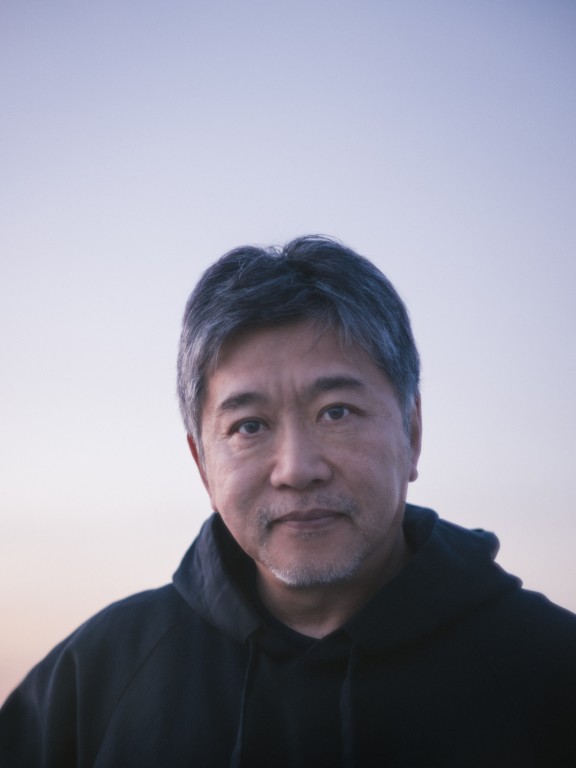
Across his films, one of director Hirokazu Kore-eda’s core thematic interests has been that of found family, the way people whose shared histories should normally divide them instead find kinship with one another. His films, from the wayward children of “Nobody Knows” to the eclectic outsiders who populate “Broker,” find ways to foster a sense of safety among each other. With his latest, “Sheep in the Box,” Kore-eda explores these questions in the context of science fiction, complicating his questions around belonging and family by introducing artificial humanoids and generative AI.
Director Hirokazu Kore-eda.The artificial humanoid in question is named Kakeru (Rimu Kuwaki), who lives with his parents, Kensuke (Daigo Yamamoto) and Otone (Haruka Ayase). Kensuke and Otone are still actively mourning the death of their son Kakeru and, through a company called ReBirth, order an android replica of their child. While the robot Kakeru may physically resemble their son, there’s dissonance between how he acts and how Kensuke’s and Otone’s son originally was.
It’s in that gap between expectation and reality that Kore-eda adds new wrinkles to the questions that have long captivated him: Can families be healed through technology or is it an unworthy salve? What can an intentional community look like with beings who have no soul? Does an algorithm gain any sort of humanity the moment it takes on corporeal form?
Not too long after “Sheep in the Box” premiered in Competition at Cannes, RogerEbert.com sat down with the master filmmaker about the influence of The Little Prince, how he approached his sympathetic depiction of AI while being fully aware of its detriment to the environment, and the embodied practices that continue to help him stay rooted in a world that’s going increasingly more digital.
This conversation has been edited and condensed for clarity.
Until watching your film, I had honestly forgotten that the title, “Sheep in the Box,” was in reference to Antoine de Saint-Exupéry’s book, The Little Prince. What significance does that book hold for you, and why did you choose to anchor the text around it?
Hirokazu Kore-eda: Well, I read the book as a child, and to be honest, I didn’t really understand it. There were certain scenes that I remembered as is often the case, and I knew that imagination was key to this story. When I knew I was making this film about humans and generative AI, I knew that I wanted the mother to read a bedtime story to this humanoid that had come into her home, but I also thought it’d be interesting if the humanoid didn’t understand the story, and the scene of the sheep inside the box came back to me. I thought, “He wouldn’t have the imagination to know that there’s a sheep inside the box,” which I thought could be really interesting.
So I wrote that scene featuring the book, then came up with the idea of the snow globe, and ultimately of him rescuing the prince from inside it. Ultimately, I thought it would make a good title that connects back to this theme of imagination that I wanted to ground this film.
One of the famous lines in this book is “It is only in the heart that one can see rightly; what is essential is invisible to the eye.” That line feels like it can apply to your whole filmography, particularly works like “After Life” or “Monster.” Looking at your work, you’ve been very heart-forward, very human-centered, and I’m wondering if you find that line a succinct way to summarize your philosophy of art-making.
You would be right. I came across that in a book I was reading by the architect Ryue Nishizawa, who is mentioned in the film. I was reading some of his writings, and he said that in architecture, the most important things are the things you can’t see. It came back again in the film, and the idea that what’s most important for the parents is not when they can actually see what looks like their son in a physical form, but rather when he leaves them, and they are able once again to imagine their son in the trees in the garden. For humans, it is more important and beautiful to imagine new possibilities rather than keep their love in the realm of memory. This is the story of them coming to realize that.
Sheep in the Box (NEON)As much as the film is about generative AI and humanity’s relationship to it, you’re also offered musings about nature as a whole and how that complicates that dynamic. I think of the opening sequence where we see the drones flying through Kamakura: it is an intersection of humanity, technology, and nature. You’ve talked about how the way humans communicate is very similar to trees, so I’m wondering if you can flesh out that parallel.
Well, I read a lot of books about trees and how they communicate, and they communicate with each other through their roots and their leaves and in ways that human beings can’t see, and that’s how they protect the forest from invaders, including insects, and they keep their environment healthy. They have this system that connects them all, which is astonishing. Then I started researching generative AI and saw in the news that AIs have already begun communicating with each other without human interference.
I spoke to some scientists, specifically AI researchers, who said that this is a possibility in the near future, that AIs will be able to interact without any contribution from human beings, and that they might start connecting and working out how to survive. In that case, I thought the way the AI communicates might be more similar to how trees communicate than to how human beings communicate. Maybe, as in the story, the way generative AI is working is closer to trees.
I think in the past, human beings were also connected in this way. Even if it was not a 1:1 ratio with trees, human beings connected through their imaginations. With this film, I wanted to set out whether that way of connecting–through our imaginations–is something that we’re still able to do or whether we’ve lost that ability, and how we might relearn that muscle.
You hold a sympathetic view of AI in this film, which I found to be in tension with as a viewer, if only because I think about the environmental devastation caused by the proliferation of data centers. Were you thinking through this tension when working on this film, of whether you might have been too sympathetic in your portrayal?
Do you think AI is more damaging to the environment than humans? It’s true that technological progress has damaged the environment in various ways, but I don’t think we can place the responsibility for that at the door of AI. It’s human responsibility. It’s human beings who have chosen to live this way, but I’m not trying to absolve AI of any responsibility.
In the film, I wanted to show that these human beings who started out living in nature have now moved into cities and can’t live in the forests anymore; that’s what civilization is to them. Whereas the humanoids representing the dead children and those who reject the children who’ve been rejected by society can now live in the forest, and maybe it’s a bit cynical, but it’s as though the human beings have been left behind by this new society that they’re making.
I suppose if I’d had the parents living happily ever after in the forest with the machines and the children, then that would have been a fairytale ending, but that’s, I think, impossible. So I’ve tried to give them a difference.
Sheep in the Box (NEON)You ground so much of the film’s action in the house occupied by Otone and Kensuke. It feels very much like a living character, warm and inviting during the day because of the way it holds natural light, but for that very reason, it feels more terrifying in the evening, when it holds more shadow. How did you and Production designer Okada Takuya ultimately decide on that house?
That’s a real house in Kamakura that was built by a couple. The wife is an architect, and the husband works with wood exactly like a film. I came across this house with that walkway without any railings, and I imagined a child living there, running carefree, unafraid of the night and rejuvenated by the day. 70% of the shots you see are us using the real house. There was about 30% of the house that we couldn’t use, such as the bathroom, bedroom, and part of the kids’ room, so I had Okada-san recreate that based on the designs of the house.
At the film’s press conference, you talked about how technological progress, while great, also makes things more uniform. Each of your films feels and looks distinct; what practices are you holding to that help retain your sense of identity?
I’m writing this new screenplay, and as you can see [shows script book], I don’t move things around on the computer screen. I have to have it on the paper and then add my notes. I can better organize my thoughts when I use my hands; it helps with creativity to have those ideas physically embodied, and the same goes for writing. It’s a bit like the analogy of the AI having a physical body, because that helps give it an identity, and in this way, my ideas sort of take shape physically as I use my hand to make these marks on the paper. It all starts from there [gestures to script book]. It’s an important element of my creativity, and it’s my philosophy.
I almost feel bad having my computer here now in front of you with my questions.
(Laughs) Don’t worry, I use one too.
Sheep in the Box (NEON)As much as the film comments on technology, nature, and humanity, this is ultimately a film about parenting. Even though Kensuke and Otone shouldn’t punish themselves for what happened to Kakeru, as parents, they can’t help but turn the blame inward. Has working on the project made you think about technology as a form of absolution?
I’m not sure how well I managed to achieve this, but I thought if the role of that humanoid was to show up, assuage their guilt, and then disappear again, that would be very convenient. But at the same time, if he shows up, gets them to face up to their guilt, and then disappears again, that would be quite cruel.
So I wanted him to show up and get them to somehow face up to their guilt, but then I started thinking about what it is about his presence that allows them to be healed. I think it’s because this boy grows up to become an architect in a sense, but influencing both of those parents, he becomes a new kind of architect, and in that sense, he’s turning the guilt of the past into something positive for the future. The humanoid has the idea of building his own house, and his parents have both contributed to his being able to do so.
It’s a new step, a new possibility that goes beyond the guilt, and that’s what the scene where the three of them are standing with their backs to us looking at the tree is- that’s the way that I hope the audience will take that scene.
I’ve spoken with Neo Sora, and he’s spoken about a desire for filmmaking as a way to push back against the historical amnesia that, in his mind, is gripping Japan. Your works feel similar in that they’re earnest calls to remember.
What a great thing to say. He’s so young, and it’s very encouraging to have such young people articulating these ideas. But I think the fact that people can stand up in public and say Look at the crimes they’ve done and say, “That had nothing to do with us; we’re not responsible. ‘ ” It’s a lack of awareness but also a lack of imagination.” In that sense, it’s tied in the way memory intersects in this film, but I wouldn’t say that’s something I directly explored with this film.
“Sheep in the Box” is in select theaters now via NEON.
Hence then, the article about closer to trees hirokazu kore eda on sheep in the box was published today ( ) and is available on Roger Ebert ( Middle East ) The editorial team at PressBee has edited and verified it, and it may have been modified, fully republished, or quoted. You can read and follow the updates of this news or article from its original source.
Read More Details
Finally We wish PressBee provided you with enough information of ( Closer to Trees: Hirokazu Kore-eda on “Sheep in the Box” )


Also on site :
- Billboard’s 2026 Top Music Lawyers Revealed
- 'Real Housewives of Salt Lake City' Star Angie Katsanevas & Husband Shawn Trujillo Split After 27 Years of Marriage
- T.J. Maxx's Beautiful Linen Dining Chair Sets Has Shoppers Racing to Buy Them Before They're Gone for Good