
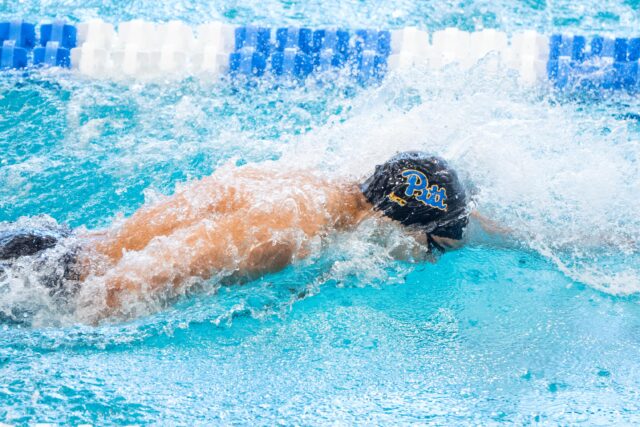
By Olivier Poirier-Leroy on SwimSwam
Higher stroke rates are one of the defining features of sprint freestyle swimming.
At the Paris Olympics, the men’s finalists in the 50m free averaged over 60 stroke cycles per minute.
Compare that to:
100m freestyle – 51.43 200m freestyle – 42.31 400m freestyle – 41.9But just spinning your arms out like a set of bald tires on wet pavement isn’t a guarantee for speed either.
A study (Staunton et al., 2025) with sprinters at the European Championships found that everyone had high RPM stroke rates—but the winners separated themselves by combining increased stroke length with that high turnover.
And that’s where this sprint set comes in.
It’s all about playing with constraints—challenging swimmers to stay fast under different stroke rates. This gives the body an opportunity to learn and self-organize in a way to increase stroke length without sacrificing turnover.
The result—faster swimming.
Here’s a look at the set and how to do it.
The Stroke Rate Ladder
After you’ve gotten yourself properly warmed-up:
2 rounds:
6×25 freestyle all out 60 seconds rest Rep 1: Preferred stroke rate Rep 2: Slightly lower stroke rate Rep 3: Much lower stroke rate Rep 4: Preferred stroke rate Rep 5: Slightly higher stroke rate Rep 6: Much higher stroke rate 3:00 rest between roundsA study (Silva et al., 2022) had swimmers do this set for eight weeks, twice per week. At the end of the intervention, speed, stroke length and stroke index all improved.
Swimmers got faster and increased the amount of pool they covered with each stroke by approximately 6% (1.81 > 1.92m per stroke cycle). The control group, meanwhile, actually got a bit slower.
Where Stroke Rate Meets Stroke Length
I absolutely love this form of sprint set because it challenges swimmers within the context of their stroke.
Often swimmers will lean on drills to increase distance per stroke (long dog drill) or to try and increase stroke tempo (head-up freestyle, freestyle arms with dolphin kick).
But drills change the task. You end up training a different type of stroke that doesn’t always transfer to your race-specific stroke. With constraints, you simply change the demands and naturally encourage your body to find smarter solutions.
The lower stroke rate reps will force you to get as clean as possible with your body line, really maximize every stroke, keep the trunk stiff and horizontal, and search for every last ounce of thrust you can muster. The higher stroke rate reps will challenge your coordination and timing. The arms will have to get into position faster, the hips will have to stabilize quicker, and your muscles will have to be Johnny-on-the-Spot to stay atop of the rapid-fire stroke rate.For swimmers keen on doing this kind of set and who don’t want to use a tempo trainer, you can also sub in stroke counts.
For example:
Rep 1: Preferred stroke count Rep 2: Preferred stroke count minus one Rep 3: Preferred stroke count minus two Rep 4: Preferred stroke count Rep 5: Preferred stroke count plus one Rep 6: Preferred stroke count plus twoThe Next Step
Sprinting looks like a whole bunch of chlorinated chaos, but beneath all that flying white water is a surprising amount of precision.
Elite sprinters understand the trade-offs between stroke rate and stroke length and work diligently and intentionally to find that sweet spot where blinding speed lives and breathes.
Do this set consistently and you’ll learn how to hold more water at higher tempos, coordinate your stroke under pressure, and carry a six-pack of speed under your arm on race day.
Because the fastest performances on race day aren’t the result of one snazzy set or workout. They are built methodically by stacking hundreds of sharp repetitions that, together, create that golden race you’ve been dreaming about.
Happy sprinting!
ABOUT OLIVIER POIRIER-LEROY
Olivier Poirier-Leroy is a former national level swimmer, 2x Olympic Trials qualifier, and author of several books for swimmers, including YourSwimBook, Conquer the Pool, The Dolphin Kick Manual, and most recently, The 50 Freestyle Blueprint.
The book is a beastly 220+ pages of evidence-based insights and practical tips for improving freestyle sprint speed.
It details everything from how to master stroke rate, technique, build a thundering freestyle kick, improve your start and underwaters, and much more.
The 50 Freestyle Blueprint also includes 20 sprint sets to get you started and a bonus guide on how to master the 100 freestyle to complete your sprint preparation.
Learn more about The 50 Freestyle Blueprint here.
Read the full story on SwimSwam: A Sprint Set That Builds Stroke Length at High Stroke Rates
Hence then, the article about a sprint set that builds stroke length at high stroke rates was published today ( ) and is available on swimswam ( Middle East ) The editorial team at PressBee has edited and verified it, and it may have been modified, fully republished, or quoted. You can read and follow the updates of this news or article from its original source.
Read More Details
Finally We wish PressBee provided you with enough information of ( A Sprint Set That Builds Stroke Length at High Stroke Rates )


Also on site :
- Will Warren delivers in relief in final act of regular season as Yankees playoff role comes into view
- Spain Face England Today: Kickoff Time and Broadcast Details
- Major Erling Haaland decision made after Man City 115 charges verdict