
It’s Oppenheimer all over again. Christoper Nolan's The Odyssey ends with Matt Damon’s Odysseus, much like the father of the atomic bomb millennia later, wracked with guilt for conjuring something that destroyed not just one city but, in his mind, an entire civilization: the Trojan Horse. In creating the vessel in which the Greeks hid to penetrate the walls of Troy and massacre its citizens to ultimately win the war, Odysseus believes he violated what characters throughout the movie refer to as “Zeus’ Law.” In doing so, he then gave tacit permission for others throughout the Mediterranean to break the rules that long held this ancient civilization together. But to understand Odysseus’ guilt, his exile, and the collapse of the Bronze Age at the end of the movie, you first have to understand xenia, the Ancient Greek concept of hospitality.
Robert Pattinson as the worst of Penelope's suitors —Courtesy of Universal
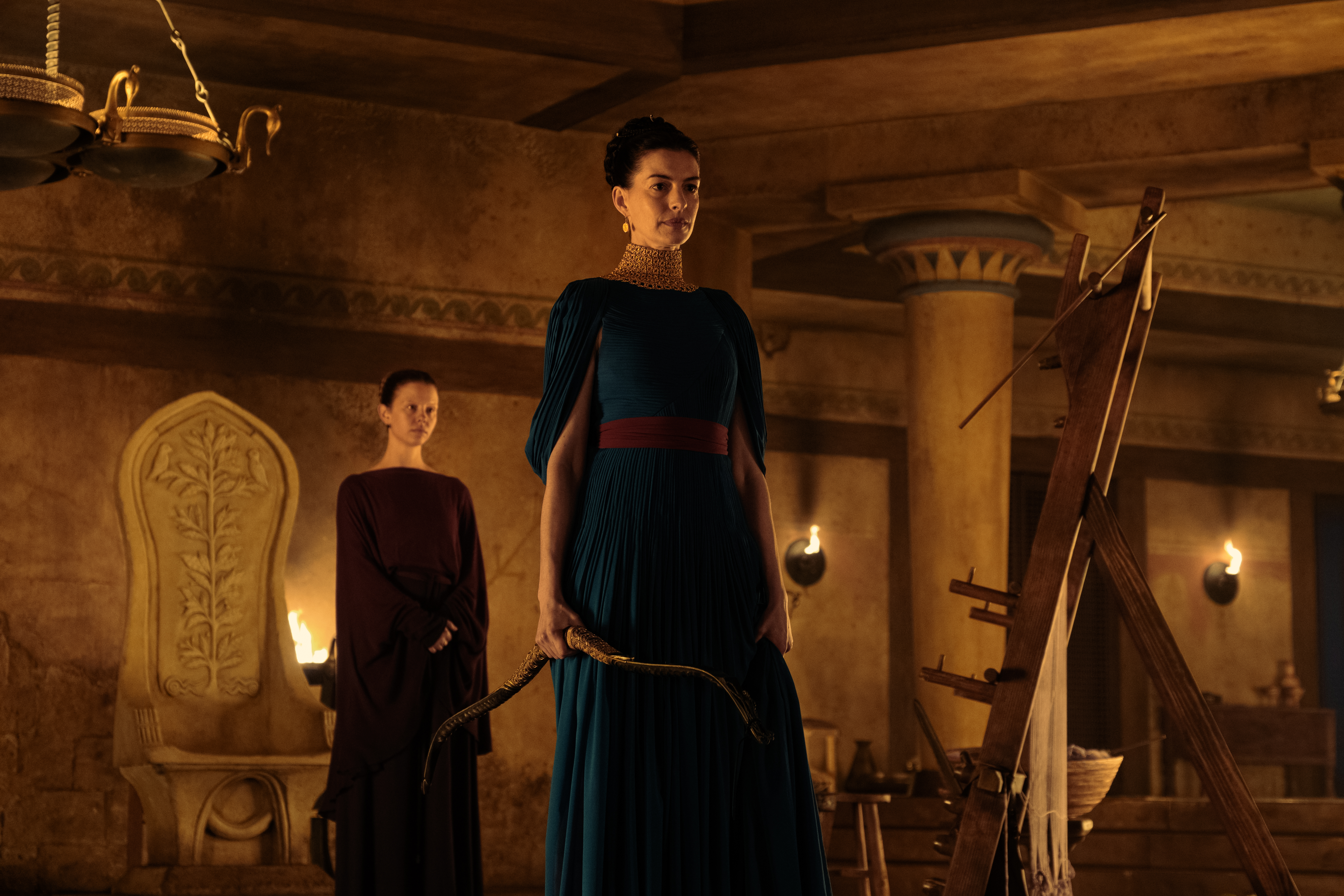
Characters in The Odyssey frequently mention “Zeus’ Law,” which at one point Telemachus (Tom Holland) uses to explain why all guests in their household, even his mother’s bawdy suitors who have taken up residence in Odysseus’ absence, must be treated well in case they are gods disguised as men. Telemachus and Penelope (Anne Hathaway), at other moments, basically define the law as the Golden Rule: “Treat others the way you want to be treated.”
In the Bronze Age, xenia was crucial in a civilization made up of islands. Traveling away from one’s homeland often meant being battered by the seas and landing on foreign soil seeking food, water, and respite. The ancient Greeks lived by a code: If a stranger showed up at your house, you must offer them hospitality—things like wine, food, and no chance of murder or injury while under the host’s roof. The guest, in turn, must treat the host kindly. If everyone followed this rule, which was tied closely to the Greeks’ religious beliefs, it would prevent a lot of unnecessary bloodshed.
In the starkest terms, a person’s goodness in ancient Greek texts is in part defined by their willingness to play host: Telemachus is noble because he takes in strangers and beggars and feeds them; the suitors are not because they kick and mock those they deem beneath them. The Trojan War, according to Greek myth, begins because of a violation of xenia: the Trojan prince Paris, while staying as a guest in the Greek king Menelaus’ house, steals away his host’s wife, Helen. The Greeks’ invasion of Troy is a reaction to that violation. (Though, as Damon’s Odysseus points out in the film, Helen’s abduction is largely used as an excuse for Menelaus’ power-hungry brother, Agamemnon, to raid the rich city of Troy.) And characters throughout the story talk warily about the “Sea People,” pirates who do not obey “Zeus’ Law.” Historians theorize that, among several other factors, these sea peoples plundering the Mediterranean helped usher in a Dark Age where the ability to read and write was lost in Ancient Greece.
How Christopher Nolan weaves xenia into The Odyssey
The Trojan Horse in Nolan's The Odyssey —Courtesy of UniversalXenia is crucial to The Odyssey in general, but particularly to Nolan’s interpretation of the story. In Nolan’s telling, Odysseus believes that he essentially put an end to the practice of xenia by thinking up the trick of the Trojan horse, a treacherous gift that allowed the Greeks to invade Troy after spending 10 years on the beach unable to breach the walls of the great city. When the Greeks finally got inside, they raped and pillaged. They desecrated temples, took priestesses as sex slaves, and committed acts of immeasurable cruelty. Though it’s not shown in The Odyssey, Achilles’ son Neoptolemus tore Hector’s baby son Astyanax from his mother’s arms and threw him from the city walls.
The myth goes that Athena favored the Greeks, and particularly Odysseus, throughout the Trojan War. But she was displeased with their violations in the sack of the city, which led in part to the woes that the Greeks met on the way home (along with the anger of Poseidon and Zeus at other violations like poking out the eye of the cyclops Polyphemus and eating the Sun God’s cattle).
In Nolan’s movie, that cruelty haunts Odysseus, who seems to be suffering from not merely PTSD, but deep guilt over the death and suffering that he has brought down on both civilian Trojans and his own men. He often manifests Athena (in the form of Zendaya) and speaks with her, but later we discover that the woman he sees is not a goddess at all but in fact a priestess in the temple of Athena who was murdered during the sack of Troy. She is the symbol of all the cruelty he witnessed his men committing.
It matters little whether the gods do not exist at all and Odysseus is just externalizing his guilt, or Athena really was angered over the desecration at Troy. The point is that, much like Nolan’s last subject, the godfather of the nuclear bomb Robert J. Oppenheimer, Odysseus cannot stand the fact that he is responsible for unleashing chaos and cruelty. They are both overcome with guilt. In Odysseus’ case, he avoids returning home because of that guilt, afraid of the world he’ll find where xenia no longer exists and filled with shame at having to face his family after committing atrocious acts. And his fears are realized when he returns to find a land where xenia is no longer observed—the suitors abuse strangers and take advantage of their hosts, Penelope and Telemachus. It feels almost as if Odysseus’ violation of the codes of ethics have given these men permission to harm his own family.
Throughout the film, we do get hints that this credo is falling apart. Polyphemus doesn’t respect xenia when he eats his guests, Odysseus’ men. Circe, too, disobeys the code, turning Odysseus’ men into pigs. But she explains that she is only doing so in self-defense, anticipating Odysseus’ crew’s own violation of the rule. By transforming them into swine, she is revealing their true nature—that they would have raped her, stolen from her, hurt her if given the chance. Circe, who is blessed with some powers of insight, turns out to be right. We see in flashbacks many of Odysseus’ men committing heinous and violent acts in Troy. And it is heavily implied that Odysseus’ ally Menelaus purposefully scarred his wife Helen’s face after the Trojan War both as a punishment and so that no man would be tempted to steal her again.
At the end of the film, Odysseus admits that it is his men who are the Sea People—or perhaps all Greek men are. Law and order is falling apart, and he believes it’s all his fault. In fact, the mythical character of Odysseus does not deserve the blame. Most historians believe that Troy did exist, and the city was destroyed by warfare and fire. In all likelihood, the legends of those battles, passed down through song, grew into myth, hence how the character of Odysseus was probably born. And a dark age really did follow that war in which the ability to read and write was lost. Popular archeologist Eric H. Cline has theorized that many factors contributed to the period of roughly 50 years (c. 1200–1150 BCE) in which almost every major civilization in the region collapsed in rapid succession. Those reasons include the so-called Sea People—migrating groups who attacked Egypt and other coastal civilizations—as well as drought; climate change; a disruption of trade networks; earthquakes; and internal rebellions.
Nolan’s new ending for The Odyssey
The sacking of Troy —Courtesy of UniversalNolan changes the ending of The Odyssey from the text. According to Homer, after Odysseus arrived home and avenged himself by killing the suitors, he left again to do the gods’ bidding and honor his fallen men. But he did so alone. (And, because the Greeks had some truly bizarre preoccupations with the relationships between children and their parents, the myth gets even weirder. In other stories, Odysseus is accidentally killed by Telegonus, the son he unknowingly fathered with Circe. Telegonus goes on to marry Penelope. And Odysseus’ son with Penelope, Telemachus, marries Circe. Wild stuff!)
The film version sees Odysseus exiled for his murder of the suitors, but he leaves with Penelope, as they once dreamed of doing when Odysseus was initially called to serve in the Trojan War. On the boat, they speak of the impending end of the Bronze Age and how their exploits will be sung about because the ability to write will be lost during the dark age. It’s a fascinating historical lens through which to reframe the myth—and also a much more romantic ending. We love a couple sailing off into the sunset. At the very least, it makes for a much more satisfying conclusion than the mom-swapping marriage of ancient lore.
Hence then, the article about to understand the ending of the odyssey you must first understand zeus law was published today ( ) and is available on Time ( Middle East ) The editorial team at PressBee has edited and verified it, and it may have been modified, fully republished, or quoted. You can read and follow the updates of this news or article from its original source.
Read More Details
Finally We wish PressBee provided you with enough information of ( To Understand the Ending of The Odyssey, You Must First Understand ‘Zeus’ Law’ )


Also on site :
- Walmart’s Farmhouse Baker’s Rack Makes a ‘Cute Coffee Station’ and Offers Extra Storage for Small Kitchens
- This Popular Children’s Show Ended 24 Years Ago, and a Child Psychologist Says It’s Still One of the Best Ways To Teach Kids About Feelings
- Outdoor gear retailer Patagonia sues Trump for shrinking beloved Utah national monument managed by tribes