
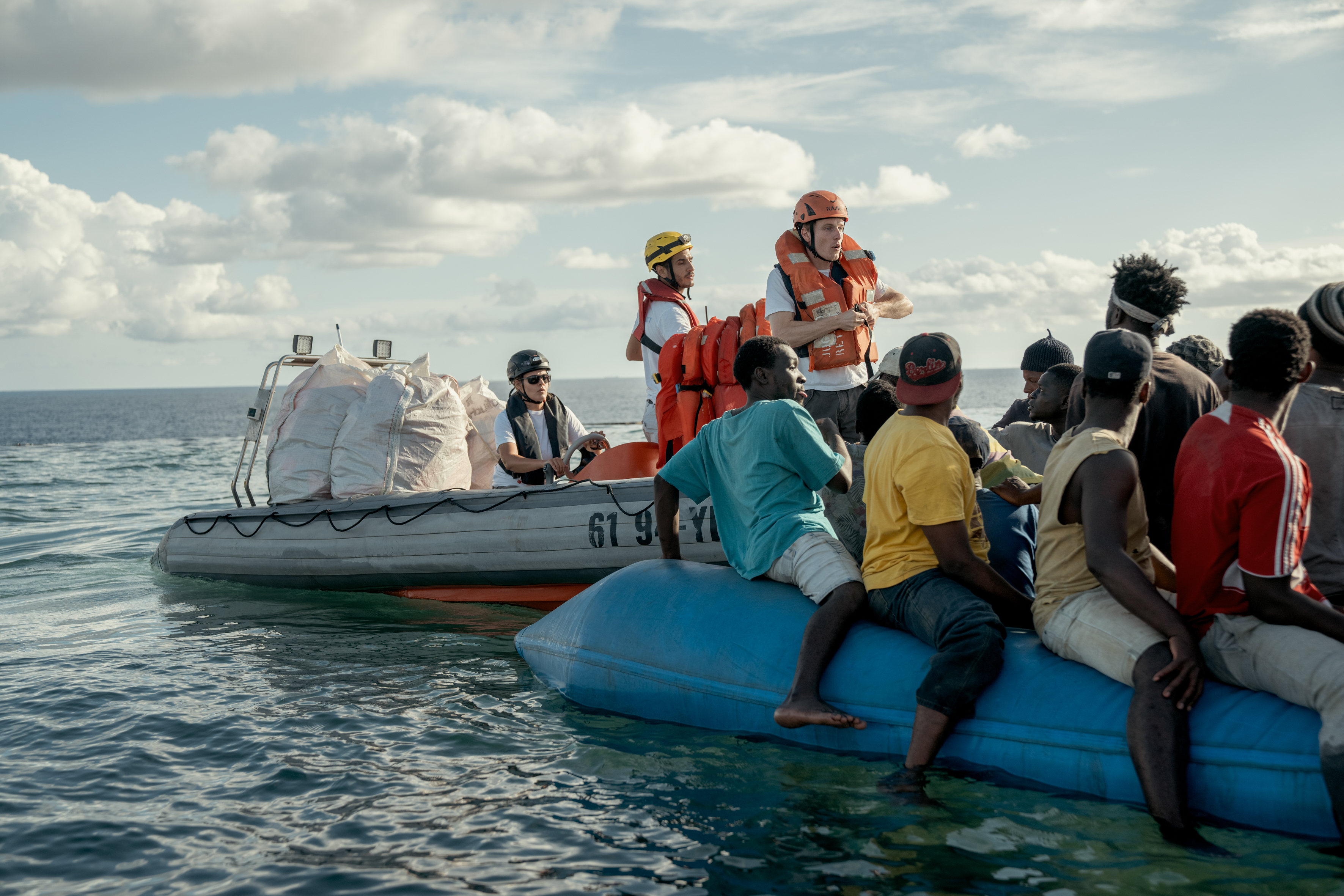
Netflix's 23,000 Lives introduces audiences to a group of young activists who refuse to watch Europe's migration crisis from a distance. While the film dramatizes their journey, the events behind it unfolded over nearly a decade and became one of the most significant legal battles involving civilian search-and-rescue operations in the Mediterranean.
Directed by Markus Goller, the film is inspired by the story of Jugend Rettet ("Youth Rescues"), a German non-governmental organization founded in 2015 by volunteers with no previous maritime rescue experience. Disturbed by the growing number of deaths along one of the world's deadliest migration routes, they launched a crowdfunding campaign to purchase a rescue vessel and begin operations in the Central Mediterranean.
—Courtesy of Netflix
The ship at the heart of the story, Iuventa, had a long working life before becoming a humanitarian vessel. Built in 1962 as a 32-meter steel ship, it had served as a fishing boat before later operating as an offshore supply vessel under the name Alk Explorer. In 2016, Jugend Rettet purchased the vessel for approximately €130,000, renamed it Iuventa, and refitted it for search-and-rescue missions.
Unlike larger humanitarian ships, the Iuventa functioned primarily as a first responder. Operating as close as possible to the Libyan search-and-rescue zone, its crew deployed fast rigid inflatable boats (RHIBs) to reach overcrowded inflatable dinghies before larger rescue vessels could arrive.
Their work often focused on stabilizing dangerous situations rather than immediately transporting everyone aboard. Crew members distributed life jackets, administered emergency first aid, evacuated the most vulnerable passengers, and coordinated with larger ships responsible for completing rescues.
More than 23,000 people rescued
Medial care aboard the Iuventa —Courtesy of NetflixBetween 2016 and 2017, the Iuventa completed 16 rescue missions. During those operations, the crew assisted 175 boats and participated in the rescue of more than 23,000 people, the figure that ultimately inspired the movie’s title.
More than 9,000 migrants were taken directly aboard the Iuventa, many requiring urgent medical attention after surviving both the Mediterranean crossing and the violence and abuses that prompted many to take their chances on the sea.
Volunteers regularly treated dehydration, hypothermia, fuel burns caused by leaking gasoline mixed with seawater, circulatory collapse, near-drowning incidents, aspiration injuries, and pregnancy-related emergencies.
For a relatively small vessel, the Iuventa became one of the most active civilian rescue ships operating in the Central Mediterranean.
The organization's activities unfolded during an increasingly contentious political debate over migration in Europe. Jugend Rettet openly acknowledged that its work conflicted with policies designed to discourage irregular crossings.
On its official website, the organization states: “We never hid what we were doing. Our aim was simple: to make the crossing less deadly. If that made a smuggler’s job marginally easier, and the border guard’s job of violent exclusion marginally harder, then so be it.”
According to Jugend Rettet, accusations that NGOs were collaborating with smugglers became part of a broader campaign to restrict migration routes into Europe, involving state institutions, sections of the media, private security contractors, and anti-immigration political groups.
The investigation begins
—Courtesy of NetflixThe controversy intensified in late 2016. Former police officers working as private security contractors aboard another rescue ship operated by Save the Children contacted Italian intelligence authorities, alleging that Iuventa volunteers maintained contacts with smugglers.
Months later, in May 2017, during one of the Mediterranean's largest rescue operations, Italian maritime authorities ordered the Iuventa to leave the rescue zone. On August 2, 2017, Italian authorities lured the vessel into docking in Lampedusa before transferring it to the Sicilian port of Trapani, where it was seized.
Prosecutors alleged that crew members had collaborated with smugglers during three rescue operations conducted between 2016 and 2017. The central accusation claimed volunteers had arranged meetings with traffickers, accepted the "delivery" of migrants, and returned empty boats so they could be reused.
Ten crew members became the focus of a criminal investigation that would stretch on for years.
In January 2021, Italian prosecutors charged 21 individuals and three organizations, including Jugend Rettet, with aggravated facilitation of illegal immigration. Supported by a dossier of more than 30,000 pages, the case alleged that the Iuventa crew had coordinated with smugglers during three rescue operations between 2016 and 2017 by arranging transfers of migrants and returning empty boats for the next group of migrants. More than 40 hearing days followed over the next three years.
As the proceedings advanced, the prosecution's evidence steadily became less compelling in the face of witness testimony. Key witnesses who had monitored NGO rescue ships contradicted both their earlier statements and one another when they finally testified in court.
Another pillar of the case was an undercover investigator known as "Luca Bracco," who secretly documented rescue missions while posing as a firefighter aboard Save the Children's Vos Hestia. Rather than confirming the allegations, the court later found that his reports misrepresented photographs and portrayed routine rescue procedures as suspicious, describing parts of his work as "reality-distorting."
On April 19, 2024, the Court of Trapani dismissed the case, ruling there were no grounds to proceed. In its written decision, the judge found that the investigation relied on incomplete evidence, interpreted facts from a one-sided perspective, and treated uncertain information as established proof.
The ruling concluded that the alleged offenses did not exist, that the evidence could not support the prosecution's claims, and that there was no realistic prospect of strengthening the case through further proceedings. After nearly seven years of investigations and hearings, the Iuventa crew was cleared of all criminal allegations.
The ship is forced to retire
—Courtesy of NetflixAlthough the criminal case ended, the Iuventa itself never resumed rescue operations. For almost seven years, the vessel remained moored in Trapani under government custody with little opportunity for maintenance.
As time passed, the ship deteriorated significantly. A burglary damaged parts of the bridge, equipment disappeared, corrosion spread throughout the hull, valves seized from marine growth, the propeller became inoperable, and much of the interior fell into severe disrepair.
By the time inspectors examined the vessel after its release, experts concluded that restoring it would cost more than its estimated market value. Today, the Iuventa remains unable to return safely to sea.
Jugend Rettet is currently pursuing legal action against Italy's Ministry of Infrastructure and Transport, seeking compensation for the damage sustained while the ship remained under state custody.
Hence then, the article about the true story of the daring migrant rescue operation behind netflix s 23 000 lives was published today ( ) and is available on Time ( Middle East ) The editorial team at PressBee has edited and verified it, and it may have been modified, fully republished, or quoted. You can read and follow the updates of this news or article from its original source.
Read More Details
Finally We wish PressBee provided you with enough information of ( The True Story of the Daring Migrant Rescue Operation Behind Netflix's 23,000 Lives )


Also on site :
- Walmart’s Farmhouse Baker’s Rack Makes a ‘Cute Coffee Station’ and Offers Extra Storage for Small Kitchens
- This Popular Children’s Show Ended 24 Years Ago, and a Child Psychologist Says It’s Still One of the Best Ways To Teach Kids About Feelings
- Outdoor gear retailer Patagonia sues Trump for shrinking beloved Utah national monument managed by tribes