
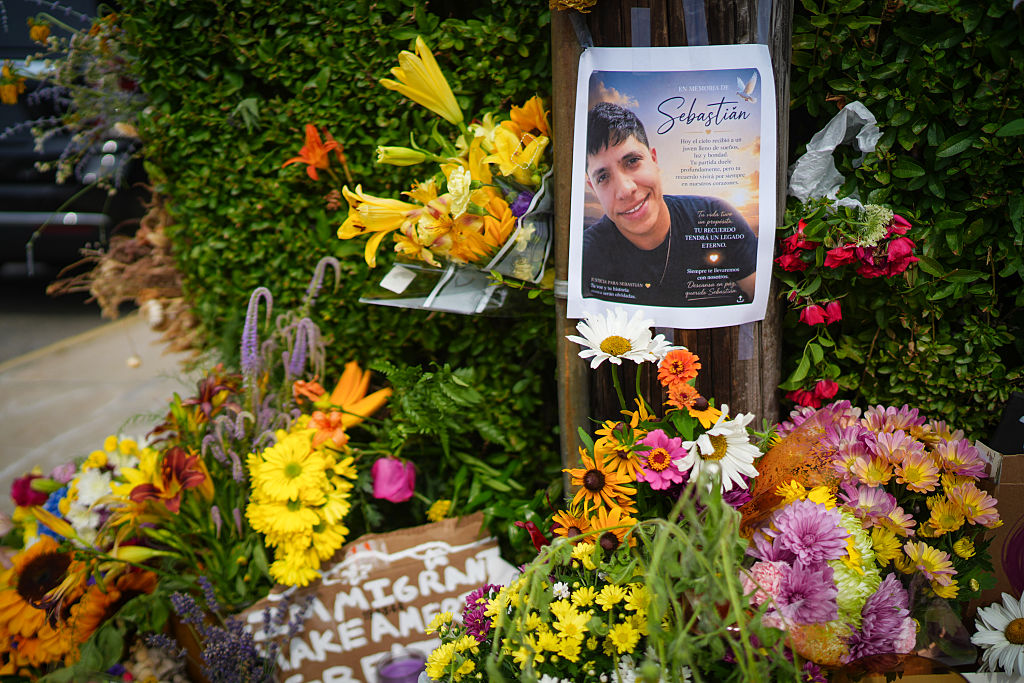
Joan Sebastian Guerrero, the 26-year-old man shot by ICE while driving to work on Monday, attended the same school my mother did in Bucaramanga, Colombia: Nuestra Señora del Pilar.
My mother remembers Nuestra Señora del Pilar as a place of hushed corridors and wind-swept balconies, where nuns ushered her from class to class. Students went to church every morning.
In Maine, Guerrero worked cleaning at a veterinary clinic, and then he delivered food. He loved his three-year-old. A joint statement by the Maine Immigrants’ Rights Coalition and Presente! Maine said he had legal status, a work permit, a Social Security number.
A witness tells the Portland Press Herald that Guerrero’s last words were, "I tried to stop."
In one photo from his social media, Guerrero poses before a mirror. Through his clear phone case, you can see two photos of his pregnant wife, displaying her belly, hugging him over his shoulder.
One video published by The Bangor Daily News shows agents pulling his unmoving body out of the driver’s seat—then handcuffing him. It is unclear if he is alive. I wondered how much fear must have been in the minds of those ICE agents that they felt the need to still restrain him.
Just six days earlier, Lorenzo Salgado Araujo was killed by ICE agents in Houston, this time shot through the passenger window. The ICE agents were in an unmarked vehicle, and though they said they were in pursuit and their emergency lights were on, a video shows they were not. Salgado was dead within minutes.
As a Latina, it is impossible for me not to see my father when I think of Guerrero and Araujo. In them, I see men who wanted nothing but a better life for their children. Families like mine can’t help but feel their families’ pain, and fear for each other and our own.
In June 2025, my dad got his green card. It was something we had long worked toward in the years before COVID. Filing for his documents, paying the fees, getting certificates and letters stamped and translated. He was happy, relieved. He sent me photos of the permission in his passport. He scanned it, printed it, and even worked it into passing conversations with people at the grocery store in Mexico City, at the shoe store. He couldn’t stop sharing. “I’m going to the United States!”
I wished my dad would tone it down. While he had received his documents, my mother’s had been rejected. The application fees changed, and my sister, who was filing for my mother, had paid the previous amount. She was told the money would not be returned to us and would need to start the whole process for my mother again. While my father happily bought a plane ticket in June 2025, headed to Minnesota to start his life alongside my sister and his grandchildren, my mother remained in Mexico, alone.
My dad lost 20 pounds while living in Minnesota. He watched, as we all did, as ICE stormed cities across the country: Los Angeles, Portland, Minneapolis.
My father feared going outside, understanding that how he looked—brown and indigenous— put him at risk. My father, documented, afraid, still went every day to pick up his granddaughters at their school bus stop.
He has nothing to fear, I kept telling myself. Then, Does he have nothing to fear? The truth was I feared for him too.
Throughout 2025, as my mother lived alone for the first time in her life, I called her every day during lunchtime. My mother hates cooking, as do I and we entertained ourselves by complaining about the slimy texture of onions over speakerphone. Our conversations turned, always, to my father.
“Your father makes himself a knot worrying,” she said one day. “He’s afraid they’ll pick him up and decide to take away his green card,” she said. “So what! They put him in a plane, then it’s over.”
Sometimes, I tiptoe around my mother’s feelings. In this case, I needed her to understand. I told her the fear was being taken, regardless of paperwork, and being held in an ICE detention facility. During the second Trump Administration, these facilities had become more dangerous than ever.
Tens of thousands of people have been held in ICE detention, 70% of whom have no criminal convictions. Still, the Department of Homeland Security (DHS) drums up fear of immigrants.
“Over the weekend, U.S. Immigration and Customs Enforcement (ICE) law enforcement arrested more worst of the worst criminals across the country, including those convicted for murder, sexual assault of children, aggravated assault, drug trafficking, and other despicable crimes,” DHS declared this week.
Where will l these pounding drums lead to?
Last December, on his way back to Mexico City to see my mother and take her to medical appointments, my father was afraid ICE would be at the airport, that they might apprehend him and hold him indefinitely. He asked me to send him the citation for when I was a finalist for the Pulitzer Prize. I sent him a PDF with all my awards. He printed them and he put them in a folder that not only included all his legal documentation, but other documents that made a case for his humanity. This broke my heart. I waited all day by my phone for him to say that he was safe. Sat on pins and needles. I flitted between thinking our fear unlikely and reasonable. The drumming up of fear made me afraid.
My family of four lived in Colombia amidst the uncertainty and fear in the 90s. My father was kidnapped by FARC, the violent Fuerzas Armadas Revolucionarias de Colombia. He was let go in the end. We continued to receive threatening calls to our home. In 1998, we left Bogotá. Since that time, we have dreamt of finding a place to live together in peace. We hoped it would be in the United States.
Now, I often think about the irony of us escaping Colombia only to be seized by the fear of detention in America.
In April, my dad returned to the U.S. He was nervous at the airport once again, not knowing what would happen to him. Increasingly in my family, we ask the question of where we will live. It seems altogether out of the question that we will all live together in the United States.
When I call my mother, like all mothers of her age must do, she lists all the things going wrong with her body. She says, "Nobody calls to ask me how I am." Even though that is what I am doing. "Nobody calls me," says my father, when I call him. What is clear to me is that they miss each other. The fullness of what they are to each other when they are together none of us can be for each of them.
Here I am 41-years-old, parenting my parents through their feelings, but also through the inhumanity of a broken immigration system.
The deaths of Salgado and Guerrero are a collective grief. To grieve is to take stock of what we have lost, can lose, and to spend time deconstructing the harmful narratives that cause our grief. What happens to a country where going to work is enough to get killed?
I fear that, tragically, maybe my family’s story, which started with fear, must continue with fear.
What of all the other stories of migrant families?
Hence then, the article about i see my father in the fathers killed by ice was published today ( ) and is available on Time ( Middle East ) The editorial team at PressBee has edited and verified it, and it may have been modified, fully republished, or quoted. You can read and follow the updates of this news or article from its original source.
Read More Details
Finally We wish PressBee provided you with enough information of ( I See My Father in the Fathers Killed by ICE )


Also on site :
- Nigeria confirms US troop withdrawal
- Stay Prepared for Tropical Storms and Wildfires With This 120-Serving Food Supply That Lasts 25 Years
- "A game for everyone is a game for no one": Don't expect an easy ride in Carcass Clad, the co-op tank horror game from the makers of Mouthwashing