
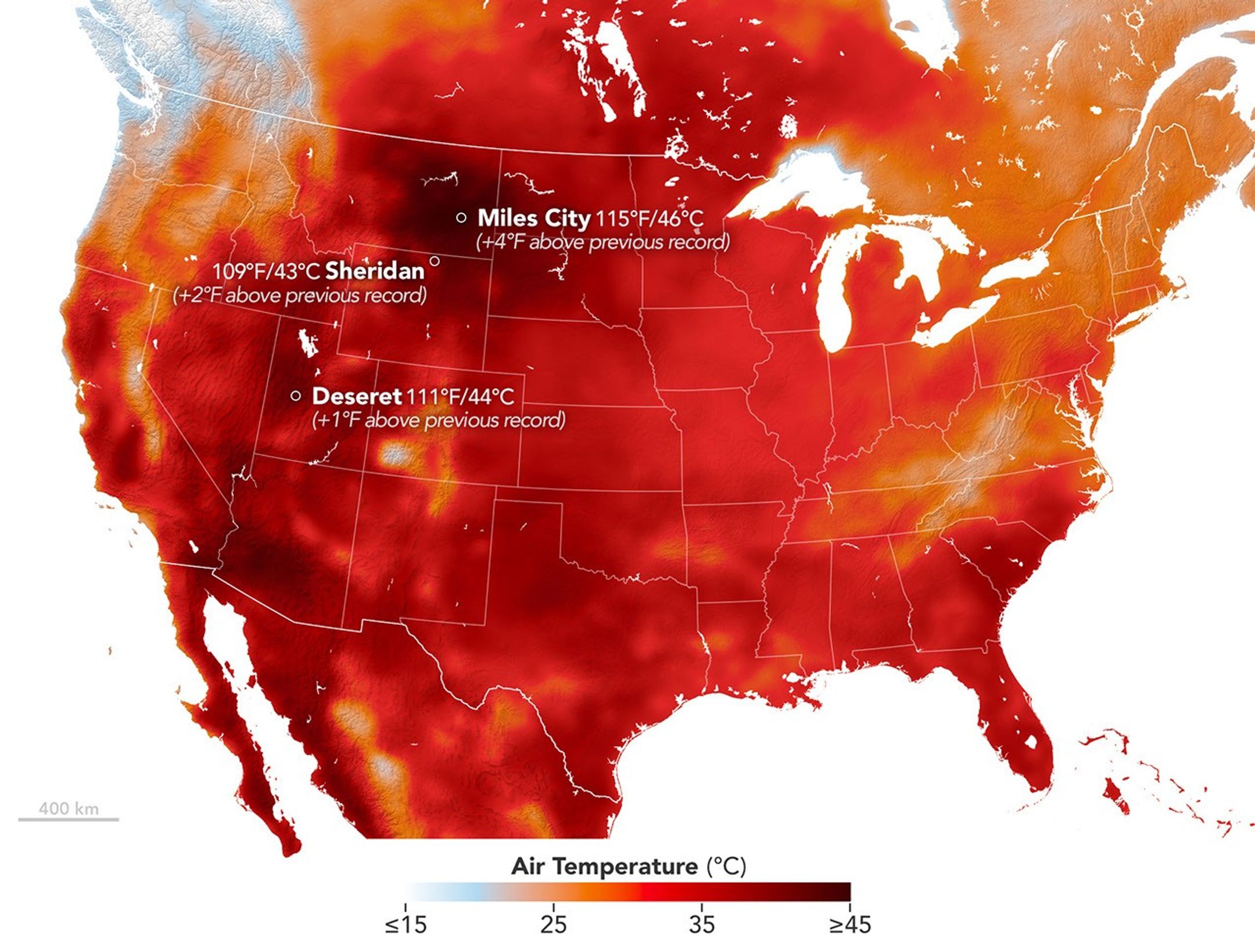
It’s still relatively early in the summer season in the Northern Hemisphere, but several parts of North America were sweltering in mid-July.
The latest purveyor of heat was a strong ridge of high pressure that lingered in the upper atmosphere over the northern Rockies on the weekend of July 11-12, 2026. This pushed hot air toward the surface and trapped it there—a weather phenomenon meteorologists call a heat dome.
Heat domes put the brakes on convection and suppress clouds and precipitation. This allows sunlight to reach Earth’s surface relatively unhindered and further elevate air temperatures. As a result of the July heat dome, sites in Montana, Wyoming, and Utah broke all-time temperature records.
The map above shows air temperatures across the United States on July 12, 2026, at 2 p.m. Mountain Time, modeled at 2 meters (6.5 feet) above the ground. It was produced by combining satellite observations with temperatures predicted by a version of the GEOS (Goddard Earth Observing System) model, which uses mathematical equations to represent physical processes in the atmosphere. The darkest reds indicate areas where temperatures approached or exceeded 45 degrees Celsius (113 degrees Fahrenheit).
A preliminary analysis from the National Weather Service office in Billings found that temperature sensors at airports in Billings and Miles City, Montana (111°F and 115°F, respectively), and Sheridan, Wyoming (109°F), all recorded new all-time record highs on July 12. Each of these stations topped its previous record by at least 2°F, with Miles City breaking its record by a full 4°F. The Montana records date to the 1930s; the Sheridan record begins in 1907.
Multiple locations in Utah broke all-time records as well, according to the National Weather Service office in Salt Lake City, including Deseret (111°F), Salt Lake City (109°F, or 4°F above the previous record), and Randolph (100°F, or 6°F above the previous record). These stations in Utah have records that date back to the 1890s.
Extreme heat doesn’t just make people uncomfortable. It can have serious health consequences, particularly for older people. Extreme heat worsens common age-related health conditions such as heart, lung, and kidney disease. Health tracking data from the U.S. Centers for Disease Control and Prevention shows that the rate of heat-related emergency department visits in the Mountain states spiked tenfold during the July heat.
Heat waves like this one have become more frequent in the United States in recent decades, according to researchers at NASA’s Goddard Space Flight Center. Using a NASA modeling system called MERRA-2 (Modern-Era Retrospective analysis for Research and Applications-2), one NASA team found that summer heat waves in the U.S. roughly doubled in number between 1980 and 2023, increasing from an average of two to four per month.
Forecasters expect the heat dome to spread east into the Midwest, New England, and the Mid-Atlantic in the coming days, where triple-digit temperatures are likely in some areas. The United States isn’t alone in facing significant heat. Parts of both Western Europe, Central Asia, and East Asia are also facing heat waves.
NASA Earth Observatory image by Michala Garrison, using GEOS-FP data from the Global Modeling and Assimilation Office at NASA GSFC. Story by Adam Voiland.
Downloads
July 12, 2026
JPEG (1.98 MB)
References & Resources
AccuWeather (2026, July 13) ‘Steam-cooker’ pattern grips the Central, East as heat and humidity peak. Accessed July 14, 2026. NASA (2025, May 8) Rising Heat Waves in North America in the Past 40 Years. Accessed July 14, 2026. NASA Earth Observatory (2010, June 9) GEOS-5: A High Resolution Global Atmospheric Model. Accessed July 14, 2026. National Weather Service (2026, July 14) Short Range Forecast. Accessed July 14, 2026. NOAA (2026, July 12) Record Heat Southern Montana July 12, 2026. Accessed July 14, 2026. Royal Meteorological Society (2021, August 11) What is a heat dome? Accessed July 14, 2026. U.S. Centers for Disease Control and Prevention (2026) Daily Heat-Related Illness. Accessed July 14, 2026. U.S. National Weather Service, via Facebook (2026, July 13) Yesterday was quite historic in terms of heat. Accessed July 14, 2026. The Washington Post (2026, July 14) One of the planet’s strongest heat domes will soon scorch the East Coast. Accessed July 14, 2026.You may also be interested in:
Stay up-to-date with the latest content from NASA as we explore the universe and discover more about our home planet.
A Hot Start to Spring in the Southwest
3 min read
Temperatures in several states climbed over 100 degrees Fahrenheit in March 2026, which in some places was the highest March…
ArticleEl Niño Is Underway
4 min read
Satellite observations of sea surface height indicated that the 2026 event continued to strengthen in early June.
ArticleGravity Waves From Super Typhoon Sinlaku
4 min read
Satellites observed striking upper-atmosphere phenomena generated by an intensifying tropical cyclone.
Article 1 2 3 4 Next Keep ExploringDiscover More from NASA Earth Science
Subscribe to Earth Observatory Newsletters
Subscribe to the Earth Observatory and get the Earth in your inbox.
Earth Observatory Image of the Day
NASA’s Earth Observatory brings you the Earth, every day, with in-depth stories and stunning imagery.
Explore Earth Science
Earth Science Data
Open access to NASA’s archive of Earth science data
Hence then, the article about heat dome broils the western u s was published today ( ) and is available on NASA ( Middle East ) The editorial team at PressBee has edited and verified it, and it may have been modified, fully republished, or quoted. You can read and follow the updates of this news or article from its original source.
Read More Details
Finally We wish PressBee provided you with enough information of ( Heat Dome Broils the Western U.S. )


Also on site :
- 1978 Yacht Rock Single, a Favorite of John Lennon and Frank Sinatra, Is Still a Major Hit 48 Years Later
- ‘Dazed and Confused’ Star, 53, Who Played a High School Heartthrob, Still Looks ‘Beautiful’ 33 Years Later
- 1973 Led Zeppelin Song, Recorded in Mick Jagger’s Driveway, Made an Unexpected Comeback 19 Years Later