
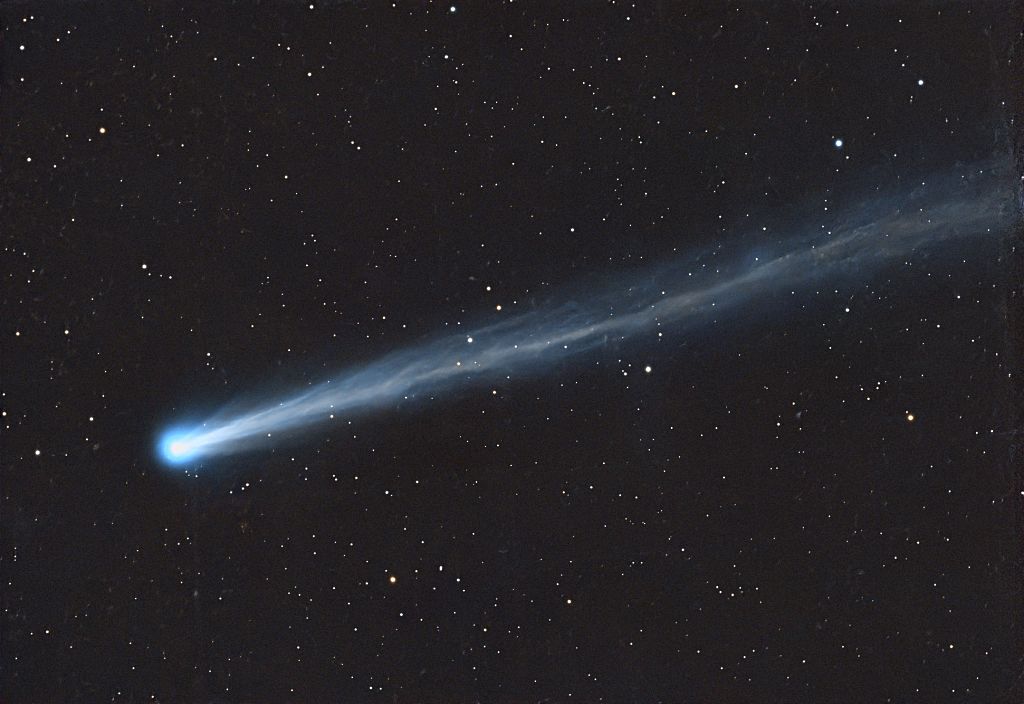
If you’ve ever wanted to see a comet, you could soon have a good opportunity.
This week, Comet 10P/Tempel 2 is set to return to the inner solar system, making it visible from Earth for the first time in years.
Here’s everything you need to know about how to spot it.
A comet is a celestial body that orbits the Sun and is made up of frozen gases, rock, and dust, sometimes being likened to a “dirty snowball.”
“When frozen, they are the size of a small town,” according to NASA’s website. “When a comet’s orbit brings it close to the Sun, it heats up and spews dust and gases into a giant glowing head larger than most planets. The dust and gases form a tail that stretches away from the Sun for millions of miles.”
Comet 10P/Tempel 2, also known as “Tempel 2,” is a large comet with an estimated diameter of 10.6 kilometers, slightly smaller than the well-known Halley’s Comet. Tempel 2 completes its orbit around the Sun roughly every 5.5 years, meaning that we typically have the chance to see it at the same interval when that regular orbit brings it back into the part of the solar system where Earth is located.
When can you see it?
According to NASA, one of the best times to see Tempel 2 will be around the New Moon on July 14, when moonlight likely won’t interfere with the view as much as it might on other nights.
Astronomers predict that the comet will reach its peak brightness as it passes even closer to Earth in early August, though, so if you miss your shot at seeing it this week, don’t worry—there will be other nights to catch a glimpse of it before its orbit carries it away again, though it may be harder to spot if you live in the Northern Hemisphere.
Some experts have said that they expect that Tempel 2 will be “putting on its best showing since 1967,” so you’ll want to try getting a peak at this celestial phenomenon while you still can. Otherwise, you’ll have to wait another 5.5 years before you can get another shot at it!
How can you watch it?
Unlike some other passing celestial objects, Tempel 2 is not one that you can see with your naked eye alone; for this comet, you’ll need binoculars or a telescope, according to NASA.
Your best chance to see it is to get out of the city and find a location that has a dark, clear view of the night sky and is far away from light pollution. Wait until the sky is completely dark before looking for the comet; NASA recommends about 45-60 minutes after sunset.
“Through binoculars or a telescope, find the constellation Capricornus and look for a small fuzzy glow nearby, possibly with a brighter central knot and a short, broad, fan-shaped tail,” NASA advises on its website.
Hence then, the article about how you could see a comet this week was published today ( ) and is available on Time ( Middle East ) The editorial team at PressBee has edited and verified it, and it may have been modified, fully republished, or quoted. You can read and follow the updates of this news or article from its original source.
Read More Details
Finally We wish PressBee provided you with enough information of ( How You Could See a Comet This Week )


Also on site :
- Meet the CEO whose century-old company never laid off employees through the Great Depression, the recession, or Covid
- Medtronic Announces Strategic Partnership with Cornerstone Robotics to Further Expand Global Access to Robotic-Assisted Surgery
- Labor Day, Patriot Day, Rosh Hashanah and More—Check Out All These September Holidays and Observances in 2026