
For Jeffrey Wright, everything comes back to Jean-Michel Basquiat. When he was cast by Julian Schnabel to play the celebrated abstract neo-expressionist artist, who’d died a few years prior at the age of 27 in 1988 of a heroin overdose, Wright was relatively new to film. He was making the sometimes perilous jump from being a Tony-winning actor in Angels in America to tackling a different medium (he previously appeared in a bit part in Alan J. Pakula’s “Presumed Innocent” and opposite Sidney Poitier in the television movie “Separate But Equal”). The undeterred, magnetic, head-strong artist who moved through the world with a slink in his walk, was an early challenge in an illustrious career with many triumphs.But it was “Basquiat” that established Wright as a viable film actor. Not unlike his work in the theater, he was around an immensely talented cast that included Benicio Del Toro, David Bowie, Dennis Hopper, Gary Oldman, Michael Wincott, Claire Forlani, Parker Posey, Christopher Walken, Willem Dafoe, and Courtney Love. And while that large ensemble was an aid to Wright, it subtract from the responsibility of being not only the lead actor but also the lead as the star who’s playing a star. Such a task requires dynamism and prowess, a combination of skills that conjures imagination out of reality. Wright’s turn as Basquiat reaches that tall task seemingly with aplomb, offering an off-kilter alchemy of frenetic self-belief.
Upon release, “Basquiat” and Wright’s performance garnered widespread praise. “[Wright] gives a performance of almost mystical opacity,” wrote Roger Ebert. The film has since been added to the Criterion Collection. Wright will also return to Basquiat’s story, playing the artist’s father in Julius Onah’s “Samo Lives,” with Kelvin Harrison Jr playing the role once occupied by the actor.
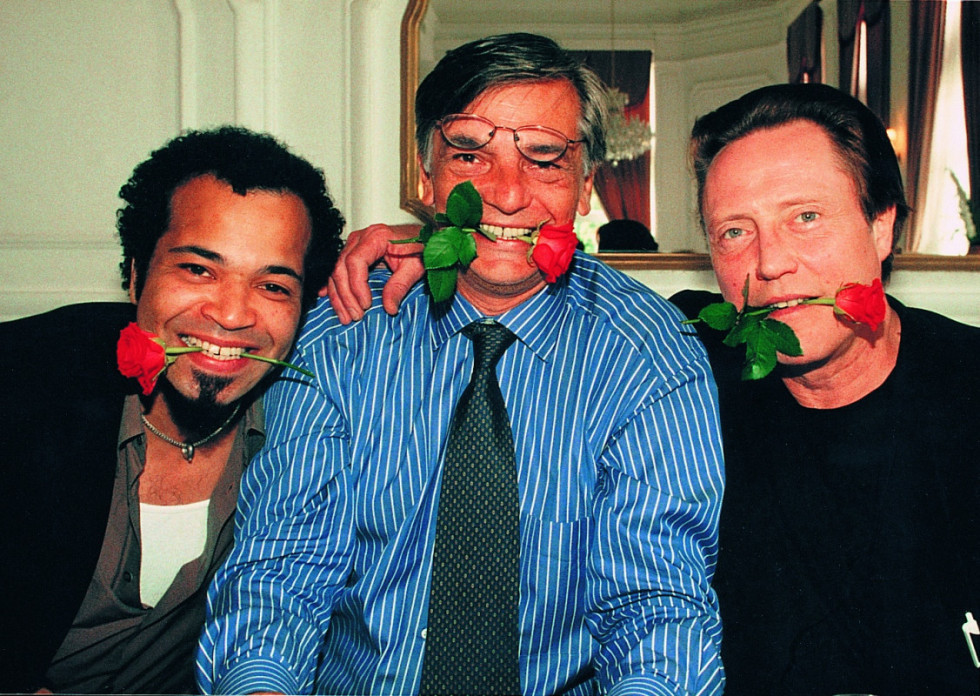
Wright’s return to Karlovy Vary International Film Festival, where he sat down to speak with RogerEbert.com represents a kind of homecoming. The film played the festival back in 1997 with Wright and Walken in attendance (in fact, a picture of the pair of them with the late festival president Jiří Bartoška, biting down on roses, is one of the fest’s most iconic images). He returned to KVIFF after nearly three decades to accept the festival’s President’s Award.
During our conversation, Wright and I spoke about capturing Basquiat the person, acting opposite Courtney Love, and the legacy of this endearing artist. This interview has been edited for length and clarity.
For the role of Basquiat you took five months to learn how to paint. Do you still paint and if not, do you think learning how to paint still feeds into your faculties as an actor?
I don’t paint, but I think about painting a lot. I think about wanting to paint, and I think about wanting to create a space where I can and will do it. But I’ve been kind of busy and I’ve got kids. [Laughs] They’re older now, but I could see myself creating a space for that.
But I tell you, the thing that I still do maintain from that time, and that was enhanced by my experience working on that film, is a sense of composition. I think one of the things that I exercised during the course of working on that project were my visual muscles. Schnabel has a brilliant eye. Obviously, Jean-Michel had just a stunning sense of color and composition. My eye matured. And I have to say that Julian lent me additional light on certain kinds of compositional ideas when we were working on with “Basquiat.” So, although I don’t paint so much, I still do feel the influence of that experience. And I do look forward to painting again someday.
Did that compositional training alter what directors you wanted to work with?
I don’t think so. I think maybe it enhanced my appreciation for the work of certain directors. I think I take better photos. [Laughs] But also there may be an opportunity to kind of express that myself by getting behind the lens as opposed to in front of it in the future. At the moment, it’s just trying to find time and also prioritizing that as a thing and finding the right story to tell. And I think I may have one. If we can put it together, maybe it’ll happen next year.
I hope it happens! In prior interviews, you’ve talked about how up until the first day of shooting you were struggling to find a way to play Basquiat. But then you took a walk, saw some plush ducks for sale, and that moment became a touchstone for your approach. What happened?
Well, it was really the walk, it was the journey that as important. I think he really was, if anyone is, shamanistic.
I mean his art is so encrypted and it resonates with things that seem like they are not there on the canvas, things that are greater than the sum of their parts. There’s a kind of mysticism within his work that hearkens back to Caribbean ideas and African ideas. But there’s also this stuff that resonates out of it, and that’s not by accident.
And so when I was trying to find him, it just felt like I was opening myself up to as many sources as possible. There were many signs along the way. In some ways, in fact, you might say his work is a series of signs that are trying to cast your eye toward things that he feels should be seen or not seen. So, I was just trying to read the signs and find him. That last day I walked from, I don’t know, I walked about 70 blocks. Part of it was thinking where is he physically or how am I going to represent him physically.
Also, the work is done when it’s done. We had another day before we started filming. There were different aspects of the canvas that I needed to work on before we did that. It happened like that with Angels in America too. When I was doing that on Broadway the first time, it took me forever. Or I guess it took me as many days as I needed or as many days as I was allowed rather [Laughs] to find that character. And when time’s up, here he is. That’s just sometimes how I work. I tend to work best under pressure.
This is such a stacked ensemble, and I know you get asked about everyone in this cast, but I’m always struck by the worlds colliding of you and Courtney Love, who appears in two scenes in the film as Basquiat’s fling Big Pink. What was making that first scene, when you two meet on the street, like?
Courtney showed up fully, Courtney.
We’d never met before. I was obviously kind of new on the scene. She either didn’t quite get who I was or what I was doing. And then we rehearsed, and I won’t go into detail, but there was one moment where the light bulb went off for her—and then we were off to the races. We just did it and she understood the assignment and so did I.
It’s funny though, when we were shooting that scene, I forget exactly what street that was, but we’re setting up the shot, and I remember this very vividly, it was maybe the first week of filming that scene where we first meet. We’re setting up shot and we hear: Mr. Director, you’re blocking the traffic! We looked out, and it was Willem Dafoe calling to Julian out of a car as he happened to be passing by. Of course, Willem was in the movie, but you know there was so much of that kind of New York as a character. We were filming not too long after Jean-Michel had passed. There were still remnants of his world around. At that time, in 1995, when we filmed, it was all kind of there. The city as a living thing kind of accommodated us too. Everybody who came to be part of that film came because they loved that world, and they also loved Jean-Michel’s work, even if they did not know him. They wanted to be part of that, to touch that. So, Courtney, like everyone, came because this was the hip place to be, this is where they wanted to be, and that represents what he was.
He had that type of magnetism, and I think his work has that type of magnetism, which is why his iconography exists globally. Everywhere you go in the world, you’ll see references to his work. You’ll see that same old crown everywhere you go. You’ll see influences on young artists all around the world. He’s just that guy; he’s one of those humans who had that resonance. He wasn’t an ordinary dude.
I think the fascinating part about “Basquiat” is that, as you were saying, you were making it in his New York, relatively close to his time. To everyone who made the film, he was a living memory. But you just finished shooting “Samo Lives” last fall, and the cast is notably young—very few of them were even alive when Basquiat died. He’s essentially a “historical” figure to them. What was that generational difference like?
Well, I think it’s really cool that young people are so intrigued by him and by that time. They recognize that there was something special happening during that period. There’s something that they want to connect with, that they recognize is rich. And you know, things happen in cycles. I think part of revisiting this is wanting to dredge up that kind of creative purity, that sense of like an iconoclastic, anti-corporate purity. Everybody knows that’s the shit. It’s just harder and harder to be that. So, I’m really glad because they’re doing it out of a sense of respect and curiosity. And if I can be of some help I’m glad to. I can only be supportive of that.
Before we end, I have to ask: You’re one of the few actors who has been in a Spike Lee (“Highest 2 Lowest”) and a Singleton (“Shaft”) film. How do they compare as directors?
Film nerds of the highest degree. I loved working with Spike. We had come close to working together many times. But I think what they both have profoundly in common is that film is a home for each of them. To them, film is deeply personal. I think they probably saw the world through film. I know Spike does. His absolute most fluent language is the language of film. That was probably true of John too. Admittedly, I didn’t know John as well personally as I know Spike. I’ve known Spike for forever. I live in Fort Green, I see him all the time. So, I knew him before I worked with him. But I suspect that was probably true of John too, that he was most comfortable in film. Because even though the Spike you see is exuberant and he does his thing, both him and John were pretty reserved people. They were at their loudest and clearest through the language of film.
Hence then, the article about he s just that guy jeffrey wright on basquiat was published today ( ) and is available on Roger Ebert ( Middle East ) The editorial team at PressBee has edited and verified it, and it may have been modified, fully republished, or quoted. You can read and follow the updates of this news or article from its original source.
Read More Details
Finally We wish PressBee provided you with enough information of ( He’s Just That Guy: Jeffrey Wright on “Basquiat” )


Also on site :
- Walmart’s ‘Beautiful’ Multifunctional Floor Lamp Is a Dream Find for Small Spaces, and It’s Under $50 For Labor Day
- Drew Barrymore’s $15 3-Piece Silicone Utensil Set Is a ‘Simple, Reliable, and Stylish’ Kitchen Upgrade
- 1995 Robin Williams Film, Which Inspired a Space-Themed Spinoff, Ranked Among Best Adventure Movies of All Time