
The following is a lightly edited transcript of the July 9 episode of the Daily Blast podcast. Listen to it here.
Greg Sargent: This is The Daily Blast from The New Republic, produced and presented by the DSR Network. I’m your host, Greg Sargent.
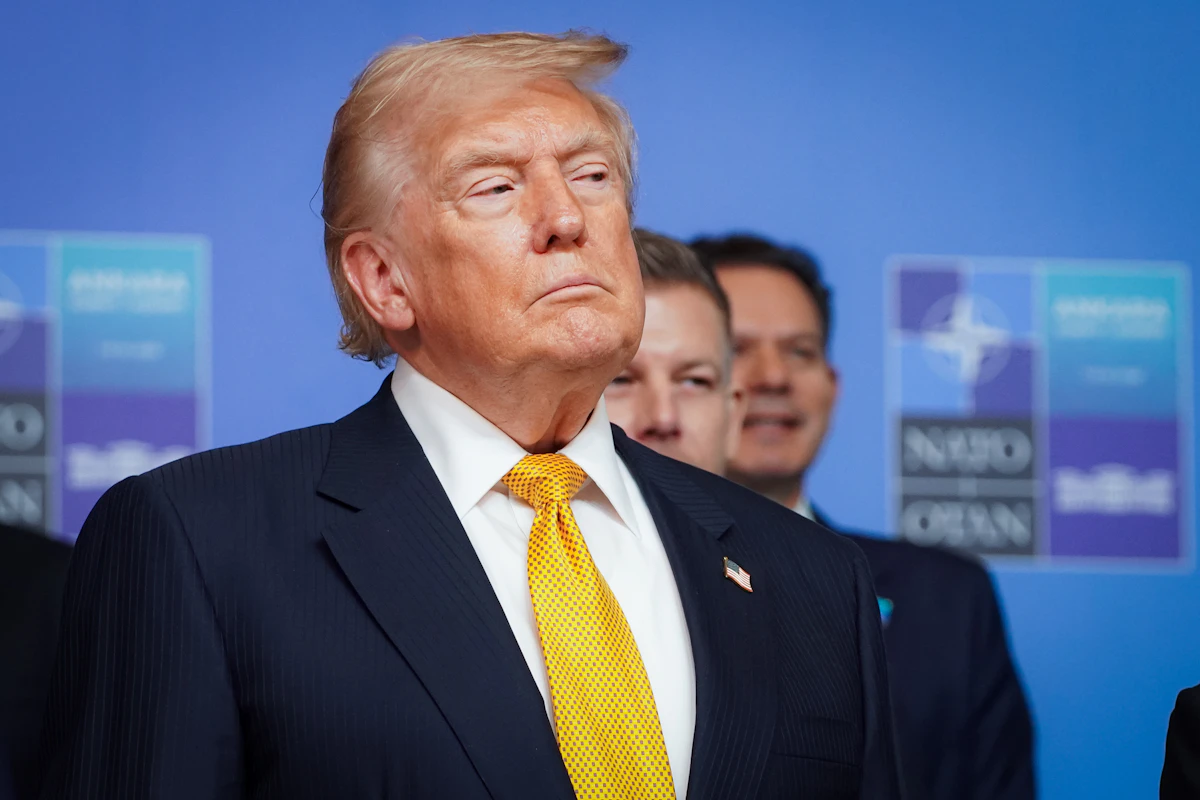
Donald Trump stumbled haplessly through a series of events at NATO on Wednesday. It was profoundly humiliating in countless ways, not just to him, but also to the United States. But there was one remarkable exchange in which a Danish reporter pressed the NATO secretary-general about NATO’s relationship with Trump that captured something really essential about this moment. The reporter asked, how can you have any self-respect praising Trump after all he’s done to NATO and to our allies?
The deeper question here is: What’s going to happen to NATO and America’s international alliances after all that Donald Trump has done to them? We’re talking about it all with Elizabeth Saunders, a foreign policy writer and thinker who’s really good on this sort of thing. Elizabeth, thanks for coming on.
Elizabeth Saunders: My pleasure. Thanks for having me.
Sargent: OK, so the headline news out of Trump’s visit to NATO was that he lashed out at everyone in sight. He said the ceasefire with Iran is over. He threatened more strikes. He erupted at Spain for failing to help with Iran, said our trade is finished with them. And he again threatened to steal Greenland outright. Elizabeth, what was your one simple big takeaway from everything that happened there?
Saunders: Well, I think it was a classic Trump display of volatility. NATO is in survival mode. Its mission at these meetings is to not have anything major come out of them in terms of an American withdrawal, right? So I think if you think back to the Davos meetings in January, when Trump had already been engaged in a couple days of saber-rattling over Greenland, and even floated the idea of taking it through military force—and then Mark Carney came and delivered this “this is a rupture” speech, and then Trump did back down.
That episode—reporting in The Wall Street Journal and elsewhere has shown—it was really a—I wouldn’t say a wake-up call, I’d say it was a straw that broke the camel’s back, but it really made clear to the Europeans that this was a serious crisis, that America might be turning on its allies. And so from that point on, I think the strategy of flattery that many European countries had—I mean, it’s understandable why they thought they had to try—has really fallen by the wayside.
All that said, it is still especially NATO Secretary-General Mark Rutte’s job to try to hold the alliance together, move forward. And I think he in particular has stuck with the flattery strategy a lot longer than some of his other counterparts.
Sargent: Yeah, it’s almost comical at this point. So speaking of that, here’s an exchange in which a reporter from Denmark, Rasmus Svaneborg, questioned NATO Secretary-General Mark Rutte. The reporter starts out by saying, Mark, you sit next to Trump while he says and does all these things to NATO and our allies. Listen.
Rasmus Svaneborg (voiceover): Mark, you sit next to Donald Trump in moments where he talks about conquering Greenland, talks about lashing out at allies like Spain, starting trade wars—things that it doesn’t seem like the old Mark Rutte would approve of. Does this have any effect on your self-respect when you sit next to him like that and say nothing?
Mark Rutte (voiceover): You know, what I always do is acknowledge when praise is due. And I think we should praise Donald Trump for the fact that NATO is so much stronger. Of course it has to do with the Russian threat, it has to do with the war in Ukraine. But it very much also has to do with President Trump delivering now what, since Eisenhower, the United States tried to achieve—equalizing spending between the U.S. and Europe.
Sargent: So as you heard there, the reporter asked Mark Rutte, how can you sit there next to this guy while he talks about seizing territory by force, lashes out pathologically at allies, and unleashes wildly destructive and crazy trade wars? How can you do that while maintaining your self-respect? Elizabeth, there’s something about this moment that perfectly captures the essence of the situation. What did you think of it?
Saunders: Well, your first instinct is to cheer the reporter and hope that Rutte says something like, you know, you’re right, I feel cheap and horrible when I do that, and I really think that Trump is an idiot or whatever. Very much like people were cheering for Keir Starmer, the prime minister of the U.K., to have a Love Actually moment where he told off the American president in a big televised speech, as Hugh Grant does in the movie Love Actually.
I mean, again, I think the era of flattery is over. I think Rutte probably knows that. But in his defense, he is the one in charge of just NATO, not a country anymore. And so he may feel that there’s a reason why he wants to at least keep Trump from lashing out, right? That’s how you get the no-drama—is you flatter him enough that he doesn’t do anything rash. I do think it does seem increasingly ridiculous to see anybody acting that way, though.
This is the president of the United States. His words really matter. And he again threatened Iranian civilian targets when he said he was going to bomb Iran tonight. I mean, he throws this language around so indiscriminately. And I don’t think we can forget that it’s not normal. It’s very abnormal.
Sargent: On the exchange with the reporter, I just want to point out how, in an understated way, it was an extraordinary takedown of Donald Trump, because it treated him as this buffoonish, irrelevant, sidelined figure, and essentially said, at this point, the only thing that matters now is how the rest of us react to this lunatic. It’s all on us. It essentially says, no more enabling of this madman. The whole world sees how crazy and destructive he is. It’s time to stop.
Saunders: The difficulty is, it isn’t just on the Europeans. Because the U.S. still has all the military power—or most of it, enough military power that it matters more than any other country. The Europeans and the Canadians are still dependent on it. And so you have this situation where Donald Trump is the single point of failure for the West. And it has some pretty serious threats facing it from Russia—I mean, I could go on, but the big one they were there to talk about was Russia, right?
And instead of that, he’s not just, as in his first term, doing things to kind of undermine the foundations. He has actually lashed out at Iran in a way that weakens the entire region, and over which they have very little control over events, if any.
So I don’t envy—there are many jobs I would not want to have in today’s world. University president, European head of state, right? That’s a tough one right now.
Sargent: Let’s listen to what Trump said about Spain. Check this out.
Donald Trump (voiceover): Spain is a wasted cause. We don’t want to do any trade business with Spain anymore, by the way. I’d like to cut her out. Spain is a terrible partner in NATO. They don’t participate, they don’t pay. I don’t want anything to do with Spain. Cut off all trade with Spain, please. Including visits. OK, we don’t want anything to do—watch them, watch them come running back. They’re open about it, they’re hostile about it. And let’s see how hostile they remain when they call up and they please, please, we want to trade with you, sir, we want to trade with you, sir. They make so much money with us, and we’re going to see that they make a lot less.
Sargent: He appears to be angry because Spain wasn’t willing to help reopen the Strait of Hormuz. But let’s just recap what happened there. Trump went to war without consulting allies, after spending the last year and a half shitting all over them. And then when his war went south—exactly as his own advisors and everyone else, including the allies, warned that it would—he suddenly runs back to our allies for help in cleaning up his mess. Elizabeth, can you talk about that big dynamic? How ridiculous it is?
Saunders: Yeah. I think the other piece of it is that Spain refused to sign on to the defense spending pledge that Trump wanted and that Mark Rutte tried to kind of get everyone to pledge. And Spain is pretty far from Russia. It has some mountains in between it and the rest of continental Europe. It certainly has maritime—it’s of great maritime importance.
But Spain is not going to be the backbone of NATO under any circumstances, right? And it doesn’t make sense for Spain to spend as much, or to spend the same way, right? Not every European country can build tanks.
So he’s been angry about Spain not providing help that makes no sense, and then insulting Spain and Italy and—you know, Keir Starmer, who flattered him, as not very Churchillian and so forth—but then he really does need help from the NATO allies. So it’s a situation where, again, he’s not a very good negotiator. He doesn’t know how to take care of his friends and keep them happy so that they’re there when you need them.
Sargent: Rutte has kind of praised Trump by saying he was right about getting European powers to chip in more for defense and all that. And just putting that aside, there’s no denying that Trump has essentially screwed over the alliance in all kinds of ways, is there?
Saunders: And also screwed over America, right? It’s very helpful to have these allies. This is the part that Trump has never appreciated—that having allies who will not just share the burden, but allow you to use their bases, provide all kinds of logistical support without having to occupy them—that’s a huge advantage.
It’s an advantage the Soviets didn’t have in the Cold War. It’s an advantage China doesn’t have today. It’s much better and strategically more valuable and easier for the U.S. to just be really close friends with Denmark and get what they need out of Greenland, rather than take over Greenland itself.
So the U.S. role in the alliance is special. It has the most capabilities, especially the nuclear umbrella. But fundamentally, NATO boils down to trust. Trust that each country will in fact come to each other’s aid if attacked. And fundamentally, the most important country there has always been the U.S., and the credibility of the U.S. guarantee is the most important thing.
Presidents have always sought to make that promise credible. And the way you make things credible is you say what you mean, and then you follow through, and you don’t change your mind overnight and start making demands and so forth. And so I think they have recognized that Trump is the single point of failure in this alliance, and they cannot allow—they need to build in some redundancies.
It’s also just kind of another example of how this is screwing over America too. The dynamic of NATO has always been, we ask the allies to spend more and do more on their own. But the minute they start to do that, we get annoyed, because we also want to tell them what to do. And whatever one thinks of that, clearly we’re giving up whatever leverage we had over the NATO countries militarily. And that’s a loss for the U.S. You can’t deny it.
Sargent: Yeah. Let’s just try to sum up the big picture here. So Donald Trump comes in. He’s supposed to be the hard-headed realist who does big things in the world. He knows how to manhandle Putin because he’s a tough guy like Putin. He recognizes that China’s a threat, and he’ll confront China because, unlike Biden, that softy—he’s a tough guy and all that.
But then what you’ve basically actually got is Trump empowering Russia in all kinds of ways, Trump failing vis-à-vis China, doing things that actually empower China, and simultaneously throwing away all our allies who would essentially act as our allies in being a bulwark against those rising powers. Is that a fair summary of what’s going on?
Saunders: Yeah, I think that sums it up. And for me, one of the—it was both ridiculous and very poignant moments—was when a reporter asked Trump a question about his recent talk of, you know, the fear of communists, because he’s been calling some Democrats communists of late. And leaving aside the whole domestic angle of that, he then went on a long discussion about communism and the dangers of communism, and you can’t go back once you’ve gone communist, and you suffer and you suffer.
And I’m thinking, as I’m listening to this, does he realize that he is in a room full of people dedicated to an organization that was founded to stop the spread of communism and Russian and Soviet aggression? And many of the countries that are now NATO members were behind the Iron Curtain for decades. And they sure do know what it’s like to live under communism.
So I think what you say is right. And I think NATO is sort of hoping that it can limp along—maybe not to a point where—I think nobody really thinks it can go back to the way it was. But I think they hope that they can improve their own defenses to a point where they can make a deal with a much more rational president who will stick to what he says.
Sargent: Yeah, and I think that that’s possible. I think a Democratic president could actually repair all this. Which brings me to this Wall Street Journal report—you referenced this earlier. The Journal reported on what our NATO allies are doing right now as they contemplate a world with a much less reliable America.
As the Journal put it, these countries are engaged in “an unprecedented experiment in de-Americanization.” Paul Krugman had a good line about this, where he said this reflects Europe’s realization that a country that elects Trump twice can’t ever be trusted again.
What I take from this is, the world is moving on from us. Can you talk about this de-Americanization process? What does it entail, and what does it all really mean? Where does it go?
Saunders: Well, there are various points on a spectrum of, quote-unquote, “de-Americanization,” right? And one would just be hedging, where you might not want to have American technology underpinning literally every facet of your defense and economy and so forth—not just because of Trump, but because of American tech companies, and being overly reliant on a single set of systems. Everybody knows that redundancy is good in this sort of situation.
So there’s sort of hedging, insurance, reducing dependency. And then there’s rupture. And Carney’s speech in Davos talked about rupture. But I think even he would probably say it would still be better if NATO existed, right? And existed in a form that people didn’t question whether it was still going to exist in a year or two.
So I think fundamentally we’re going to see more hedging from Europe. I don’t think that they will break away entirely, because their interests—if you step back, if you take a sort of 30,000-foot view of this—fundamentally Europe wants Ukraine to stay sovereign. The U.S. should want Ukraine to stay sovereign.
There’s lots of common interests that still exist. And so I think you’ll see some hedging, but it’s not going to be as far as maybe a full de-Americanization. And part of that also is just the constraints of what Europe can do and how fast it can do it. It can’t make a tech industry overnight.
Sargent: Yeah, it does seem like a Democratic president probably can repair things so that some form of an alliance that really matters in the world can continue. Do you think that’s possible?
Saunders: I don’t think we’re ever going back to the way it was, because I think we had Biden and then we got Trump again. And I think Krugman’s point about this—you know, they voted for him twice. That is the thing that stops people in their tracks when they think about it that way. So I think there will be—even if you got a president from the sort of more, you know, supposedly—like, just throwing out a name, Nikki Haley, right?
Someone who even worked for Trump, but who has clearly got a more internationalist outlook, would not ever want to go trashing NATO for the sake of trashing it. I think that’s someone the leaders at this meeting could work with, would want to work with. But they’re under no illusions anymore. And I think they will want to have redundancy. It’s just prudent, right? Diversification of portfolios—it’s what we’re all supposed to do with our money, right?
So I don’t think they’re going to allow themselves to be in this position, to the extent their economies and capacity allow them to diversify. They have learned an important lesson. And I think America’s going to have to learn what it’s like to have a Europe with some autonomous capacity. As I said before, that traditionally has not been what we actually want when push comes to shove. We’d much rather tell them what to do.
Sargent: Yeah. Well, I think that that reporter and that exchange really kind of nailed it. He basically said, in his own way, it’s time to move on. Elizabeth Saunders, really great to talk to you. Thanks for all that. It’s really great stuff.
Saunders: Thank you so much.
Hence then, the article about transcript danish journo s viral trump moment amid epic nato meltdown was published today ( ) and is available on The New Republic ( Middle East ) The editorial team at PressBee has edited and verified it, and it may have been modified, fully republished, or quoted. You can read and follow the updates of this news or article from its original source.
Read More Details
Finally We wish PressBee provided you with enough information of ( Transcript: Danish Journo’s Viral Trump Moment amid Epic NATO Meltdown )


Also on site :
- Today’s NYT ‘Strands’ Hints, Spangram and Answers for Tuesday, October 27, 2026
- Macy’s ‘Stunning’ Diamond Necklace Adds ‘Lots of Sparkle’ to Any Look, and It’s Now 79% Off
- Amazon’s ‘Beautiful’ $20 Cordless Crystal Table Lamp Brings a Cozy, Vintage-Inspired Look to Any Room