
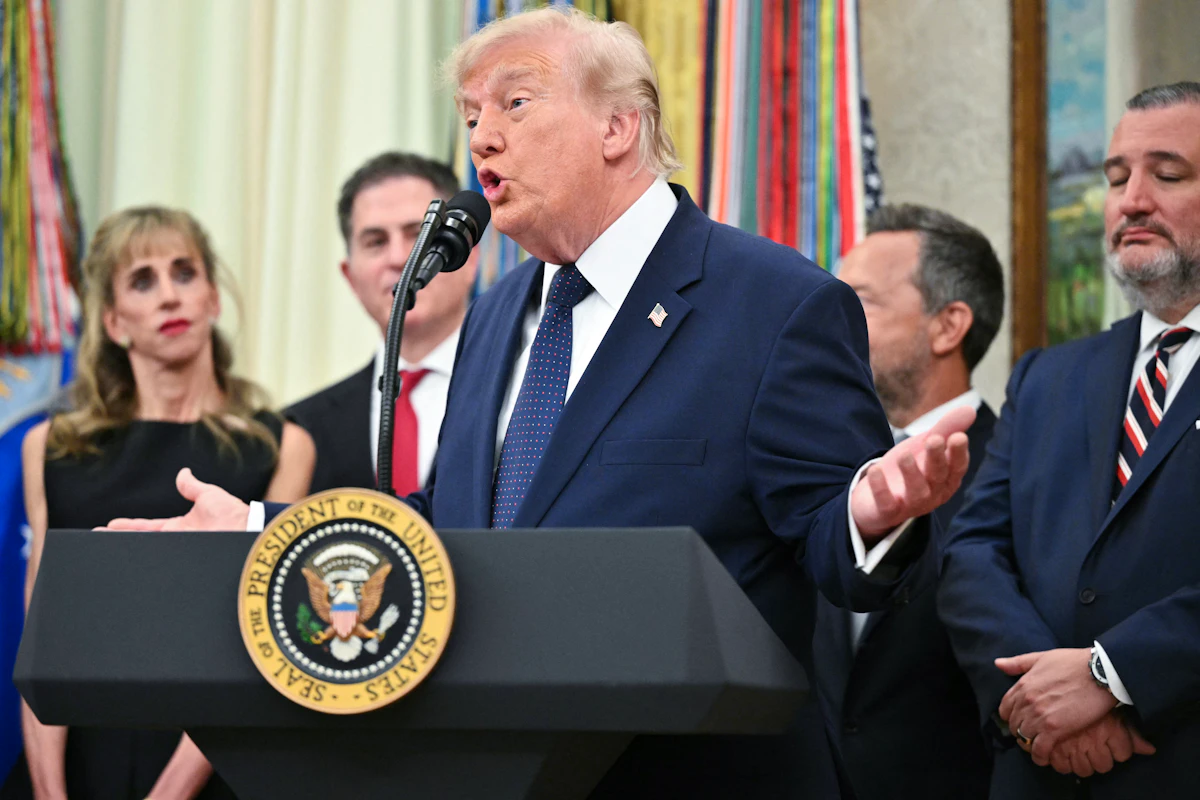
The following is a lightly edited transcript of the July 7 episode of the Daily Blast podcast. Listen to it here.
Greg Sargent: This is The Daily Blast from The New Republic, produced and presented by the DSR Network. I’m your host, Greg Sargent.
In the run-up to Donald Trump’s gala celebrating the nation’s 250th anniversary, we’ve been arguing here that it was important for it to fail. Trump delivered his speech, and there were some pretty bad highlights, but perhaps most notably it was beset with chaos after Trump overruled officials who recommended calling it off amid storms causing an exodus from the mall. But we’re going to dig deeper into the bigger failures here.
This was the moment when we were supposed to celebrate the American experiment enduring for a quarter of a millennium, and Trump still couldn’t help but make it all about the crowd sizes that were supposedly there for him and all about his pet obsessions. We’re talking about all of it with New Republic senior editor Alex Shephard, because Alex predicted very early on that Donald Trump would lose the culture, including on this, on the celebration of the 250th. Alex, good to have you back.
Alex Shephard: It’s great to be back.
Sargent: So what we now know is that Trump finally delivered his speech after 11 p.m. on July 4, after what The Washington Post called a “chaotic scramble.” This was the result of officials essentially saying this thing should be canceled and then him overruling them. Trump claims 150,000 people were there in the end, while saying that at least twice or three times as many had been there before the evacuation. Alex, you saw the imagery of the empty seats. What’s your take on the claim of 150,000 for the speech?
Shephard: I mean, there have been a lot of ridiculous Trump crowd-size claims, but I think this is one of the more brazen ones. The VIP section of this speech wasn’t even full. It was half full by the middle of the speech. People that love Trump and that need things from Trump weren’t willing to stay the entire time.
The weather was awful, but I think mostly people did not want to sit through what Trump had promised to be a very long speech. It wasn’t actually that long—I think it was like 30, 35 minutes. But it was exactly what you would expect. It was this kind of endless recitation of the familiar grievances, with a few kind of new half-baked insults thrown in.
So it just felt exactly like a perfect encapsulation of where we are with this president right now. Somebody who’s just almost bored, I think, with it, but who has no real argument to make to the American people and is still just kind of falling back on these very, very tired arguments.
Sargent: And of course, crowd sizes were really essential for Trump. Leading up to it, there was reporting saying that he had been in absolute rage about pictures of the crowd sizes during the events leading up to this. They had really set him off quite miserably in many ways.
Shephard: Well, I think going back to that too, there’s this larger failure of the Great American State Fair project, this kind of idea that they were supposed to put on almost like a world’s fair on the National Mall. It increasingly got taken over by Trump people. And between the weather and, I think, the lack of real draws, you were just seeing nobody coming through here.
And I think that again, like, the president can be furious about this as much as he wants, but it’s just another example of him living in this total fantasy world. It’s like when he posts about polls where seventy percent of the people love him. It’s just absurd.
Sargent: It is. Well, let’s check out what Trump said during the speech about the size of his crowd. Listen.
Donald Trump (voiceover): And they estimated they had 375,000 people before everybody had to leave. And they now have 150,000 people. It’s the craziest thing anyone’s ever seen. At least.
Sargent: But then on Truth Social afterwards, he suddenly inflated the number. He said, “The crowd at 7:05 in the evening was 422,000 people.”
Shephard: I mean, I think it also gives it a sort of historic register, right? He wants this to be like the March on Washington. He wants this to be like—I don’t know, when they tried to levitate the Pentagon or something. But I think what you’re seeing is the president trying, like, really, really hard to use his theoretical superpower, which is to just manufacture reality, right?
He’s a disciple of the power of positive thinking. He believes he can just kind of manipulate reality by saying things, and that by the time people correct him, it’ll be too late. But I think what we’ve seen again and again, especially since the start of this year, is that he’s just totally lost that ability, right? He can just say this stuff and people just ignore it. It doesn’t matter anymore.
Sargent: I mean, it’s almost like one final humiliation for him to not only get 150,000 by his own invented estimation, but that’s actually this huge bump down from this bigger number that he estimated—and then he turns around and undermines even that bigger number by inventing another one.
Shephard: I think Trump at his best, in a kind of non-value-judgment way, is sort of like the Grateful Dead or something, where people are going because there might be these parts that are not very good, but there’s going to be 20 or 30 minutes that are genuinely surprising and new and interesting.
And I think that’s like what brought people into Trump in ‘15 and ‘16. And I think now you’re seeing Trump as the Grateful Dead when Jerry Garcia was on loads of heroin or something—it’s just very familiar and it doesn’t work at all. And I think people are just bored by it right now.
Part of it is that he’s the president, right? So he’s just repeating the same kind of points over and over again. But I think that what we’re seeing is just a president that’s not actually engaged with people or with the culture in a larger way. And the speech itself, to me, failed on numerous grounds. But I think one of the reasons why people were not coming is just, it was this really familiar recitation of grievances, and kind of really pro forma points that Trump himself doesn’t even really care about.
Sargent: So let’s talk about a few highlights here. Trump claimed that we built the “Empire of Liberty.” He slurred his speech numerous times, a lot of screw-ups. He actually talked about the need to end mail balloting, which is really, truly bizarre. Talk about grievances—that’s something that a lot of Republicans don’t want to hear him talk about anymore.
And then there’s one quote that really leapt out, I think. It was this quote: “As our Declaration of Independence tells you, we’re all made in the image of one Almighty God, and a communist will never say that.”
Alex, to you, what substantively about the speech really kind of jumped out?
Shephard: I think part of it to me—or the big part, you just got at it—was this really new move from Trump, which is to try to kind of re-energize the Cold War, or to sort of make the larger fight for the country one of capitalism against communism. Essentially the idea here seems to be to use Mamdani as the kind of symbol of the Democratic Party heading into the midterms. But part of the issue here is—and maybe I’ll just sound like Barack Obama in the debate against Mitt Romney, but I’m like, the Cold War was a long time ago, right?
And one of the reasons why—and you see this—I think Steve Bannon is not somebody whose word should be taken literally most of the time, but I thought he had a very interesting point about the rise of kind of democratic socialism after the Colorado results last week, where he was essentially saying, yeah, you know what, these people are speaking to people who are dissatisfied with our current politics, right?
And they’re organizing really effectively around that. And I think that with Trump, what’s notable here is that Trump first rose speaking to a similar kind of person, right? Somebody who’s disaffected, somebody who is, I think, fairly concerned about the corruption of our politics and looking for people who don’t fit the mold of regular politicians. And that was Trump for a while, right?
But now Trump is himself trying to say, no, I am the kind of symbol of capitalism—all while running the most corrupt and crony-filled administration that you’ve ever seen. And I think that to me points to somebody who’s just lost his touch to some extent. This is the laziest argument that you can make in politics, essentially: my opponents are all communists, right? Well, people like Mamdani—he’s made himself a kind of very approachable, kind force in American politics.
And I think has actually organized really effectively, in a way that Trump has as well. But I think what we’re seeing here is just this effort to kind of narrativize his way out of this mess. And the narrative that he’s offering is one that Republicans have been pushing since Barry Goldwater, right? And sometimes it works, but most of the time it doesn’t.
Sargent: That’s absolutely right. I want to home in a little bit on his characterization of the Declaration of Independence, though. When he says, “we are all made in the image of one Almighty God,” he’s referring to the fact that the Declaration says we hold these truths to be self-evident, that our creator made all people equal and so forth. But Trump very much invisibly dispenses with the equal part. And also, “our creator” is not the same as “one Almighty God.” “Our creator” is a much more generic way of putting it, which is deliberate. He’s turning this into almost like a Christian nationalist celebration in a sense.
Shephard: Yeah, I mean, I think that Thomas Jefferson certainly would be appalled by that, right? Like, as a deist, he was not somebody who was thinking about our creator endowing us with anything. I think that the idea here for Trump is that the white men who founded this country did so with very clear designs in that order, that align with the sort of Pete Hegseth vision. And again, I think that speaks to a weakness within this administration, to me—that Trump is parroting stuff that he doesn’t care about, right? He’s not a Christian nationalist. He’s just doing this to try to pander to people within his base, right? And whenever Trump sounds like Pete Hegseth, I feel like he’s really losing here overall.
And I think again, we’re just seeing this kind of laziness, right? It’s this really warmed-over version of Republican politics, really like kind of mainstream Republican politics. As bad as the Christian nationalism stuff has gotten, a lot of the content of this speech would be familiar in a bad speech given by any Republican politician for the last sixty years. And ordinarily you would say, OK, well, that’s fine.
But the problem is that Trump’s whole thing is he’s not like those other people. So this speech, I think, to me captures the two halves of what we’re seeing with Trump right now, which are, on the one hand, these really finely ground grievances like the SAVE Act, right, that most people do not care about, things that Trump cares about quite a bit. And then on the other half, it’s just this really familiar drivel that has sort of characterized the conservative movement and the Republican Party for decades. And I think when you combine these two, you get one, just a really boring speech, but you also get a picture of a presidency that’s in total freefall.
Sargent: And let’s point out that Barack Obama spoke at the dedication of his presidential center just around a month ago. I want to read a sentence from his speech, because I think it’s really applicable here. It’s sort of fortuitous that Obama’s speech came around a month before Trump’s display, because they really neatly bookend this moment in a really kind of telling way. Obama said that the story of America at its best rests on shared values that make democracy possible.
They include this quote: “a belief in the intrinsic dignity and worth of all people, that no one is above the law or beneath its protection. A belief in checks and balances in our government, a belief that our military and law enforcement owe allegiance not to any president or political party, but to the people and our Constitution.”
You know, Alex, there was a time when a Republican president, whether he would mean it or not, would say something quite like that. But of course, let’s be clear—it’s a defining fact of this moment that Trump and MAGA don’t accept any of those things to be true, what Obama said, right?
Shephard: Yeah, I mean, I think it’s part of the long run of Republican and Democratic presidents giving speeches that subtextually rebuke Trump in this exact way, right? Like, George H.W. Bush could have given a large part of what you just read as well. But that’s—I think one of the other things that really jumps out about this moment, and in some ways the tragedy of Trump being president at this moment—there are many worse things that are happening.
But one of them, I think, is that this is an opportunity to reflect on the actual meaning of this nation. And I think it’s one of the things that Obama does very well. It’s something that actually Mayor Mamdani here in New York City, I think, also did very well in a speech that he gave on July 3 that was largely about immigration as part of the American story. But there’s just been this refusal to engage with that kind of narrativizing, right? Which I think is an important part of building a culture.
And I think what you see with Trump is that he’s only capable of essentially either, when things are going well for him, building a political movement, or, I think, attempting to sustain or salvage it, which is what we’re seeing now. And it’s just the political movement, right? It’s only things that are innate to Trump. And as you’ve mentioned, the Declaration of Independence is hostile to that project, right?
Like the Reconstruction amendments are hostile to that project. When you think about the larger American story—which Obama has narrativized, I think, brilliantly many times, of a country struggling to live up to the ideals in its founding documents—that’s, I think, a powerful story. But that’s not the story that Trump tells, right? The story that Trump tells is, these people won’t pass the SAVE Act, and so my elections are going to keep getting stolen.
Sargent: You’ve got the World Cup really sort of acting as the perfect foil to Donald Trump’s Christian nationalist display of our 250th. Can you talk about the contrast there?
Shephard: For the most part, what you’ve seen in this World Cup is it being a celebration of the kinds of things that Obama talked about in that speech, that I think you look at when you think about the good parts of America, right? People are really friendly here. People like to visit America, and they like to visit it because of Americans and because of American culture. And I think we’ve seen quite a bit of that. And this tournament has largely been a huge refutation of Trumpism.
The best player for the United States men’s national team during this tournament is somebody who is only a U.S. citizen because of birthright citizenship. It’s a huge refutation of the president. But what we’ve seen since Sunday, when that player for—Folarin Balogun, who had been suspended, that he gets unsuspended, possibly because of lobbying from the White House, and the president certainly takes credit for it. And I think what you see is, it’s not that dissimilar to when Trump came to New York for game three of the NBA Finals. What you see is a sort of party, right? This sort of joyous thing that’s then poisoned by the president.
But I think it’s more notable here too, in that it’s another example of his weakness culturally, right? Like, the U.S. team is doing really well, but Trump doesn’t own that at all—partly because, again, the striker on this team, Folarin Balogun, is on the team because of birthright citizenship. His backup, Ricardo Pepi, his family is Mexican, right? The left back is English, the right back is Dutch. It’s a complicated story of America, but it’s one that refutes what the president’s trying to say. And I think with this sort of eleventh-hour intervention, what you’re seeing from this president is someone who can’t own the narrative. So he has to force his way in. And I think that’s what we’ve seen here.
And the U.S. will play Belgium after we talk, before this episode goes out. But I think that the team may or may not respond to that. Hopefully they are able to kind of compartmentalize it. But for a lot of people—and I wrote about this for the New Republic site today—this has kind of poisoned the World Cup. And that, I think, is what Donald Trump has been doing culturally for the last year and a half, essentially. He’s just kind of butted into things and ruined them.
Sargent: And just to conclude this, Donald Trump is clearly trying to associate himself with the success of the World Cup, but failing. And I think the dynamic that you’re getting at is really that everyone just wants to be done with this guy and done with this movement already, right? Everybody just at this point sees how toxic Trump and Trumpism have really become as toxic forces in American life.
I mean, the ethno-nationalism, the cruelties and the barbarities, the corruption, the self-dealing, the oligarchy, right? The big upward transfer of oligarchic wealth, which was a major component of Trump’s second-term agenda, the displays of dictatorial self-glorification, and him just kind of desecrating these symbols of republicanism, small-r republicanism, in the nation’s capital. Everybody just wants to be done with this—all these enmities, all these hatreds, all these degradations, all this nonsense already.
Shephard: Well, yeah, I think that the U.S. team is a great example of this, right? Like, so I mentioned Balogun being a sort of birthright citizen, but you don’t have to know that to enjoy this team, right? They’re a fun team. And I think that they encapsulate a lot of what you would like to love about this country. If you’re a MAGA person, you could easily get into a kind of “USA, USA” version of this team. If you’re a liberal like myself, you can find a million ways to be excited about them, right?
And I think that what you see about Trumpism culturally here is the inability to let those kind of monocultural things stand, right? You have to choose one or the other. Taylor Swift can’t be Taylor Swift, right? She has to be an enemy of the MAGA movement. Bruce Springsteen, same thing—which is, again, how you got the horrific music lineup at the Great American State Fair.
But I think that you’re seeing a kind of resistance to that now as well, right? And I think that this is a sort of political movement dying out, in that it’s resisting Trump’s efforts to co-opt it. But it sucks to be in the end stage of that too, because he is, I think, really raging against the dying of the light right now, for lack of a better term.
Sargent: Yes, I’ve been using the term “Late Stage Trumpism.”
Shephard: Yeah.
Sargent: It really is—it’s got an end-stage feeling to it, an end-stage cult feeling. We’re in the middle of Late Stage Trumpism, and everybody’s just waiting for it to collapse in on itself, basically. And I think maybe the ultimate tell here is for Donald Trump to inflate the crowd sizes at the 250th event, right, which is supposed to be all about the country. And one last time, he makes it about himself. He makes it about his own crowd sizes. It’s almost the final humiliation.
Shephard: Well, yeah, and it’s how it all began, right? That was literally day one of the Trump administration, when people were saying, maybe this guy will be different. And you’re just like, nope. It’s just going to be an even dumber and worse version of what we thought. And now we’re just—it’s crowd sizes all the way down now. And we’ve got two and a half more years of this, and it’s going to be brutal. But, you know, again, it is the late stage.
Sargent: Late-stage Trumpism, folks. That’s what America’s become. Alex Shephard, always a great pleasure talking to you, man. Thanks so much for all this. And you were really ahead of the curve on this stuff, I’m telling you.
Shephard: Thank you. I appreciate it.
Hence then, the article about transcript trump 250 crowd size claims collapse in final humiliation was published today ( ) and is available on The New Republic ( Middle East ) The editorial team at PressBee has edited and verified it, and it may have been modified, fully republished, or quoted. You can read and follow the updates of this news or article from its original source.
Read More Details
Finally We wish PressBee provided you with enough information of ( Transcript: Trump 250 Crowd Size Claims Collapse in Final Humiliation )


Also on site :
- Iran war live: Trump claims US Navy blockade stops Iranian ships in Hormuz
- ServiceNow CFO says leaders working 14 hours and getting 4 hours of sleep set a ‘terrible example’ for their employees
- Brad Caleb Kane Teases ‘It: Welcome to Derry’ Is “Bigger” In Season 2 With “A Different Kind Of Pennywise”