
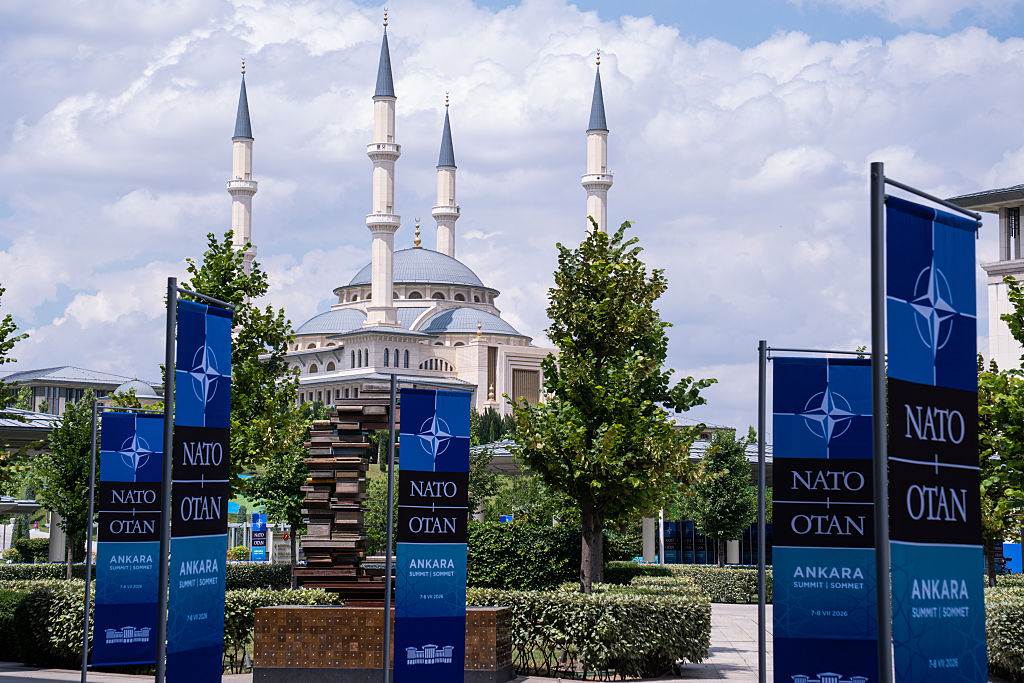
Is Europe capable of securing itself?
That is the singular question NATO leaders gathering in Ankara, the Turkish capital, for a crucial summit on July 7 and 8, will have to confront. President Donald Trump and the alliance leaders are convening in Ankara at a time of profound transatlantic tensions, widening intra-European fractures over how to manage President Trump, active wars on the European continent and along its strategic periphery from Ukraine in the east to Gaza, Lebanon, and the broader Middle East in the south.
Self-doubt and self-abasement, which have defined the European approach to Trump and European security, are no substitute for strategy. Ankara must be the moment Europe stops mourning the alliance it once knew and begins building the one it actually needs.
In the short term, Europe must strengthen the collective weight of European NATO members, not the European Union members or EU as an institution alone, within the alliance. In the medium to long term, however undesirable the prospect may be, Europe needs to prepare for a security order that is not dependent on American power and the old terms of the alliance.
Europe needs a continent-wide security architecture encompassing NATO members both inside and outside the EU. It needs a reformed and expanded engagement with its Eastern neighborhood—Ukraine, Moldova, Georgia, and the Western Balkans—and with its Southern neighbourhood, stretching from North Africa and the Sahel through the Levant to the Persian Gulf.
And Europe needs an honest reckoning with an uncomfortable truth: any post-American security framework cannot simply replicate the existing NATO-centric order, which rests on strategic clarity, institutional permanence, and a shared threat perception.
A new security architecture in which the American role is reduced or redefined should move Europe to adapt to the present and prepare for the future. Europe is fearful of the future and relatively resistant to the ongoing global reordering, but the Global South is more hopeful about the future and more open to structural global change. Europe wants its future to resemble its post-World War II past. Major countries in Asia, the Middle East, and Africa—and the US—have moved on.
Hakan Fidan, the Turkish foreign minister, recently emphasized the importance of NATO’s official mantra for this summit, laying the ground for NATO 3.0—a milestone in the alliance’s history. The framework is instructive: NATO 1.0 describes the alliance’s Cold War rationale, designed to address a conventional, state-centric threat embodied by the Soviet Union.
NATO 2.0 describes the post-Cold War context, in which the alliance had to pivot toward non-state threats—most notably when, for the first time, NATO invoked its collective defense clause, Article 5, following the Sept. 11, 2001 attacks by al-Qaeda, acting in defense of the US against a non-state actor.
NATO 3.0 signals the alliance’s adaptation to today’s changing global order. This is a call for both cognitive and geopolitical adaptation, and it falls most heavily on NATO’s European members. Any continent-wide framework for European security must begin by building closer, more structured cooperation not only among NATO’s key EU member states but also among its non-EU member states: the United Kingdom, Turkey, and Norway.
An EU-centric approach to European security will not deliver a continent-wide new security order. Exclusion of non-EU states—the UK, Turkey, Norway, and some Western Balkan countries—will lead to more rivalry and fragmentation. France’s exclusion of the UK from the Security Action for Europe defence program already backfired.
This holistic logic must extend beyond geopolitical matters to encompass new defense industry initiatives, energy security, and supply-chain redesign. There have been encouraging developments: almost all European NATO members have increased their defense budgets. But the new moment requires a holistic understanding of both “security” and “Europe.”
New boundaries of European security
Europe must fundamentally rethink its engagement with its proximate security environment. The future of European security will be shaped as much by developments across its broader periphery as by those at its center. These two phenomena are intimately interconnected. And Europe will have to summon the political will to overcome potential resistance from far-right and populist parties to this strategic agenda. To respond effectively, Europe will have to summon the political will to overcome resistance from far-right and populist parties to this strategic agenda.
Both of these dimensions of Europe’s proximate security environment will be high on the agenda in Ankara, including renewed commitments to Ukraine. President Trump has expressed frustration over what he sees as insufficient European support during the Iran war. Europe, for its part, is alarmed by the prospect of American abandonment of Ukraine. Europe’s strategic periphery is not only integral to European security but is actively deepening transatlantic tensions and sharpening intra-European divisions.
Yet European strategic thinking is dangerously skewed toward its Eastern neighborhood, above all Ukraine. Support for Kyiv is imperative not only for the defense of the country, but also for the security of the continent. Europe, however, needs to adopt a wider conception of its neighborhood. In today’s European strategic imagination, geopolitics begins in Russia and ends in Ukraine. The continent risks becoming a single-issue actor, as has been painfully evident in Europe’s near-total absence from its Southern perimeter stretching from North Africa through the Levant to the Persian Gulf. The Iran and Gaza wars have thrown that absence and European strategic impotence into sharp relief.
Still, engagement with the Southern perimeter remains integral to European domestic political order and to European security itself. Consider the Syrian civil war: the resulting refugee crisis and the spread of jihadist radicalism across the Mediterranean provided fuel for far-right parties across the continent. What originates along Europe’s Southern strategic perimeter does not stay there. It travels, in the form of people, ideologies, and political shocks, directly into the heart of European politics. The Southern perimeter has the potential to redefine politics at the center, whether Europe chooses to engage with it or not.
It is long overdue for Europe to devise new strategies toward its proximate security environment, above all toward the Southern perimeter. The absence of a shared engagement strategy not only advertises Europe’s strategic vacancy in the face of rapid transformation across both its Eastern neighborhood and its Southern strategic perimeter.
It also feeds intra-EU rivalries and intra-NATO rivalries. This has been evident in the competing agendas of France and Italy in Libya, and in the clashing postures of Turkey and France in Libya and the Sahel. These contestations expand the room for Russia and China to operate across the Southern perimeter.
For many years, the prevailing expectation was that Europe would transform its neighborhood and remake it in its own image. The opposite has occurred. Both the Eastern neighborhood and the Southern perimeter are redefining Europe, and not in ways Europeans anticipated or desired. Going forward, the relationship between Europe and its broader proximate security environment will be a story of mutual transformation.
The Eastern neighborhood will not simply be stabilized and absorbed into European structures, and the Southern perimeter will not be reformed in Europe’s image. Both will continue to shape Europe as surely as Europe seeks to shape them.
The rise of minilateral diplomacy
The question of how best Europe can be present and effective across this dual proximate security environment forces a deeper issue: how best can Europe advance its security interests there?Conventional responses point to collective and institutional frameworks as the answer. But such frameworks may prove both unattainable and even undesirable.
The security architecture emerging from a redefined or reduced American role will have to be more variegated, ad hoc, issue-based, and flexible, resting on different forms of minilateralism: small coalitions of relevant states organized around specific crises, whether in the Eastern neighborhood, along the Southern strategic perimeter, or elsewhere.
Consider the E3 format—France, Germany, and the UK—which emerged in 2003 to negotiate with Iran over its nuclear program. That issue-based minilateral arrangement paved the way for the signing of the Iran nuclear deal in 2015, a landmark European diplomatic achievement.
The contrast with Europe’s near-total absence from current diplomatic efforts to resolve the renewed crisis with Iran, a country that sits at the intersection of its Southern perimeter and Europe’s most sensitive energy and migration corridors, is jarring. The Coalition of the Willing for Ukraine represents another such platform, operating outside both NATO and EU institutional frameworks, for coordinating European responses to the war in the Eastern neighborhood.
These minilateral models point toward the architecture of a post-American European security order: flexible, issue-specific, coalition-based, and applicable across both the Eastern neighborhood and the Southern strategic perimeter. In Ankara and beyond, NATO’s European members must do two things simultaneously: strengthen the European pillar of the existing NATO structure and begin preparing for a new European security architecture in which the American role is downsized and redefined.
The Ankara Summit should serve as Europe’s graduation ceremony: the moment the continent accepts full responsibility for its own security and asserts itself as the center of gravity not only for its Eastern neighborhood, from Ukraine and Moldova to the Western Balkans and the South Caucasus, but equally for its Southern strategic perimeter, from the Maghreb and the Sahel through the Levant to the Persian Gulf. Europe cannot afford to be a single-flank power in a multi-front world.
Hence then, the article about stop mourning the old nato build the new one was published today ( ) and is available on Time ( Middle East ) The editorial team at PressBee has edited and verified it, and it may have been modified, fully republished, or quoted. You can read and follow the updates of this news or article from its original source.
Read More Details
Finally We wish PressBee provided you with enough information of ( Stop Mourning the Old NATO. Build the New One. )


Also on site :
- ServiceNow CFO says leaders working 14 hours and getting 4 hours of sleep set a ‘terrible example’ for their employees
- Iran war live: Trump claims US Navy blockade stops Iranian ships in Hormuz
- Brad Caleb Kane Teases ‘It: Welcome to Derry’ Is “Bigger” In Season 2 With “A Different Kind Of Pennywise”