
Scientists say they have built a "synthetic cell" that can eat, grow and divide in a way that's remarkably similar to living cells.
The research, released to the preprint database bioRxiv July 2, has not been peer-reviewed yet. It introduces SpudCell, a new type of artificial cell, and marks a striking step toward creating living cells from scratch. But for study co-author Kate Adamala, a synthetic biologist at the University of Minnesota, that's far from the most interesting part of the work.
"I do not believe [SpudCell] is alive," Adamala told Live Science. Instead, she describes the system as a framework that could generate "all the chemicals we need for our civilization with biology." The thought is that SpudCell could serve as a tiny factory, pumping out medicines, fertilizers, plastics or any number of other compounds.
The work's announcement has sparked some controversy, with some scientists seeing it as a ploy to gain media attention for the simultaneous launch of the author's nonprofit Biotic, which aims to raise money to further develop the SpudCell platform. Adamala does not take umbrage to that criticism, as she is keen to bring more attention and funding to her field. If a synthetic cell can be perfected, she thinks, it could help humanity generate chemicals without relying as heavily on petroleum products.
"I feel this incredible stressful urgency that if we don't get to work on it now, then we're going to run out of time," she said, referring to the climate crisis. "We need to highlight that bioengineering can offer a solution. That's why I'm doing it."
According to the preprint, Adamala and her team produced a lifelike system that closely resembles a living cell. To do so, they combined 36 purified enzymes and a fatty membrane with a pared-back genome about 50 times smaller than that of an average bacterial cell. By mixing these human-made elements together, the scientists generated a cell that could feed, grow, and divide — so, in essence, they created a full cell cycle in a petri dish.
"We built a cell-like system that is fully chemically defined, so there are no unknown building blocks in it," Adamala said. "It's capable of doing things that people up until now used to think only natural living cells can do." They call the system "SpudCell" because it looks similar to a potato, The New York Times reported. The name is also a nod to the Sputnik satellite, per CNN.
The concept of recreating the cell cycle in a dish is not entirely new. The J. Craig Venter Institute's 2016 "minimal cell" paper flirted with the concept by stripping as many genes from a bacterium as possible to leave only a minimal cell that could still replicate. However, the new study is the first time scientists have achieved feeding, growing and division using a "bottom-up" approach.
The work marks "a great advancement," said Mauro Rinaldi, a lecturer in biotechnology and biochemistry at the University of Hull in the U.K. who was not involved in the work. "It moves the needle because one of the key things about cells is division."
But there are important caveats. For one, the cells cannot yet create their own energy as our cells do with mitochondria. They also rely on externally provided fats, sugars and enzymes. The cells cannot make their own ribosomes, the machinery that turns genetic instructions into working parts of the cell. That means it relies on proteins being delivered from the outside.
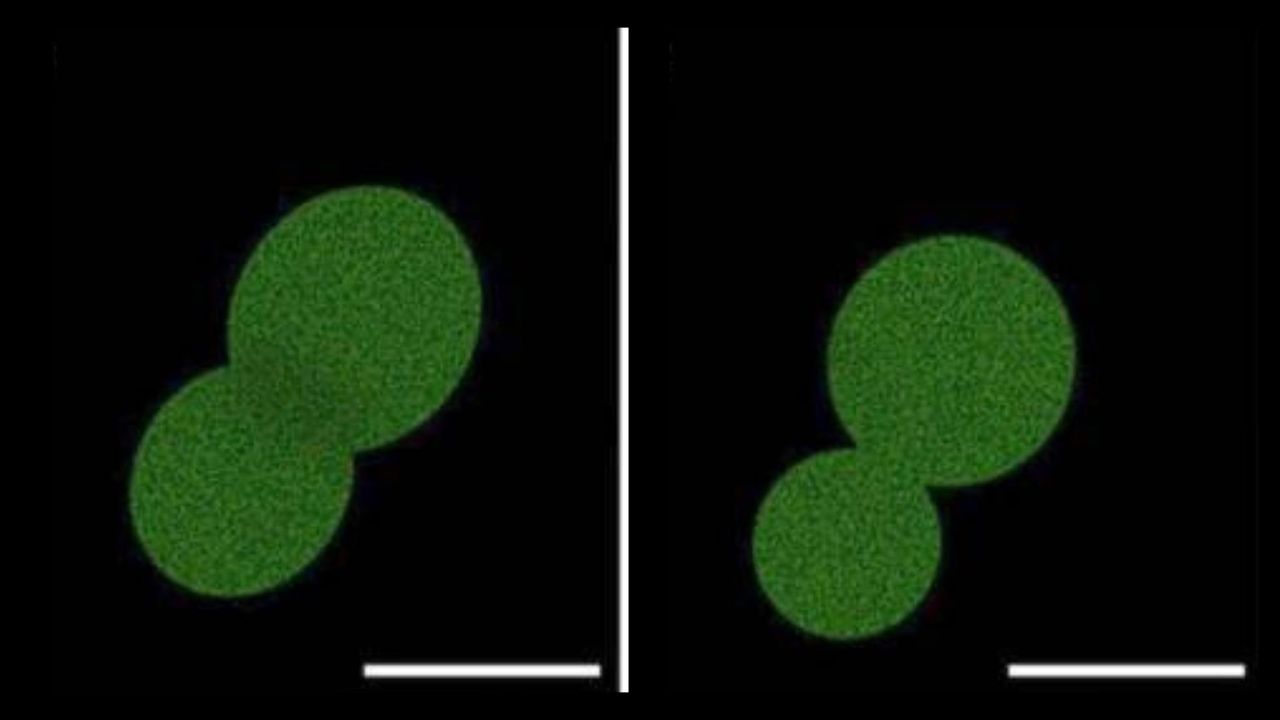
Left: A super-resolution image of SpudCell's liposomes with an encapsulated genome and active protein expression. Right: A SpudCell encapsulates a whole genome. The DNA of the genome and the synthetic cell membrane are stained with fluorescent dyes. (Image credit: Orion Venero, Adamala Lab)Another difference is that SpudCell's genome is spread out over bits of DNA called plasmids, rather than being neatly packaged in chromosomes. It does not possess the skeleton that cells typically use to neatly split DNA during cell division, so consequently, the division of SpudCell's DNA to its daughter cells can be somewhat haphazard.
"The description of the results leaves me with substantial technical questions regarding the nature and the robustness of the findings," said Cees Dekker, a biophysicist at the Delft University of Technology in the Netherlands who was not involved in the work. "[Its] approach uses some ingenious engineering tricks as shortcuts to achieve complex functions such as growth, but a major challenge remains to create a truly autonomous cell that executes all these functions without external help," he said.
Dekker is among the scientists who would have preferred that the research made the news after being published in a peer-reviewed scientific journal. "If these findings are solid, that great media attention is definitely warranted; if peer review would, however, reveal weaknesses or issues, all the current media reporting is premature," he argued.
From cell to manufacturing platform
Adamala sees SpudCell as a blank slate for engineering. "We believe that if we make a cell from scratch, that's fully engineerable," she said.
Cells have long been used to produce chemicals for human use. Millions of people use synthetic insulin made in bacteria and yeast cells, for example. But cells resist making chemicals that could be harmful to them, and through evolution, they've developed systems to prevent them from doing so. A SpudCell-like system could circumvent those natural hurdles, Adamala and her colleagues think.
That kind of platform could also be useful for making newer generations of medicines, such as those based on mRNA or peptides. These drugs use molecular building blocks, like amino acids or nucleotides, that have been chemically tweaked to make the molecules more stable or harder for the body to break down. SpudCell could be engineered to produce such modified components directly, rather than scientists having to synthesize them in traditional chemistry labs. This could potentially shorten development timelines and lower costs, the team thinks.
Adamala and her colleagues also envision the cells being used as easily shippable laboratories. They could be dried out, shipped, stored without refrigeration, and then activated on-site to make chemicals, vaccines or proteins when and where they are needed.
But there's still a long road ahead. For now, SpudCell is only a proof of principle, and many hurdles must be addressed before it could become an industrial platform.
Related storiesMost advanced lab-made human embryo models look like the real thingMini model of human embryonic brain and spinal cord grown in labTiny 'brains' grown in the lab could become conscious and feel pain — and we're not ready
"[SpudCell] is not an engineering platform that can give you any useful product, but it's step one," Adamala said. "It's probably at least a couple of decades from now when we can actually scale it up to the point where we can replace all the petrochemicals with biology, but I do believe it's doable."
Adamala hopes the nonprofit Biotic will help funnel donations from philanthropists directly to research. "Biotic is a funding agency that is going to globally fund this work," she said.
While the technology is promising, "it needs to go through peer review," Rinaldi said. "I expect a lot of the hype and some of the terms that they're using to go away after a couple of years have passed."
Hence then, the article about scientists just created the most lifelike cell ever made in a lab here s what it could accomplish was published today ( ) and is available on Live Science ( Middle East ) The editorial team at PressBee has edited and verified it, and it may have been modified, fully republished, or quoted. You can read and follow the updates of this news or article from its original source.
Read More Details
Finally We wish PressBee provided you with enough information of ( Scientists just created the most lifelike cell ever made in a lab — here's what it could accomplish )


Also on site :
- Walmart’s ‘Sleek’ $160 Folding E-Bike Is a ‘Zippy’ Way to Get Around, and Perfectly Priced for Holiday Gifting
- Man charged with attempted murder in violent attack on woman at Old Orchard Mall
- Sylvester Stallone Calls Himself an ‘Idiot’ After Years Performing His Own Stunts and Countless Surgeries