
We’re closing in on July Fourth and the nation’s 250th birthday, and right on time, the all-knowing digital algorithm deposited a memory from 2015 on my screen: That year, burning the Confederate flag on Independence Day was in vogue, sparked by the mass shooting at the Emanuel African Methodist Episcopal Church in South Carolina. My fondness for desecrating rebel iconography is not restricted to either a national holiday or a national tragedy—we should have fully conquered the Confederacy when we had the chance, instead of allowing them to commemorate their traitorousness. Maybe those nine parishioners would be alive today if we’d done a better job discrediting that toxic ideology.
That’s some food for thought here in 2026, as an ailing, flailing President Donald Trump sets his sight on being the ringmaster of the clown show he has planned for the Fourth. When Trump’s not losing wars or setting the economy on fire, he’s busy turning the nation’s capital into an orgy of self-aggrandizement ahead of next week’s semiquincentennial celebration. At Wednesday’s kick-off event for his “Great American State Fair,” Trump announced that “America is back.” Where had it gone? The president proclaimed that “a short time ago we were a dead country. We were dead. Now we’re the hottest country anywhere in the world. We’re respected by everybody. Nobody’s laughing at us anymore.”
As a thin crowd made for the exits, he also touched on the matter of state that’s consumed most of his time lately: “The Reflecting Pool that you’ve heard so much about, which is so incredible, it’s been gruesomely vandalized by thugs, bad people, but soon will be looking as beautiful as it looked just two weeks ago,” Trump said. “In fact, I looked at it just a little while ago. It looks perfect already, but we’re fixing it.” As it happens, the Reflecting Pool is still green, still peeling, and half-assedly stashed behind some chain-link fence. It may be a federal crime for me to report this, it’s not really clear.
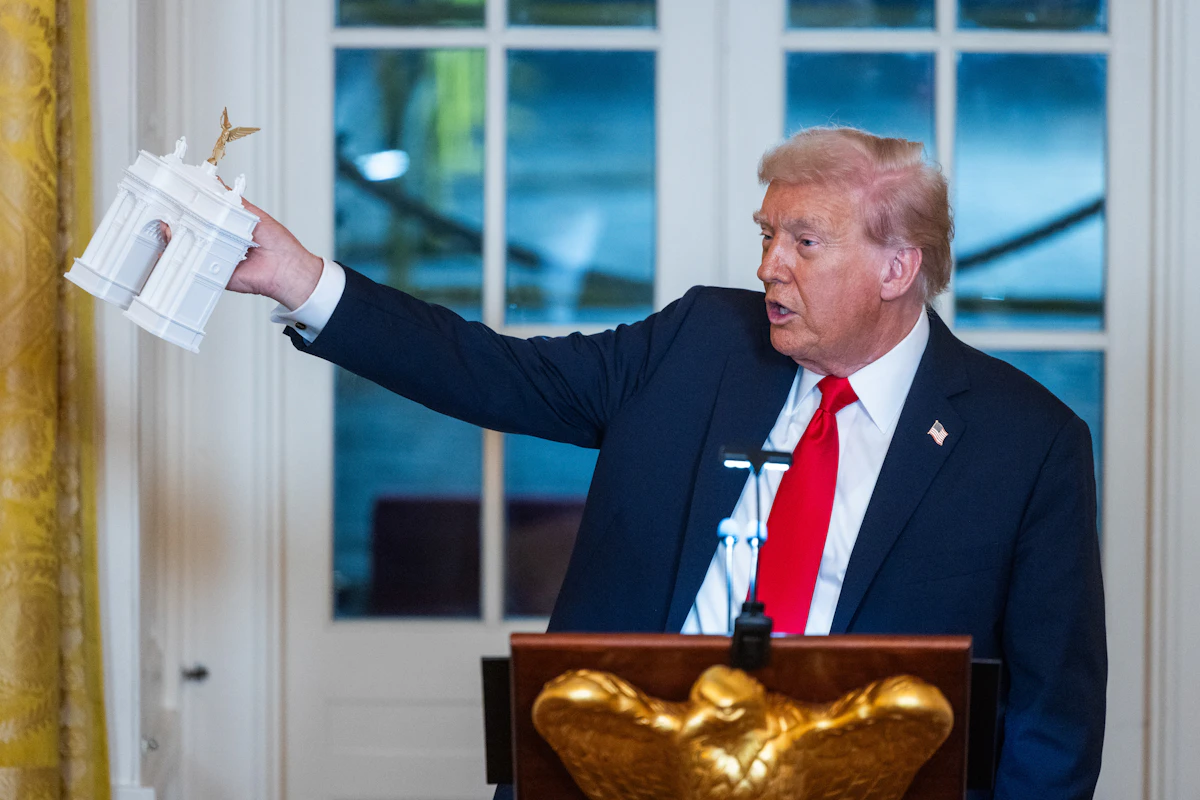
All of this is definitely a product of ego, but it’s also highly reminiscent of Confederate kitsch. Trump’s drive to commemorate himself, which has even run afoul of some of his fellow Republicans, is animated by the same idea as the Lost Cause: to lend legitimacy to a period of betrayal and to ensure this malevolent force lives on. Allowing the Confederacy to commemorate itself was a profound failure on our part, and it seeded the earth for the weakening of our democracy. As Trump plans to sully the District of Columbia’s skyline with his triumphal arch (now with more fist!), I can see history repeating: Trumpism as the new Lost Cause.
I am hardly the first to evoke this comparison. As The Atlantic’s David Graham wrote back in 2020, Trump spent his Independence Day marinating in a variety of Lost Cause grievances: the decision to remove the Confederate iconography from the Mississippi state flag and NASCAR events, the renaming of the Washington Redskins and Cleveland Indians, along with the usual suspects (“the radical left, the Marxists, the anarchists, the agitators, the looters, and people who, in many instances, have absolutely no clue what they are doing”).
As Graham noted at the time, Trump’s Lost Cause fetish was his campaign schtick, the red meat he used to rally his base. In 2020, that playbook failed, in no small part because the Covid-19 pandemic was foremost on the minds of voters. But Trump played the same game in 2024 and won back the White House. And as the Southern Poverty Law Center’s Rivka Maizlish wrote last year, the “unrelenting propaganda of the Lost Cause” returned with a vengeance. The names of Confederacy luminaries stricken from U.S. military bases were restored, there was a renewed push to whitewash the sins of slavery, and the Civil War era’s insurrectionists were conflated with the nations’ Founders. It’s no accident that Trump believes our latter-day insurrectionists should be the ones to get government reparations.
As Maizlish noted, ’twas ever thus:
Lost Cause mythology is central to Trump’s movement. He romanticizes the gender and racial hierarchies of the Old South, valorizes Confederate leaders and symbols, and demonizes those who would remove Confederate memorials as “angry mobs” trying to “wipe out our history.” The Confederate anthem “Dixie” played at Trump’s Madison Square Garden rally on Oct. 27, 2024, an event filled with racist harangues and ridicule.
Trump is now deep into his dotage (and perhaps his inexorable decline). He has no campaigns left to run and no further need to worry about uniting the American people to build some kind of sustainable electoral coalition. These days, the president is motivated entirely by thoughts of his legacy. But the Lost Cause schtick remains the same—only now it’s manifesting itself in his relentless pursuit of various vanity projects and alterations to Washington, D.C.
The possibility that he might not be remembered seems to vex Trump, whose administration moved with the same sort of alacrity to forestall the removal of his name from the Kennedy Center as it did in fighting its inane war with Iran. As Brian Beutler reported in his Off Message newsletter, Trump’s name only came off the building because Ohio Democrat Joyce Beatty, as an ex-officio member of the center’s board, had the standing to sue over the matter and she took the opportunity. Some other Democrats who had standing for the same reason decided to pass, including House Speaker Hakeem Jeffries and outgoing D.C. Mayor Muriel Bowser.
Beutler hails Beatty as a model for other Democrats to follow, given what can happen to a country when a traitor to the Constitution is allowed to remain commemorated. Every lasting monument to Trump is really a monument to accommodating his misrule, celebrating his corruption, and a signal to the public that it’s OK to forget his criminal legacy and accept the Trump era as legitimate. “It will be much easier to arrest the normal process of forgetting,” writes Beutler, “if Democrats embrace the goal of Trump humiliation now. If peeling Trump’s name off the Kennedy Center is just a taste of what’s to come.”
Tearing Trump’s various architectural vanities down isn’t what I’d call a top priority. Like TNR’s editor, Michael Tomasky, I think Democrats need to commit themselves to freeing us from the iron grip of oligarchy and radically reshaping the Supreme Court. Still, as Tomasky wrote earlier this week, we should look to future Democratic presidential candidates to follow in the footsteps of Beatty and commit to a cosmetic de-Trumpification. It would send a strong signal that the party will brook no attempts to commemorate a discredited president—and that it has the stomach for the civic deworming this nation needs to kick off its next century.
This article first appeared in Power Mad, a weekly TNR newsletter authored by deputy editor Jason Linkins. Sign up here.
Hence then, the article about america s 250th celebration is donald trump s lost cause was published today ( ) and is available on The New Republic ( Middle East ) The editorial team at PressBee has edited and verified it, and it may have been modified, fully republished, or quoted. You can read and follow the updates of this news or article from its original source.
Read More Details
Finally We wish PressBee provided you with enough information of ( America’s 250th Celebration Is Donald Trump’s Lost Cause )


Also on site :
- Witney Carson Claps Back at ‘DWTS’ Judge Carrie Ann Inaba, Joining Uproar Over Comments on Guillermo Rodriguez: ‘I Said What I Said’
- ‘The Debut’: Jesse Eisenberg Praises Oscar Frontrunner Julianne Moore’s ‘Perfect Performance’ at NYFF
- James Gunn Responds to ‘Clayface’ Criticism: ‘The Public Voting on What IP They Want to See’ Isn’t ‘the Only Way to Make a Movie’