
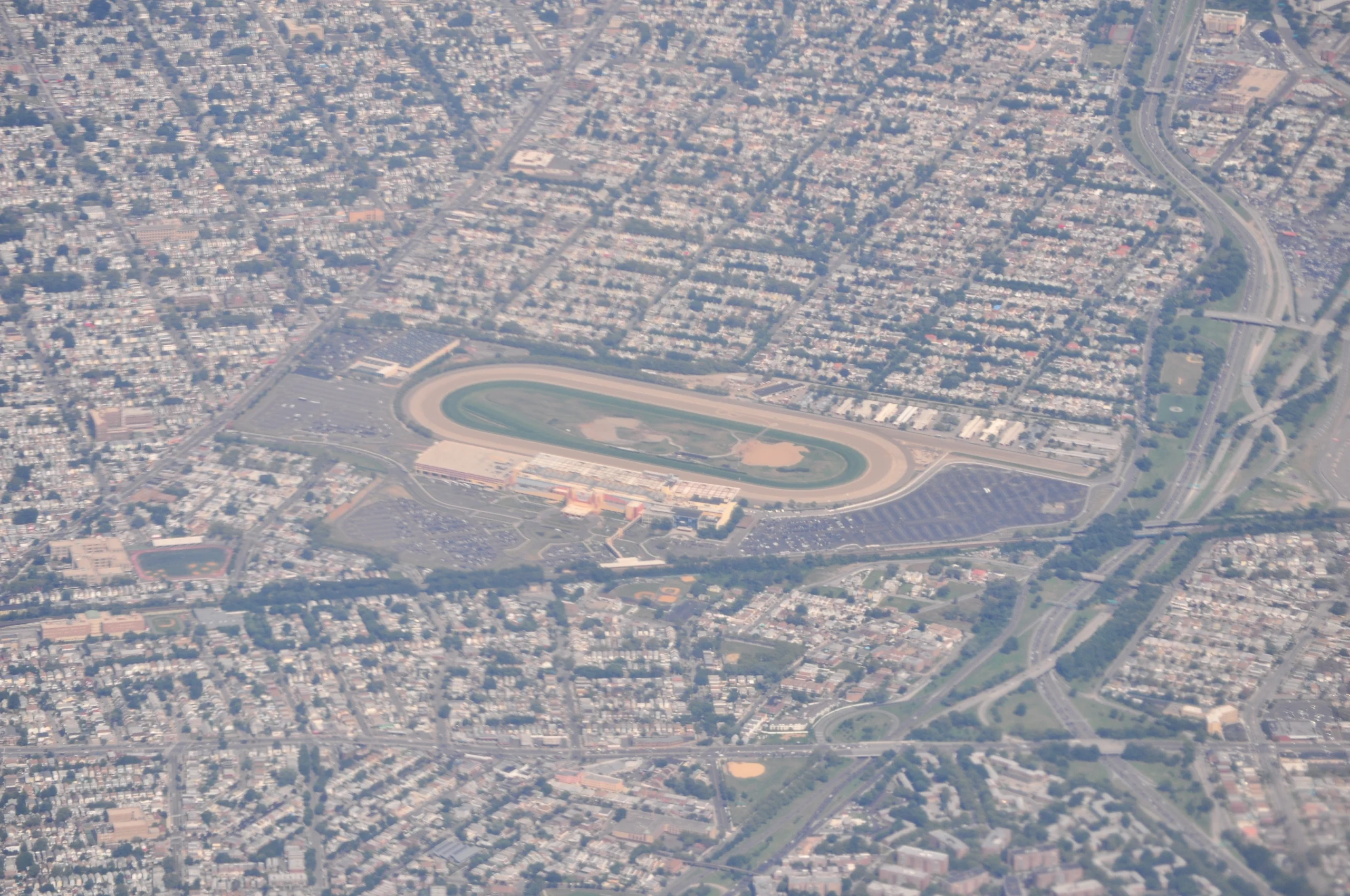
On September 14, 1959, a “new” Aqueduct Racetrack re-opened with 42,473 in attendance. At the time, the $33 million structure was the world’s largest sports venue in terms of acreage, and hopes were that the city’s lone racetrack would be the backbone of racing revenue in the state of New York.
That first day of wagering totaled $3.4 million – about $37 million in today’s dollars – and opened with a massive crowd that included Mayor Robert Wagner and former Gov. Averell Harriman, the adjective “glittering” no doubt added to bolster its locale in the oft-maligned borough of Queens.
And yet … the “new Aqueduct” of 1959 (the track first opened in 1894) never ascended to its hype as the most modern, up-to-date and user-friendly racetrack in the nation.
Yes, it had a modern massive grandstand, superior sightlines, improved amenities, a huge clubhouse and the promise that the state had entered the space age. But it was still in Queens, in an industrial, working-class part of the city where you weren’t arriving at some pastoral venue but next to an airport, highways, warehouses, and neighborhoods that never became destinations.
Meanwhile, Belmont Park, when completed in 1968 in its first (or second of third, but who’s counting?) renovation, still had the glamour. When winter racing came around, to Aqueduct, the track became synonymous with gray skies, bitter winds, grimy snowbanks; e.g. the place where horseplayers went because the races are running.
And yet … Aqueduct had its fans. Not because it was beautiful, but because it reflected the gritty honesty of its surroundings. The winterized “inner track” had its own specialists, both horsemen and handicappers, and some of the greatest New York riders and trainers earned their reputations grinding out wins there.
Parade of Stars at the Big A
— Eighteen-year-old Steve Cauthen, who in the bitter winter of 1977 notched five and six winners on multiple cards (riding 23 winners in a single week) and ended the year winning a record $6 million in purse earnings while still an apprentice.
— A talented young 3-year-old named Easy Goer setting a track record of 1:32 2/5 for a mile winning the 1989 Gotham Stakes.
— A plethora other memorable stakes races including the 1967 Woodward Stakes, in which Damascus beat both Buckpasser and Dr. Fager to cement Horse of the Year honors with his 10-length victory
— The triple dead heat of 1944, when on June 10, Brownie, Bossuet and Wait A Bit hit the wire as one in the Cater Handicap, still the only triple dead heat in a major North American stakes race.
— A parade of champions including Man o’ War, who won the 1920 Dwyer Stakes, defeating his rival John P. Grier while conceding 18 pounds; Hall of Famer Cigar, who launched his 16-race winning streak by winning his first two races there; and, of course, Triple Crown winner Secretariat, who made his career-opening debut and his final farewell appearance at Aqueduct.
Kelso ruled the 1960s
Which brings us to Kelso. A five-time Horse of the Year, Kelso garnered a legion of fans from 1960-65 despite never having run in a Triple Crown race, and often carried 130 pounds or more in his races at the Big A. He hit the board in 58 of his 63 races, won from 6 furlongs to 2 miles and set world records on both dirt and grass.
He was the first horse to have his own official fan club and had his own personal mailbox at owner Allaire duPont’s Woodstock Farm in Maryland. Despite many requests, a strand or two from his mane or tail were never mailed back to his fans (for fear he would die bald), which left many Kelso lovers from the five boroughs of New York bereft.
When he did pass, on Oct. 16, 1983, turf writer Joe Hirsch memorably wrote: “Once upon a time, there was a horse named Kelso. But only once.”
And, like Kelso, the Aqueduct of 1959 that became racing’s blue collar workhorse will be remembered not for its beauty but for its resilience.
On Sunday, a nine-race card closes out 132 years of racing at the Big A. So many memories, but certainly time to move on.
Jenny Kellner is an award-winning journalist and teacher who has covered thoroughbred racing for years. As a reporter for both United Press International and The Associated Press, her work has appeared in publications and on websites around the world. Jenny has also written for The New York Times, the New York Post, Newsday and Sports Illustrated.
Aqueduct Racetrack Closing: Recalling Memorable Moments | US Racing Top World News Today.
Hence then, the article about aqueduct racetrack closing recalling memorable moments us racing was published today ( ) and is available on TOP world News today ( Middle East ) The editorial team at PressBee has edited and verified it, and it may have been modified, fully republished, or quoted. You can read and follow the updates of this news or article from its original source.
Read More Details
Finally We wish PressBee provided you with enough information of ( Aqueduct Racetrack Closing: Recalling Memorable Moments .. US Racing )


Also on site :
- Walmart’s ‘Sleek’ $160 Folding E-Bike Is a ‘Zippy’ Way to Get Around, and Perfectly Priced for Holiday Gifting
- Man charged with attempted murder in violent attack on woman at Old Orchard Mall
- Sylvester Stallone Calls Himself an ‘Idiot’ After Years Performing His Own Stunts and Countless Surgeries