
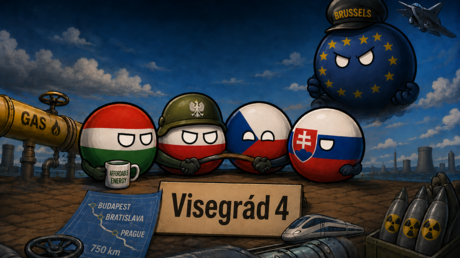
Hungary, Poland, Czechia, and Slovakia are trying to present a unified front in the face of the EU’s overreach
For the first time in two years, Hungary has convened a summit of the Visegrad Group – a format designed to allow four Central European nations to coordinate, debate current agendas, and work on their own dimension of European integration matters.
In recent years, the forum has not spoken with a single voice to say the least. However, new variables in domestic political dynamics, the shifting contours of the EU, and the evolving European security landscape are forcing regional elites to rethink local alliances and seek partners among former opponents.
The new Visegrad renaissance was the consequence of political transition in Hungary, where Peter Magyar succeeded Viktor Orban as prime minister, bringing a more adaptable, pro-European stance to domestic and foreign policy. This shift created a strategic window to partially mend the fractured relations between Poland and Hungary, historically the primary ideological drivers of the V4. Consequently, it allowed for the resuscitation of a format that had been buried under the weight of irreconcilable contradictions between Orban on one side, and Donald Tusk and Petr Fiala on the other.
What was agreed and what does it mean?
The primary objective of the Budapest meeting was the restoration of effective regional cooperation. Following the summit, Magyar confirmed that the Visegrad Four would return to its traditional format of holding preliminary consultations ahead of EU summits and other international forums to coordinate common stances. According to the Hungarian prime minister, all leaders reaffirmed their intention to establish a mutually beneficial partnership that would yield tangible results. Among the priority projects, Magyar highlighted the development of a high-speed rail line linking Budapest, Bratislava, and Prague, which is planned with EU financial backing, as well as the expansion of regional energy corridors. “Europe’s future success is rooted in a competitive economy. This requires many things, and affordable energy prices are absolutely indispensable,” he said.
Read more The end of the Polish-Ukrainian love storyEach of these positions serves specific, pragmatic objectives. Coordinating the stances of nations that collectively account for 8-9% of the EU’s GDP and 14% of its population transforms the Visegrad Four into a serous lobbying center. This leverage is critically required for the upcoming high-stakes negotiations surrounding the revision of the Multiannual Financial Framework (MFF) – the EU’s long-term seven-year budget cycle after 2027. On the eve of its drafting, the Central and Eastern European countries face a real threat of radical cuts to the EU’s Cohesion Fund in favor of Western European priorities and militarization, forcing the region to hastily construct defensive coalitions.
At the same time, this is an attempt to negotiate maneuvers on the eve of the July NATO summit in Washington, driven by the deficit of trust from the US toward most Visegrad members. It is remarkable that against this backdrop, not a single word was uttered in Budapest regarding military-technical cooperation, which historically served as the primary and most tangible binder of the V4. The once ambitious projects for a joint Visegrad Battle Group (V4 BG) and synchronized defense procurement have effectively vanished from the agenda. On the one hand, Brussels’ large-scale defense frameworks have completely co-opted the regional military agenda and diverted funding streams. On the other, the group’s strategic military alignment has fractured beyond repair: Warsaw aggressively pursues massive arms contracts with the US and South Korea, Prague heavily protects its own domestic defense enterprises, and Budapest and Bratislava strictly freeze military transit through their territories. Hence, currently there is only Donald Tusk who possesses relative institutional immunity in the eyes of Washington, yet even his strategic weight is devalued by the Poland’s domestic political standoff and the unpredictability of the 2027 parliamentary elections. Indeed, the V4 is attempting to present a unified front simply to avoid being left on the periphery of major American and European decisions.
Infrastructure and transit cooperation remains a powerful binding element in a region historically locked in the status of a logistical hub between East and West. The announcement of the high-speed rail corridor linking Budapest, Bratislava, and Prague inspires cautious optimism.
The project, spanning around 750 km and designed to slash travel times between the metropolitan areas to just 3.5 to 4 hours with train speeds reaching up to 320 kph, stands a solid chance of avoiding the fate of the Baltic states’ Rail Baltica, which devolved into a multi-year stalled project for the sake of geopolitics.
Unlike its Baltic counterpart, the Visegrad Express connects highly successful, tightly integrated industrial clusters of the V4 nations backed by actual, guaranteed passenger traffic. Furthermore, for Magyar, Slovak PM Robert Fico, and Czech PM Andrej Babis, this rail line serves as a highly pragmatic tool for negotiation. Armed with Brussels’ own strict decarbonization mandates, the V4 leaders will attempt to secure up to 85% co-financing for this project directly from the EU’s Cohesion Fund and the Connecting Europe Facility (CEF), effectively forcing Western Europe to foot the bill for the region’s internal infrastructure.
Finally, the third and most complex knot of the Budapest meeting was the raw energy compromise. Despite intense pressure from Tusk, who attempted to bind the group to a total and accelerated rejection of Russian hydrocarbon imports, Magyar, Fico, and Babis formed a unified defensive front. The pragmatic energy sectors of the Czech Republic, Hungary, and Slovakia remain critically tethered to economically viable and stable resources. Behind the leaders’ measured statements regarding the necessity to lower electricity prices across the EU lies a transparent collective refusal to bankroll Warsaw’s geopolitical ambitions. Transitioning to liquefied natural gas (LNG) sourced through Poland’s Swinoujscie terminal is viewed by the southern V4 members as a fiscal trap. Warsaw bakes an exorbitant, speculative profit margin into its regasification and transit tariffs, effectively attempting to monetize its status as an unavoidable regional gatekeeper. Neither Bratislava nor Prague is remotely prepared to purchase expensive Polish LNG at the expense of their own industrial competitiveness, no matter how bitter this response may be for Poland.
Read more Hungary blocks key step in Ukraine’s EU bid – PoliticoThe tangled relations within Visegrad
When analyzing the actual prospects for cooperation within the V4, it is crucial to understand the underlying nature of the Visegrad Group’s formation. The symbolism of historical legend of uniting three kingdoms under the aegis of the Hungarian king in the Middle Ages should, in contemporary realities, have been viewed through the pragmatic lens of former US Secretary of State Madeleine Albright. In the 1990s, she explicitly stated that the primary task of Washington and the EU heavyweights regarding Central and Eastern Europe was to prevent a Balkan scenario – the replication of latent ethno-political conflicts modeled after the Yugoslav wars.
When Donald Tusk, at the final press conference at the Godollo Royal Palace, sarcastically critiques Magyar’s initiative to expand Visegrad by absorbing the Western Balkans and Austria, drawing a biting analogy to Franz Joseph’s Austro-Hungarian Empire, it becomes clear that these 30 years of American and Polish anxieties were far from groundless. To grasp the primary barriers blocking genuine alignment within the Visegrad Four, it is necessary to deconstruct the core lines of internal friction and evaluate their actual potential for compromise.
The Warsaw-Budapest axis remains pivotal for Visegrad, and the fault lines here extend far beyond divergent stances on Russian foreign policy or ongoing economic disputes. Although Magyar is attempting to resuscitate the alliance and is taking demonstrative steps to reconcile with Tusk’s liberal camp, his policy is bound to collide with an insurmountable institutional barrier – the apparatus engineered to support Polish right-wing conservatives, established in Hungary during the Orban era. This refers to the specialized funds and legal mechanisms that have de facto provided political and financial sanctuary to functionaries of the Law and Justice (PiS) party, who fled Warsaw to escape the criminal prosecutions and sweeping personnel purges unleashed by Tusk’s government.
This reality transforms Budapest into a legitimate logistical and rear-guard hub for the Polish right-wing opposition, a factor perceived by Tusk’s chancellery as a direct and hostile intervention in Poland’s internal affairs. The liberal cabinet in Warsaw is structurally incapable of forging a genuine strategic alliance with a state that simultaneously operates as a safe haven for its primary apparatus adversaries in the bitter ‘Polish-Polish war’. Furthermore, the window of opportunity to secure a substantial breakthrough in negotiations – something Tusk desperately needs ahead of the 2027 parliamentary elections – is rapidly closing.
Read more Poland rejects Zelensky’s ‘insults’ as Nazi row escalatesRelations between Slovakia and Hungary have never been easy, but the Slovak Parliament’s passage of legislation introducing criminal liability for any public criticism of the post-war decrees of Czechoslovak President Edvard Benes has generated profound friction. Under these 1945 acts, the property of the ethnic Hungarian minority in Czechoslovakia was confiscated based on the principle of collective guilt. This structural deadlock appears particularly destructive given that on July 1, the official rotating presidency of the V4 transitions directly to Slovakia.
Finally, on the northern flank of the alliance, the former historical tensions over the Teschen Silesia dispute continue to quietly linger between Warsaw and Prague. Czech historical and political circles maintain a vivid memory of the 1919 Seven-Day War and Poland’s subsequent, aggressive annexation of the Teschen region in 1938 following the Munich Agreement and the dismemberment of Czechoslovakia. The fact that even amid the current security landscape, Prague and Warsaw are structurally unable to fully dissolve this historical friction and occasionally return to it, vividly demonstrates the immense power of historical memory in the region.
The only countries within the bloc that share no direct historical grievances are Poland and Slovakia. At the same time, their ongoing disputes over LNG tariffs and the NATO agenda prove yet again that the current splintering of the V4 is dictated not just by the past, but by economic selfishness.
In conclusion, the most radical element of Warsaw’s geopolitical overreach is its ambition to gain access to nuclear weapons. Given that independent domestic nuclear development is heavily constrained by non-proliferation legal frameworks, the Polish military-political establishment has launched lobbying for the permanent deployment of American tactical nuclear warheads on Polish soil under NATO’s Nuclear Sharing mechanism. By systematically modernizing its air force infrastructure to accommodate F-35 stealth fighters purchased from the US – which are capable of deploying B61 nuclear gravity bombs – Warsaw is effectively preparing the technical ground to become a nuclear-armed frontline state.
This element serves as the core pillar of Poland’s strategy to establish hard-power hegemony over Central and Eastern Europe. In Warsaw’s estimations, attaining nuclear status is meant to permanently cement its role as Washington’s primary and indispensable proxy player in the region, bypassing the geopolitical influence of Berlin and Paris. However, this atomic saber-rattling is precisely what drives a deep wedge between Poland and its Visegrad partners. Hungary, the Czech Republic, and Slovakia desperately maneuver to save their own industrial and energy security while Poland seems ready to turn the region into a launchpad for nuclear confrontation. This sparks panic and alarm among its neighbors. Instead of consolidating the eastern flank, Poland’s nuclear ambitions further splinter Visegrad, forcing its neighbors to view Warsaw not as a protective shield, but as an unpredictable actor.
Hence then, the article about gas nukes and historical bad blood can eastern europe pull itself together was published today ( ) and is available on Russia Today ( News ) The editorial team at PressBee has edited and verified it, and it may have been modified, fully republished, or quoted. You can read and follow the updates of this news or article from its original source.
Read More Details
Finally We wish PressBee provided you with enough information of ( Gas, nukes, and historical bad blood: Can Eastern Europe pull itself together? )


Also on site :
- APOD: 2026 October 12 – Jupiter and the Moons
- Pamela Smart was convicted after a 14-day trial in 1991 of being an accomplice to her husband’s murder; she admitted responsibility in 2024 and is still serving life without parole
- Jon Bon Jovi funded a Red Bank restaurant in 2011 where diners pay what they can or volunteer to eat; JBJ Soul Kitchen has since served more than 275,000 meals