
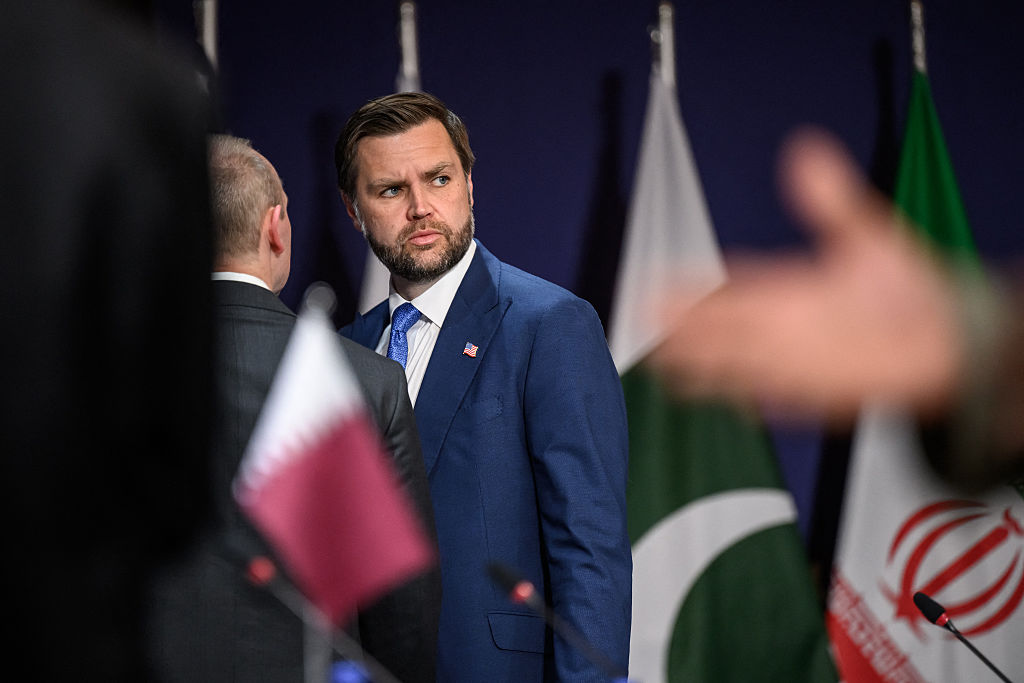
United States Vice President JD Vance arrived in Switzerland on Sunday to commence peace negotiations with senior Iranian officials, as both sides work to expand a fragile interim agreement aimed at ending the war. Among the most pressing issues is the Strait of Hormuz, which Iran said it re-closed Saturday—potentially jeopardizing a key provision of the emerging peace framework and prolonging disruptions to global trade, food supplies, and energy markets.
The move came amid renewed tensions in Lebanon. Israeli Prime Minister Benjamin Netanyahu claimed in a post on X that four Israeli soldiers were killed by Hezbollah combatants on Friday. Israeli strikes killed at least 16 people the following day, including two children, according to Lebanon’s civil defense agency, and its health ministry said that the latest action brought the nation’s death toll above 4,000.
As negotiators meet in Geneva, the following figures help illustrate some of the most consequential costs for the countries involved, the region, and the world.
Read more: U.S. and Iran Sign Agreement to Stop Fighting, Reopen Strait
Defense Secretary Pete Hegseth has been relatively tight-lipped about how much funding was being absorbed by the conflict, but Jay Hurst, the Pentagon comptroller, testified in May that Operation Epic Fury had already cost American taxpayers some $29 billion.
Several outlets have reported that the true cost of the war to the U.S. could be closer to $50 billion if it takes into account the bill for repairing extensive damage to military bases and replacing damaged or lost drones and missiles.
There will be a lasting impact on economic growth as the country faces a long process resolving outstanding costs, according to analysts. Goldman Sachs said in March that the war had “lowered our 2026 U.S. growth forecast and raised our 2026 U.S. inflation forecast to reflect higher oil prices”—a direct result of Iran closing the Strait of Hormuz.
The war has also cost the United States heavily in munitions.
“To put it in perspective, we fired more Patriot missiles in the first four days of the Iran war than we have given to Ukraine over the past four years,” Linda Bilmes, a professor at the Harvard Kennedy School, said in April.
Sen. Mark Kelly told CBS’s Face the Nation last month that it could take the U.S. “years” to replenish stockpiles—a timeframe corroborated by defense experts. For example, restocking Tomahawk missiles will cost $3 to $3.5 million each, and Patriot missiles will cost $4 to $5 million each, according to Bilmes.
The conflict has also exacted a human price. Pentagon statistics show that 13 service members have died and around 400 have been wounded in Operation Epic Fury.
3,636 lives: The toll in Iran
The U.S.-based Human Rights Activists News Agency reported in April that 3,636 Iranians have been killed since the war began. Figures compiled from government statements, health ministries, and human rights reports indicate that at least 2,100 of those casualties were civilians—the vast majority killed by U.S.-Israeli airstrikes.
Read more: These Are the Civilians Who Have Been Killed in the Iran War
Another significant measurement of the war’s impact is financial. Iran’s economy has long struggled, and its dollar currently ranks as the least valuable currency in the world. In April, Iran’s government told a Russian news agency that the conflict has cost the country $270 billion in direct and indirect damages.
Iran argued earlier this year that any peace deal would require the partial or full release of tens of billions of dollars that are being held abroad, explaining that it is essential to rebuilding the country's economy. Those assets have been tied up for decades because of sanctions, banking restrictions, and legal disputes. The framework of last week’s peace accord stated that Iran's “frozen or restricted funds or assets” would be made “fully available for use,” though details about the timing and scope of that process remain unclear.
The closure of the Strait of Hormuz, through which 20% of the world’s oil usually passes, has had worldwide economic consequences. The Institute for Economics and Peace estimated in June that the U.S.-Iran War is reducing global GDP by roughly $2.2 trillion annually—a figure that could skyrocket if the peace deal faces obstacles or fighting resumes.
Oil prices surpassed $100 per barrel in early 2026. By contrast, before the onset of the conflict, the prices more consistently hovered around $67 to $71 per barrel.
Eight countries—Iran, Iraq, Kuwait, Saudi Arabia, the United Arab Emirates, Qatar, Bahrain, and Oman—depend on the Strait of Hormuz for the bulk of their hydrocarbon exports, but the closure has led to energy shortages and conservation efforts in farther removed countries as well, including Australia, Bangladesh, and South Korea.
Fatih Birol, executive director of the International Energy Agency, called the crisis “the greatest energy security challenge in history.”
1 million: Lebanese people displaced by the Israel-Hezbollah conflict
The United Nations Office for the Coordination of Humanitarian Affairs said that over a million Lebanese people have been displaced since the start of the U.S.-Iran War. It also estimated that close to 1 in 4 people in Lebanon are set to face “crisis and emergency levels of food insecurity.”
Much of that displacement has been driven by Israel's continued military operations in Lebanon—despite several ceasefire announcements. Netanyahu said the continued strikes aim to establish “security zones” around Israel.
“We established deep security zones around the state of Israel. We did this in Gaza, in Lebanon, and in Syria,” he said in a televised press conference June 15. “And I want to make it clear: We will remain in these security zones … to protect our country.”
Read more: Israel's War Against Lebanon, Explained
According to the map published by Israel soon after the ceasefire, the buffer zone marks about 600 square kilometers consisting of 57 towns and villages. Airstrikes also took place outside of that buffer zone until late May, and evacuation orders continue to span about a fifth of the country.
At least 4,000 people have been killed in Lebanon, according to its health ministry, which does not distinguish between civilians and combatants. One of the deadliest days in the conflict was June 18, when the Israeli Air Force struck the outskirts of Nabatieh, Sidon, and Tyre, killing at least 47 people and injuring 97.
The Israeli Defense Forces (IDF) claimed that over 1,700 Hezbollah combatants died during operations in Lebanon. In comparison, an Israeli news source reported on Saturday that 35 IDF soldiers and at least four civilians have been killed since March 2.
Although the MOU requires “the immediate and permanent termination of military operations on all fronts” from not only the U.S. and Iran, but also their allies, Israel published an updated version of its security zone map last Thursday showing that forces are still deployed 10 kilometers into Lebanon. Israel’s Defense Minister Israel Katz reiterated on Sunday that Israel will not withdraw and said the military will have “no restriction.”
The ceasefire between Hezbollah and Israel "leaves the IDF in all of its positions within the security zone,” he said, adding that their presence intends to protect residents in northern Israel.
Hence then, the article about the u s iran war by the numbers was published today ( ) and is available on Time ( Middle East ) The editorial team at PressBee has edited and verified it, and it may have been modified, fully republished, or quoted. You can read and follow the updates of this news or article from its original source.
Read More Details
Finally We wish PressBee provided you with enough information of ( The U.S.-Iran War: By the Numbers )


Also on site :
- Peso Pluma Leads 2026 Billboard Latin Music Awards Finalists: Complete List
- Man who plants thousands of 9/11 memorial flags in West Sacramento will retire, hopes tradition lives on
- Giancarlo Esposito, Jinkx Monsoon & Debra Wilson Star Opposite Brandon Rogers In His Debut Feature ‘Weird Party’