
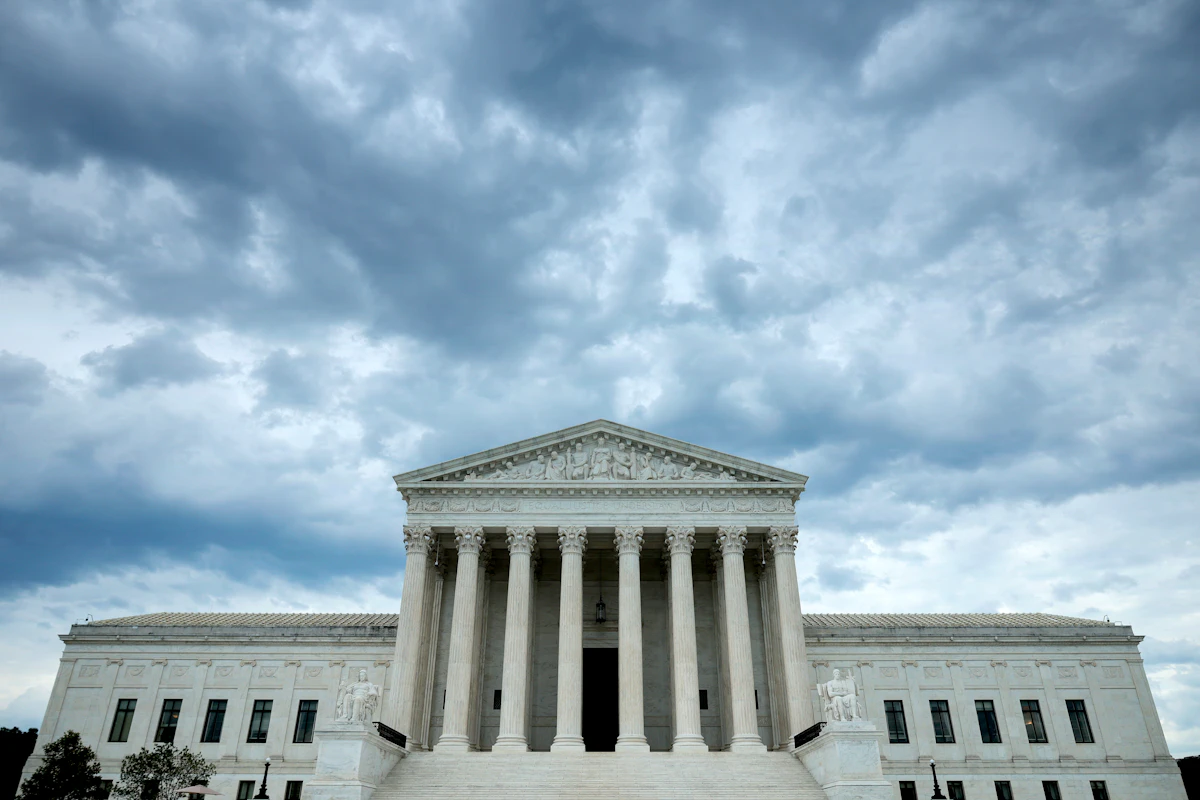
The Supreme Court narrowed a federal law that made it a criminal offense for illegal drug users to own firearms, ruling on Thursday that the conviction of a Texas man under that measure was “inconsistent with the Second Amendment.” While the ruling was a rare moment of unanimity, the various judges displayed some interesting fissures between them—and highlighted how thorny Second Amendment cases have become since the court imposed a new test for gun-rights cases.
Justice Neil Gorsuch, writing for himself and six other justices, said that federal prosecutors had not found a sufficient historical analogue under the court’s “history-and-tradition” test to support the prosecution. “Without more, the government asks us to analogize all such persons to habitual drunkards,” he wrote in United States v. Hemani. “To state the analogy is to expose its deficiency.”
Thursday’s ruling is another milestone in the federal courts’ four-year quest to reconcile America’s numerous gun restrictions with the Supreme Court’s new history-and-tradition test. While it marks the first time since adopting the test that the court has used it to invalidate a federal law, it also underscores how much the high court has curtailed the test’s original ambitions.
The case began when federal agents searched the family home of Ali Hemani in 2022. The U.S. government suspected that Hemani, a Texas-born American who also has Pakistani citizenship, had ties to terrorist organizations. During the search, Hemani surrendered a firearm that he otherwise lawfully owned and told them that he regularly smoked marijuana, some of which he had in his possession. He also took ownership of a bag of cocaine that the agents found in his parents’ closet.
Thanks in part to Hemani’s forthrightness, federal prosecutors charged him with violating Section 922(g)(3), which make it a federal offense to knowingly possess a gun in one’s home while being an “unlawful user” of a controlled substance. “The charge had nothing to do with terrorism—the reason for the search in the first place,” Gorsuch noted. “Nor did the charge involve possession of cocaine, drug trafficking, or anything like that.” Indeed, one gets the distinct impression that prosecutors were trying to prove that they weren’t wasting everyone’s time.
Before trial, Hemani sought to dismiss the indictment by arguing that it violated the Second Amendment. The Supreme Court held in District of Columbia v. Heller in 2008 that the amendment protects an individual right to bear arms. In the 2022 case New York State Rifle and Pistol Association v. Bruen, the court’s conservative majority laid out a strict new test to determine when a gun restriction runs afoul of this right.
Under Bruen, such laws that limit the individual right to bear arms are presumptively unconstitutional. “The government must then justify its regulation by demonstrating that it is consistent with the Nation’s historical tradition of firearm regulation,” Justice Clarence Thomas wrote for the court. “Only then may a court conclude that the individual’s conduct falls outside the Second Amendment’s unqualified command.”
This history-and-tradition test prompted a wave of gun-related litigation in the lower courts. The Supreme Court revisited it in United States v. Rahimi, a case challenging the federal ban on gun ownership for certain domestic abusers, to clarify that the government need not provide a “historical twin” to successfully defend a gun restriction. Instead, lower courts can uphold them by identifying a “historical analogue” to the existing law—in Rahimi’s case, for example, founding-era surety and affray laws.
In Hemani’s case, the Justice Department argued that Section 922(g)(3) was akin to founding-era laws that prohibited gun ownership for “habitual drunkards.” Some of these laws required them to post surety bonds to carry a gun; others allowed legal guardians or civil officials to involuntarily place them in workhouses or asylums. In either event, federal prosecutors argued, these laws pointed to a historical tradition of disarming people who use certain substances.
The trial court and the Fifth Circuit Court of Appeals found this reasoning unpersuasive. It fared no better at the Supreme Court, in part because of the sweeping nature of what prosecutors sought. “It doesn’t matter what controlled substance an individual uses, in what amounts he does so, or whether his drug use has ever made him a danger to himself or others,” Gorsuch noted. “It doesn’t even matter why he keeps a gun or how safely he does so. And for violating this automatic ban, the government insists, an individual like Mr. Hemani may be sent to prison for up to 15 years and disarmed for life.”
All those laws cited by the government, Gorsuch explained, affected a much narrower subset of people who used intoxicants. There is some historical evidence that early nineteenth-century Americans drank considerably more alcohol than their modern descendants do today. Founding-era laws only considered someone a “habitual drunkard” if they were basically unable to care for themselves. A person occasionally smoking marijuana like Hemani hardly fits that description.
“Had habitual drunkard laws applied to those who simply drank regularly, many notable early Americans could have faced trouble,” Gorsuch wrote, quoting from historians. “John Adams took ‘a tankard of hard cider’ with his ‘daily breakfast.’ Some say James Madison ‘consumed a pint of whiskey daily.’ George Washington often drank three glasses of madeira in the evening—‘not enough to be considered a heavy drinker in his day.’”
Gorsuch also took issue with Section 922(g)(3)’s reliance on the Controlled Substances Act to define who can be disarmed. “Without question, some unlawful users of controlled substances can pose a risk of violence,” he acknowledged. “But, by defining its scope through the CSA—a statute animated by a variety of other concerns—it is far from obvious that [Section] 922(g)(3) confines its reach to those who are categorically and unusually dangerous.”
He also stated the plainly obvious: Marijuana, though legally considered a Schedule I controlled substance under the CSA, is hardly treated like one by the federal government these days. Over the last quarter-century, many states have legalized marijuana for medical and recreational use. Federal prosecutions for mere possession of marijuana have vanished, and federal regulatory agencies actively turn a blind eye to the burgeoning marijuana industry.
“Whatever one thinks of these developments, the federal government has not just tolerated them; it helped fuel them,” Gorsuch noted. “All of which leaves it awkwardly positioned to suggest that the millions of Americans who now regularly use marijuana are categorically and unusually dangerous.” This is obviously not the case, and it is unsurprising that all nine justices reached the same conclusion.
The court claimed that Thursday’s ruling was a “narrow one” because it did not address other contexts, including whether the government could ban “addicts” or the “presently intoxicated” from possessing a gun. This will be relevant for prosecutions involving other controlled substances, of course—drugs like heroin, ecstasy, and fentanyl pose much greater risks and more easily replicate the conditions that habitual-drunkards laws addressed.
Beneath the surface, there were also some notable divides. Justice Ketanji Brown Jackson wrote a concurring opinion, joined by Justice Sonia Sotomayor, where she explained that she would have reached the same decision under the pre-Bruen framework. Lower courts previously used “means-end scrutiny” to weigh the constitutional burden of gun laws, Jackson said, and that approach was “more rational” than Bruen’s history-and-tradition test, which she described as “unworkable.”
The Bruen test “imposes on judges the unfamiliar and difficult tasks of sifting through centuries-old evidence in order to answer ‘contested historical questions,’ and ‘applying those answers to resolve contemporary problems,’” Jackson wrote, quoting from her predecessor Stephen Breyer’s dissent in Bruen. “Given those challenges, it is unsurprising that Bruen’s test is vulnerable to inconsistent and arbitrary application, as judges draw different conclusions from the same historical evidence and reach divergent assessments of the same laws.”
Justice Samuel Alito and Justice Elena Kagan agreed only with the majority on the outcome. Alito, writing for the two of them, argued that the court could have ruled more narrowly to say that there was no correlation between habitual-drunkard laws and modern marijuana use at all. “Here, the Government’s analogues are too far afield to justify the application of Section 922(g) to a marijuana user like [Hemani],” he wrote. “We need not say more to decide this case, and I would for that reason say no more.”
Ironically, the author of Bruen once again wrote for himself. Justice Clarence Thomas agreed with the majority, but also urged his colleagues to reconsider the constitutionality of a broad swath of federal gun restrictions beyond this one. Those laws may be invalid, Thomas claimed, because they exceed Congress’s regulatory powers over interstate commerce. If the court agreed with Thomas’s implied view, it would be striking down federal bans on gun ownership for convicted felons and fugitives, among other groups. One can hardly blame the other eight justices for their disinterest.
In the four years since Bruen was decided, courts reached wildly different conclusions about how far the history-and-tradition test should go in changing the landscape of American gun restrictions. There are plenty of questions left to be resolved by the justices: They haven’t yet heard challenges to state-level bans on AR-15s and other so-called “assault weapons,” for example. So far, however, the post-Bruen landscape at the high court doesn’t look all that different than the one preceding it—save for, as Jackson shrewdly noted, decisions that it could’ve reached without Bruen as well.
Hence then, the article about the supreme court has good news for stoners with guns was published today ( ) and is available on The New Republic ( Middle East ) The editorial team at PressBee has edited and verified it, and it may have been modified, fully republished, or quoted. You can read and follow the updates of this news or article from its original source.
Read More Details
Finally We wish PressBee provided you with enough information of ( The Supreme Court Has Good News for Stoners With Guns )


Also on site :
- In 1924, Caesar Cardini ran out of kitchen supplies in a Fourth of July rush at his Tijuana restaurant; he tossed romaine with what was left, and the salad carries his name
- Viola Davis, 61, Opens Up About ‘Extremely Painful’ Health Condition for the First Time: ‘It Terrified Me’ (Exclusive)
- Rosalía Shuts Down Kenan Thompson’s Idea for a Pop-Classical Album in Hilarious ‘SNL’ Promo: ‘That’s LUX’