
The lost restaurants of San Diego series reaches a turning point in the final installment — not with any one single moment, but with a gradual shift that changed how the city looked and felt when people went out to eat.
By the 1970s and 1980s, San Diego’s restaurant and nightlife scene was no longer defined only by independently designed dining rooms, hotel cocktail lounges, and one-of-a-kind neighborhood spots. Those places still existed, but they were increasingly sharing space with national chains, standardized interiors, and a growing emphasis on branding.
The change didn’t announce itself. It appeared gradually in familiar places across the city.
Hotel dining gets a new identity
Hotels remained central to San Diego’s dining culture, but their interiors began to shift. The darker, more stylized cocktail lounges of earlier decades gave way to brighter spaces, simplified design, and more standardized hospitality formats.
Westgate Hotel – Lobby c. 1970. (Photo courtesy of the San Diego History Center)The Westgate Hotel, which opened in 1970, reflects this transition. It marked a move toward modern luxury hospitality — more polished, more consistent, and less reliant on heavily themed lounge environments that had defined earlier eras.
Downtown San Diego reflected this broader change, particularly along Broadway and the 5th-6th Avenue corridors, where older lounge culture gradually gave way to more standardized hotel-driven hospitality and later entertainment-oriented redevelopment.
Downtown San Diego corridor c. 1970s. (Photo courtesy of the city of San Diego Digital Archives)When commercial corridors started to feel familiar
During this time, commercial streets across San Diego began to look more uniform. National chains expanded into areas once defined by independent diners, drive-ins, and locally owned restaurants.
Menus became more standardized. Interiors became more interchangeable. Branding increasingly shaped the dining experience.
Jack in the Box drive-thru c. 1978. (Photo courtesy of the San Diego History Center)On University Avenue in North Park, this shift is visible in archival photographs showing long-standing local businesses alongside expanding chain restaurants such as KFC and Jack in the Box. The surrounding corridor reflects the same broader pattern of commercial change.
Palisades Garden Roller Rink / KFC – University Avenue, North Park c. 1980. (Photo courtesy of the San Diego History Center)A similar pattern unfolded along El Cajon Boulevard, where independent diners and drive-ins continued operating but increasingly shared space with chain restaurants and redevelopment pressure.
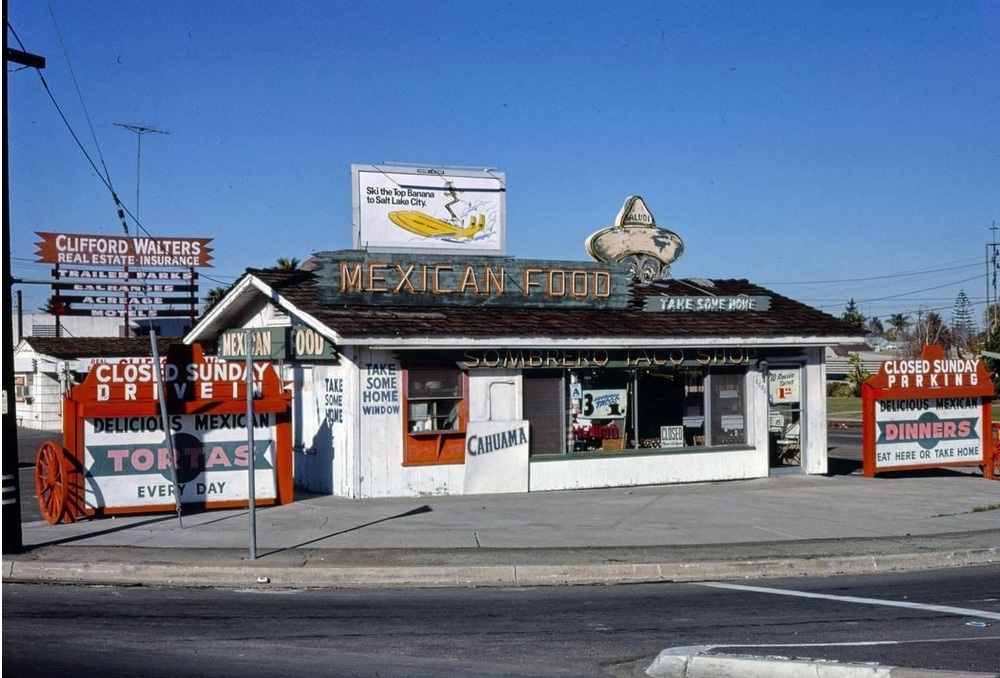
Alongside national chains, small independently owned Mexican restaurants became a more visible part of San Diego’s commercial corridors during this period. Family-run taquerías and casual neighborhood eateries appeared more frequently along streets such as El Cajon Boulevard, as well as in communities including National City and Chula Vista. These spaces added a local, informal counterpoint to the expanding presence of standardized chain dining.
Nightlife follows a new pattern
Bars and nightlife venues also shifted. Earlier decades often centered on spaces tied closely to a specific building, hotel identity, or architectural personality.
Daily Planet Bar c. 1980s. (Photo courtesy of the San Diego History Center)By the 1970s and 1980s, more venues moved toward themed concepts and flexible interiors designed to evolve over time. Identity increasingly came from branding and concept rather than permanence of place.
The “Daily Planet” bar reflects this broader nightlife shift, where atmosphere and branding carried as much weight as physical structure.
Garnet Avenue in Pacific Beach also reflects this transition, as surf-era nightlife and independent bars gradually evolved toward more concept-driven, commercially branded entertainment spaces.
Independent restaurants in a shifting landscape
Independent restaurants remained active across the city, holding onto familiar dining traditions and long-term neighborhood followings.
Patrons dining at Lubach’s in 1978. (Photo courtesy of the San Diego History Center)Lubach’s Restaurant represents that earlier era of full-service dining: white-tablecloth service, established clientele, and a more formal hospitality model rooted in mid-century restaurant culture.
But the environment around it was changing. Redevelopment, rising competition, and shifting expectations gradually reshaped how restaurants were designed and experienced.
A more uniform city begins to take shape
Across hotels, restaurants, and nightlife spaces, design became more standardized. Corporate branding systems and repeatable interior formats increasingly replaced highly individualized spaces that had once defined San Diego’s dining identity.
This shift is visible across multiple corridors — Downtown San Diego, Mission Valley, El Cajon Boulevard, and North Park — each reflecting the transition in different ways.
The transformation didn’t erase independent restaurants, but it did change the visual and cultural rhythm of eating out in the city.
Closing
By the end of the 1980s, San Diego’s restaurant and nightlife landscape no longer closely resembled earlier decades. Hotel lounges had been modernized. Chain restaurants had expanded into everyday corridors. Independent restaurants still existed, but they now operated within a more standardized environment.
What stands out in this transition is not a single break, but a slow accumulation of changes that reshaped how the city experienced food and nightlife.
The lost restaurants of San Diego series ends here.
If you missed any of the series, the links are below for parts 1-4:
timesofsandiego.com/arts/2026/05/02/history-restaurants-cafes-san-diego/
timesofsandiego.com/arts/2026/05/09/restaurants-drive-expansion-car-city/
timesofsandiego.com/arts/2026/06/02/restaurants-san-diego-roadside-dining/
timesofsandiego.com/arts/2026/06/12/restaurants-san-diego-nightlife-lounges-entertainment-dining/
Read more history stories here, and do you have a story to tell? Send an email to [email protected].
Coming soon: The canneries of San Diego series
Sources:
San Diego Historical Society / San Diego History Center archives (restaurant and hospitality development collections)Westgate Hotel official history (Westgate Hotel, San Diego — property historical timeline)City of San Diego Planning Department historical corridor redevelopment records (1970s–1980s commercial zoning and redevelopment reports)San Diego Public Library Digital Collections (photographic archives of commercial corridors, hotels, and dining establishments)Regional hospitality and tourism histories documenting the rise of chain restaurants in Southern California (UC San Diego Library Special Collections references)
Hence then, the article about lost restaurants of san diego final chapter independent dining rooms to chain corridors was published today ( ) and is available on Times of San Diego ( Middle East ) The editorial team at PressBee has edited and verified it, and it may have been modified, fully republished, or quoted. You can read and follow the updates of this news or article from its original source.
Read More Details
Finally We wish PressBee provided you with enough information of ( Lost restaurants of San Diego, final chapter: Independent dining rooms to chain corridors )


Also on site :
- Ukraine-Russia war latest: Nato jets scrambled to shoot down foreign drone after it enters Latvian airspace
- 1968 Song by The Rolling Stones, Ranked Among ‘Greatest Protest Rock Songs,’ Is Still a Powerful Hit 58 Years Later
- A small Texas company’s bid to create a Greenland oil boom—and a Dr. Phil documentary—is delayed but undaunted