
It was legendary playwright Anton Chekhov who articulated the narrative rule that if you hang a pistol on a wall in act one of a play, by act three it must be fired. That dictum applies beyond the theater. According to a new study in the Journal of Geophysical Research: Solid Earth, Chekhov’s gun may have been cocked and loaded in Southern California, where 20 million residents living along the San Andreas and San Jacinto faults appear to be facing earthquake conditions more hair-trigger than at any time in the past 1,000 years. It has been 160 years since the last major quake in that shared geological system relieved some of the faults’ accumulated stress, and the stored energy in both formations could erupt at any time.
“Our findings suggest that the potential for something more complex than a single-fault rupture is real and growing,” said lead author Lillian Burkhard, research affiliate at the University of Hawaii at Mānoa and scientist at the University of Bern, in an email to TIME.
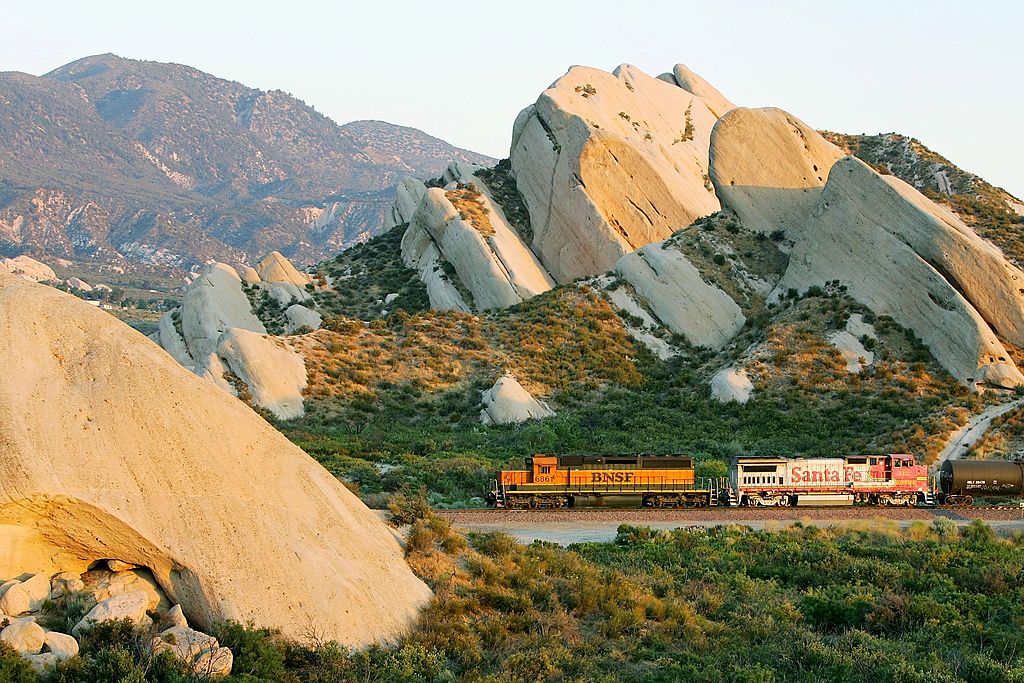
The San Andreas fault is a fracture in the Earth that runs 800 miles northwesterly from the Salton Sea in the south up through San Francisco in the north. The smaller San Jacinto fault traces a path 130 miles through Southern California, running more or less—but not entirely—parallel to the San Andreas fault. The two formations do intersect at one point: the Cajon Pass, a gap between the San Gabriel and San Bernardino Mountains that serves as a passage from the Mojave Desert to the Los Angeles Basin.
Read more: Scientists Believe This Major Earthquake Fault Line Is Waking Up
When it comes to earthquakes, the Pass is both a very good thing and a very bad thing. Either one of the two faults could heave by itself, causing a major quake, but it’s also possible that both could rupture together, leading to a more powerful and more-widespread disaster. The risk of a dual-fault event rests on the Cajon Pass, which Burkhard and her colleagues describe as an “earthquake gate”—a geologic formation that could sometimes stand in the way of a large tremor passing from one fault to the other and sometimes wave the temblor through.
“Cajon Pass is a structurally complex junction,” says Burkhard, “where multiple geological factors combine to create gate-like behavior.”
To conduct their study, Burkhard and her colleagues surveyed existing data of both tree-ring analysis and radiocarbon dating of preserved sediment, reaching back 1,000 years in the geological record. When it came to the sediment, they looked particularly at displaced regions—spots where the ground once shifted and cracked. Tree rings were more complex. Quakes can leave trees standing at irregular angles, uproot them entirely, and disturb their drainage patterns. Such stressors can lead to a narrowing of the rings.
“By precisely dating these anomalies which acts as a natural calendar going back centuries,” Burkhard says, “scientists can identify years in which a major seismic event likely occurred in the region.”
The researchers fed this millennium-long data into a computer model to determine how much stress has built up along the faults in that temporal window. The conclusion: there has been little tree ring or sediment evidence in the geologically recent record, meaning the San Andreas and San Jacinto systems are loaded to blow—more stressed than they’ve been since the 11th century.
It’s here that the Cajon Pass gets involved. If stress levels of the two faults are similar—both exhibiting the same degree of stress at the same time—they may trigger joint quakes that will break through the boundary of the pass. For a dual quake to happen, however, seismic activity has to occur deep underground, since the faults don’t cross at the surface of the Cajon Pass, but rather far below. “A rupture crossing from one region to the other requires favorable conditions at depth,” says Burkhard. Higher up and the Cajon gate will slam shut, preventing a dual-fault event.
Just how likely a major, two-fault quake is and just when it might happen is uncertain. Burkhard warns that the U.S. Geological Survey estimates a 75% likelihood of a magnitude 7 earthquake—similar to the Haiti earthquake of 2010 and the Indonesian earthquake of 2018—in California within the next 30 years. The new findings only add to that danger.
But there are caveats. First of all, the new research was a computer model, not a direct measurement of the current state of the two faults, which would yield more reliable data. Second, as with all earthquake research, trying to time just when a quake will happen is notoriously hard—“one of the most difficult unsolved problems in science,” Burkhard calls it.
The new findings are thus less a reason to panic than to prepare—to have emergency kits and go-bags at the ready, to establish family communication plans, to know in advance evacuation routes from the home and the workplace. “The risk,” says Burkhard, “is real.”
Hence then, the article about a millennium of pressure has been building under california fault lines what does that mean for earthquake risk was published today ( ) and is available on Time ( Middle East ) The editorial team at PressBee has edited and verified it, and it may have been modified, fully republished, or quoted. You can read and follow the updates of this news or article from its original source.
Read More Details
Finally We wish PressBee provided you with enough information of ( A Millennium of Pressure Has Been Building Under California Fault Lines. What Does That Mean for Earthquake Risk? )


Also on site :
- Social Security COLA Announcement Is Oct. 14, and a New Forecast Predicts a 3.5% Increase
- Brandi Glanville, 53, Shares Heartbreaking Family News Amid Her Own Health Battle: ‘I Hate This Life Right Now’
- Ella Rumpf, Júlio Andrade, Ana Flávia Cavalcanti to Star in Locarno Winner Andrea Staka’s ‘Ibicaba: O Paraíso Prometido’ for MyMama Entertainment (EXCLUSIVE)