
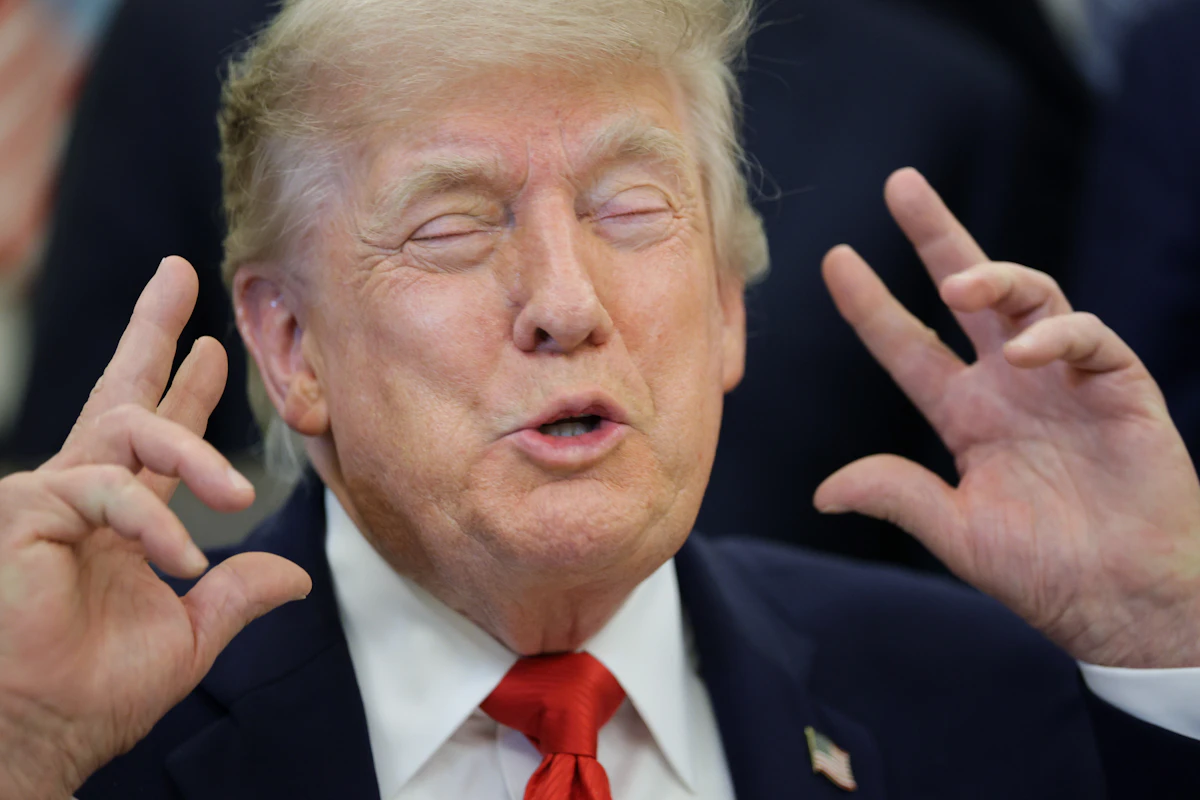
The following is a lightly edited transcript of the June 12 episode of the Daily Blast podcast. Listen to it here.
Greg Sargent: This is The Daily Blast from The New Republic, produced and presented by the DSR Network. I’m your host, Greg Sargent.
CNN reports that Donald Trump is furious because his bombings of Iran this week were not portrayed by the media as strong and powerful. He’s apparently frustrated, according to CNN sources, who are clearly leaking out of concern for his mental state. On another front entirely, Trump is smashing new records in the polling. He’s reaching new thresholds on inflation, and thanks to Trump, Democrats may now be leading Republicans by a key polling metric for the first time in many decades.
We think these stories should all be connected to each other. The rage and frustration over Iran is basically rage and frustration over his political situation, because the former is causing the latter. He’s in a political bind that we don’t think we’ve ever seen before.
So we’re parsing through all this new data and new Trump lunacy with Democratic strategist Christina Reynolds, who has worked on a lot of midterms and can explain how all this is playing on the ground. Christina, thanks for coming on.
Christina Reynolds: Thanks for having me.
Sargent: So let’s start here. CNN polling analyst Harry Enten made a point I haven’t heard before. He said Trump is the only president ever to hit a net approval on inflation of negative 50 points. And he’s done this in many polls. Listen to Enten.
Harry Enten (voiceover): Inflation net approval minus 50 points or worse. Fifty points underwater or worse. Total polls per president. Trump in 2026—already eight polls, already at least eight polls in which his net approval rating on inflation or the cost of living is negative 50 points or worse. Every other president in every other year, the answer is zero.
Sargent: So just to reiterate, in eight polls, Trump has hit a net approval on inflation of negative 50 points. No other president has ever done that. Christina, I don’t think I’ve seen polling quite this bad on the economy for a president—maybe ever, as long as I’ve been following politics. Maybe something like under George W. Bush, but I don’t know. What do you think?
Reynolds: I don’t think it was this bad. And I worked at the Democratic Congressional Campaign Committee in ‘06, and we took back the House. And Bush was certainly not a popular president at that time. But these are numbers that I would send back to the pollster and say, can you double-check? I don’t know that I’ve seen numbers this bad.
And I think Republicans have an even bigger problem than those numbers. They have a president who absolutely wants credit for fixing everything. He believes his own spin, certainly, but also he believes he’s taken action and should get credit for that action. And to some degree that happens with a lot of politicians, but this president is especially guilty of that. And so he is not going to fade away into the background, which Bush did largely in 2006. He is not going to let the Republicans go out and shift the conversation.
Not that I think they would be able to shift the conversation. When inflation is growing higher than your wages, voters understand that. They know it. They live it. And so you can’t convince them things are better when they’re literally not. But Trump is not just going to go out and talk about things and remind voters of that—he’s going to go out and talk about his ballroom. He’s going to go out and talk about the reflecting pool, as he did in Wisconsin when he went to one of the most vulnerable Republicans. So this is a huge problem for Republicans. It’s not just the polling number, it’s what Trump’s going to do because of the polling number.
Sargent: You raise a really interesting point there, which is that Donald Trump isn’t being at all accommodating of the situation that Republicans find themselves in. They’ve kind of urged him to try to talk about the economy in a way that makes it look as if he understands what people are going through and makes it look as if he’s doing stuff. But he won’t do that because it makes him look like a failure, right?
Since everything has to always be about his lionization, his glorious greatness, he just says, I don’t care about inflation, or affordability’s a hoax. There’s no sensitivity or awareness of the situation the rest of his party is in, in any sense.
Reynolds: Absolutely not. And that is counter to George Bush. It’s counter to what Nancy Pelosi did when she was House Speaker and understood that some people were going to speak out against her. As long as she had the votes, she was OK. I think that there’s some level of what gets the party, what gets the values that you support, where you need to go. And Trump is about what gets Trump where he needs to go. And it’s a huge problem for Republicans.
I mean, you heard it in the “I don’t care about the midterms” comment. You hear it in everything that he does. And my guess, if I was a Republican, I would want him to take a back seat on things outside of maybe fundraising. And he’s doing the exact opposite. And so if you’re a Republican and you’re forced to stand up there and praise him for gold-plating the White House, that’s a pretty tough campaign ask.
Sargent: That’s really interesting. By the way, Harry Enten also notes that, according to his calculations, Democrats are more trusted on inflation than Republicans for the first time since the 1970s. And Enten also notes that Trump is the only president to ever hit 80 percent disapproval on gas prices. Eighty percent disapproval on gas prices. Trump is just crushing records all over the place. I swear I have not seen numbers like this, ever.
Reynolds: No, me neither. It’s pretty impressive when you think about it. It also is a sign that you can’t pull the wool over voters’ eyes on things like this. Everyone goes to the gas station. Everyone has to deal with the prices going up because of gas prices.
And so you can’t fool them. And Trump talking the way he does and acknowledging that it’s OK, but it’ll get better, doesn’t help them now. He’s really leaving Republicans in a rough spot.
Sargent: It’s really extraordinary. So all this is key context for what’s coming next. CNN’s Dana Bash reports that sources are saying Trump is, quote-unquote, “furious.” Why? Because after Trump struck Iran this week, the media didn’t view his action as powerful enough. Dana Bash also reports that Trump is frustrated that Iran didn’t seem to be taking the strike seriously. Amazing.
So now Trump is saying that he won’t strike Iran again because they’re now close to a deal. He says—maybe by the time people listen to this, there will be a deal. Maybe not. I don’t think so, because he’s now talking about maybe this weekend. But put that aside. I want to focus on the connection between Trump’s rage and his terrible polls.
The reason Trump is angry isn’t just because Iran won’t do his bidding. It’s that by not doing Trump’s bidding and keeping the Strait of Hormuz closed, Iran has him cornered. It’s driving up prices, destroying his numbers, and destroying GOP midterm hopes. The anger and the polling are connected in that sense, right, Christina?
Reynolds: Absolutely they are. His frustration is coming out in what voters are understanding. They get—because also it’s one of the reasons he can’t stop talking about things that are incredibly unpopular.
He is just clinically unable to move on because of that rage and that frustration, because it didn’t go the way he assumed it would go. And so we are stuck in a war that people didn’t ask for, that we proactively started. But we are domestically stuck with higher gas prices and everything that stems from that.
And that’s all because he didn’t get what he wanted, and no one is giving him credit for what he thinks he should get credit for. I am a little baffled as to what he thinks he should get credit for at this point, but no one is giving him any credit. They are giving him, rightly, the blame. And he can’t handle that.
Sargent: Yeah, I think that’s exactly right. He’s in a rage because the media is portraying him as being fundamentally ineffective and unable to resolve the very situation that’s creating the high prices.
And by the way, even if he gets a deal—I don’t know, by the time people listen to this, or on the weekend, whenever—even if he gets one, those prices, especially on things like energy and gas, are going to stay up for a long time. How do you anticipate this?
As someone who’s worked on midterm elections, how do you anticipate the impact of this playing out on the ground in all these races over the next few months? What’s it going to look like politically?
Reynolds: I think it’s going to look like a few things. We’re going to see more retirements. We’re seeing that at every level of the ballot, where Republicans are choosing just not to run again in this environment. We’re going to continue to see voters open for a change in surprising places—voters who understand that maybe it’s not forever, maybe we rent some seats for a little while.
But they see it’s not working. And where we have candidates that are out there talking about issues that matter versus a candidate that is forced to talk about a ballroom or to praise a war that they’re not that into, you’re going to continue to see voters give a chance to those candidates.
And I think we’ve gotten—we’re running better candidates, and we have candidates who understand their districts and are willing to take a chance. One big difference in the shift that I’ve seen from 2002 and 2006 to 2018 and now—there’s some power in looking at Donald Trump getting elected for people who are not traditional politicians to say, maybe I can give it a try.
And maybe I can offer something different, or I can connect better with my community. And that means we see some interesting candidates out there who offer something different. Different is good in a change electorate.
And it’s going to make for some challenging elections for Republicans that they’re not expecting. What also happens in those places, when we expand the field—you have candidates that aren’t used to hard races. You have candidates who got a little lazy.
They have not done their constituent services, they have not gone out and had a tough campaign schedule, versus a candidate that’s new, that’s trying again, that has the fire in their belly. And I can tell you which candidate I’d rather work for every time in that scenario.
Sargent: I want to pick up a little bit more on that because we have a piece up at NewRepublic.com right now about American Bridge, which is a Democratic group. They’re now investing $50 million in trying to expand the House map and the Senate map as well. But let’s focus on the House for now.
They’re trying to expand the House map by really going into some very difficult districts traditionally for Democrats—ones that lean Republican by four or five, six, seven, eight, that kind of thing. And some of these are in North Carolina, some of them are in central Pennsylvania, some are in Iowa.
But they really are—it looks to me, Democrats, not just American Bridge, but as a party generally—it now looks like there’s a new level of commitment to going into harder races, to contesting tougher places and really trying to shake loose whatever can be shaken loose. That’s what happens, right? In an environment like this, if you go contest these races in hard places, things happen. Funny things happen. Surprising things happen.
Reynolds: You expand the field at a time like this because we look at what’s happened since Trump got elected. Since Trump got elected, Democrats have flipped 30 state legislative seats, Republicans have flipped none. Democrats have overperformed in the elections that have happened—a variety of special elections, state legislative elections. Democrats have overperformed in 85 percent of those seats. That number in 2006 was about two-thirds. So we’re overperforming all over the place.
And that’s why I think you’re going to see it at the House level, you’re going to see it at the state legislative level, where we’re looking for where we can play. Where somewhere is ripe for—they have an incumbent that has gotten lazy or is standing with Trump too much against the interests of their people. They have an electorate that’s just a little tired of what’s happening or is particularly impacted by the economy, by gas prices. Ag communities are great examples of this.
And so I think you’re going to see this more and more where organizations, where campaigns expand out, and we’re going to pick up some of those seats. Because the Republicans also have to try and expand their map. And I don’t—they’re not ready for that. They don’t have the message for that, to actually reach and connect with voters.
Sargent: Fascinating. And to bear this all out, we have this new Emerson poll. It has Democrats leading in the generic House ballot matchup by 10 points, 50 percent to 40 percent. That’s 50–40.
Now the polling averages have it a little tighter—at 50PlusOne, they have it at six points, the average is 49 to 43. But this 10-point poll makes me think that the average could start to widen as well. And if Democrats are up at seven, eight, nine points, you’re looking at a wave.
Where do you think it is right now? Do you think it’s closer to six or do you think it’s closer to 10? And where do you expect the spread to end up this fall?
Reynolds: I am usually a pragmatist, maybe a pessimist. But I think this is going to be a wave election. I think we spend a lot of time talking about a very few candidates. And so we miss some of the amazing candidates who are running in races down the ballot.
We have a lot of phenomenal women running around the country who are working-class candidates who’ve been really in their communities. We have a number of people who are doing surprising things on the state level. We have some phenomenal candidates.
And so I feel like between the environment, between the precedent, and between what Trump’s going to be able to do and how little they are going to be able to control that, and how much they’re going to have to walk with him off that cliff—I feel good about where Democrats are.
I think one of the reasons that generic ballot is at 10 points right now is we are reminding people—and one of the reasons, most importantly, that Democrats are winning on inflation—is we are reminding people that we understand that costs are important, that there is work that government can do, important work, to help make things a little bit easier for families. And Trump is not doing that at all.
That’s part of how he won: was communicating with voters and telling them he understood. And now he has moved on to ballrooms, to wars they didn’t ask for, and to these price increases don’t matter.
Sargent: And you’re talking about House candidates when you talk about these working-class women around the country?
Reynolds: House candidates, state legislative candidates, in some cases gubernatorial candidates. They don’t get as much attention as usually U.S. Senate candidates, but there’s some really great candidates out there doing great work. And I think that’s going to make a difference too.
Sargent: Yeah, it’s very similar to 2018, where Trump’s first election just brought in this whole new class of public servant just out of nowhere. We’re seeing a new wave of it right now, and it really is heartening stuff to see.
I want to flag something else from the Emerson poll. In the generic House ballot matchup, Democrats are leading the GOP among independents by 15, 45 to 30. Now, how important are independents in midterm elections? And what do you make of that number?
I guess my sense is a lot of what we’re seeing now is making it possible for Democrats to have conversations with certain constituencies and types of voters that they couldn’t really reach before. They’re more attuned to listening to what Democrats have to say now, right?
Reynolds: Yeah, I think that’s exactly it. I think that number is huge and hugely important. More and more people are finding themselves unaffiliated. They are deciding, maybe I’m not connected to either party. Some of this is the divisiveness, some of this is the way we paint both sides. Count me as someone who—I don’t love where the Democratic Party brand is right now. But I’m not as worried about it because I think each candidate is running their own race on Democratic values, and I think those values are incredibly popular. And that’s why we’re appealing to independents right now.
Sargent: Well, it’s sure looking really good right now, Christina. I have to say—tell us, what could go wrong?
Reynolds: Lots of things. We never know what’s going to happen in the world. We never know how things are going to change and what voters exactly are going to care about. Will there be massive world events? Will there be natural disasters and things like that? All of which just throw a campaign off its axis a little bit. And so we never know that.
But I feel very good about the fact that we have a class of candidates across the country and up and down the ballot who know how to talk to voters, who have an agenda that they can sell. This is not just “Trump stinks.” Those messages, those ads write themselves. He keeps giving us content. And that’s out there. But I do think we have to provide something positive for voters. And I actually think we’re doing that.
And so I feel good about that. I think we keep laying the groundwork, we keep supporting those candidates. And I think—gosh, I’m not usually an optimistic person, Greg—but I feel like we’re doing what we need to do, and voters understand where the world is right now and that they need change.
Sargent: It’s really got the same kind of nose-to-the-grindstone feeling that 2018 had, I think.
Reynolds: It does. It very much does.
Sargent: Christina Reynolds, on that note—we don’t usually end on a positive note around here, so let’s really grab this opportunity while it’s there. Christina, awesome to talk to you. Thank you so much. Come back, please.
Reynolds: You too. Thanks so much.
Hence then, the article about transcript trump hits shocking poll low as aides leak he s furious was published today ( ) and is available on The New Republic ( Middle East ) The editorial team at PressBee has edited and verified it, and it may have been modified, fully republished, or quoted. You can read and follow the updates of this news or article from its original source.
Read More Details
Finally We wish PressBee provided you with enough information of ( Transcript: Trump Hits Shocking Poll Low as Aides Leak: He’s “Furious” )


Also on site :
- The Zodiac Killer shot cab driver Paul Stine in 1969, the last of his five confirmed murders; San Francisco police marked the case inactive in 2004, then reopened it and still list it as open
- Robert Pattinson Approached Chris Hansen Portrayal In ‘Primetime’ As “A Fan”: “I Was Trying To Make Him Cool”
- After Kelly Clarkson Slams Brooklyn Novelty Store, Shop Says the ‘One-of-a-Kind’ Singing Animatronic Bird She Wanted Wasn’t Actually For Sale