
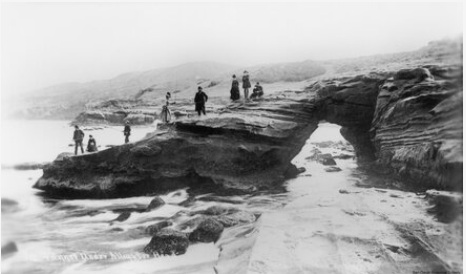
Alligators weren’t a common sight in early-1900s La Jolla — but one rock formation along the cove once carried the name “Alligator Head,” a landmark that has changed significantly over time.
In early records of La Jolla, “Alligator Head” appears as an informal name for a distinctive sandstone outcrop along the shoreline. It was not an official geographic designation, but a descriptive label used to identify natural features by appearance during a time when the coastline was still loosely mapped and locally referenced.
The formation is part of the cliffs that define La Jolla Cove, where sandstone has been shaped over long periods by wind, surf, and storm activity. Coastal research from Scripps Institution of Oceanography at UC San Diego notes that these formations evolve gradually, with some features remaining stable for long periods while others are altered by wave action and erosion.
La Jolla Cove’s ” Alligator Head,” unknown date. (Photo and caption info courtesy of the San Diego History Center)Historical photographs show that “Alligator Head” once included a prominent arch in the late 19th and early 20th centuries. Over time, that arch weakened under continued exposure to the sea and natural coastal forces.
At the time the name appears in early records, La Jolla was lightly developed, with only a small number of structures above the cove and much of the shoreline still used informally for recreation and reference.
“Alligator Head” functioned as a practical landmark in this early coastal landscape, helping describe location before modern mapping systems and standardized geographic naming were established.
Left, La Jolla’s “Alligator Head” from a distance. Middle, La Jolla Cove with the bathhouse behind it. “Alligator Head” can also be seen. There is another house to the right of the bathhouse building, and a few people are standing on the cliff near “Alligator Head,” c. 1906. At the right, another view of the La Jolla Cove. (Photos and captions info courtesy of the San Diego History Center)According to coastal geology documentation, including Shepard & Kuhn studies, the arch associated with “Alligator Head” ultimately collapsed during a winter storm in January 1978.
Today, the sandstone formation remains part of the La Jolla Cove landscape, but the distinctive arch that once defined “Alligator Head” is no longer present in its historical form. The name survives in archival photographs and historical references, preserving how early observers once described the coastline.
La Jolla – Alligator Head with a person sitting under the arch, now gone- c.1874. (Photo and caption info courtesy of the San Diego History Center)Read more history stories here, and do you have a story to tell? Send an email to [email protected].
Sources:San Diego History Center archival photograph collections.F.P. Shepard coastal geology studies of La Jolla Cove and Point La Jolla (Scripps Institution of Oceanography, UC San Diego).U.S. Geological Survey (USGS) – coastal erosion and landform processes.California Geological Survey – coastal geology and coastal processes.NOAA National Ocean Service – shoreline change and coastal processes.Local newspapers and historical references.
Hence then, the article about la jolla s alligator head rock formation has changed but the name endures was published today ( ) and is available on Times of San Diego ( Middle East ) The editorial team at PressBee has edited and verified it, and it may have been modified, fully republished, or quoted. You can read and follow the updates of this news or article from its original source.
Read More Details
Finally We wish PressBee provided you with enough information of ( La Jolla’s ‘Alligator Head’ rock formation has changed — but the name endures )


Also on site :
- Iconic Revenge Song, Ranked Among ‘Best Breakup Songs of All Time,’ Was Originally Written for Gretchen Wilson
- Tom Cruise Says Taylor Swift Was ‘Schooling Me on Football’ at Chiefs Game, Calls Her a ‘Brilliant Musician and Director’
- ‘The game Buffalo deserved’: Bills Mafia and players share reaction to victory in first game at new stadium