
Omar Abdulkadir Artan may be the best soccer referee in Africa. He’s certainly one of the best in the world. We know this because he was one of just 52 people chosen to officiate the 2026 World Cup, which kicks off on Thursday. His appointment was historic, as well as deserved: He was set to become the first Somali to referee a World Cup game. Artan is decorated and experienced—but he’s Somali. That, ultimately, is probably the reason why he won’t make history.
On Monday, Artan was turned away at customs at the Miami International Airport, after border officials reportedly questioned him about, among other things, the Islamic insurgent group Al Shabab. The Trump administration has waged a bitterly racist campaign against Somalis and Somali Americans in recent months. The nation is on the president’s travel ban list, and President Donald Trump has called Somali Americans “garbage” and said “they’re all crooks.” The Trump administration, it seems, determined it would not allow a World Cup principally hosted by the United States to provide a showcase for a Somali—even if he earned his place; even if he really wasn’t there to represent his country.
Just last year, Gianni Infantino assured fans that none of this would happen. “There is a lot of misconception out there,” the FIFA president said in August. “Everyone will be welcome in Canada, Mexico, and the United States for the FIFA World Cup next year.” That tune has changed: When the Artan news broke, a FIFA spokesperson shrugged off the fact that one of its handpicked referees had been denied entry to participate in a tournament where “everyone will be welcome.” FIFA, the spokesperson said, is not involved in host-country immigration processes, including visa adjudications, and has been informed by authorities that Mr. Artan’s status will not be changed at present.”
Welcome to the 2026 World Cup, a Frankenstein’s monster of a tournament, stitching together the rot of FIFA with the ruin of its principal host nation. With kickoff a day away, there are many reasons to despair—or just to tune the whole thing out. But there are also reasons to be hopeful. Donald Trump poisons everything he touches, as does Infantino. But the competitive spirit of the World Cup, in spite of it all, can be remarkably resilient—an often poignant, sometimes magical spectacle that often reminds us that there are many things that vulgarians like Trump and Infantino simply can’t desecrate.
At the moment, the vibe is bad; there is very little magic and almost no poignancy. Instead there are the stories, like Artan’s, bubbling up as the World Cup approaches. The United States has denied visas to Iranian officials, detained Iraq’s star striker Aymen Hussein for seven hours at Chicago’s O’Hare airport, and has denied entry or put up significant hurdles for many fans who are citizens of nations that aren’t subject to the administration’s travel restrictions, like Jordan and Scotland.
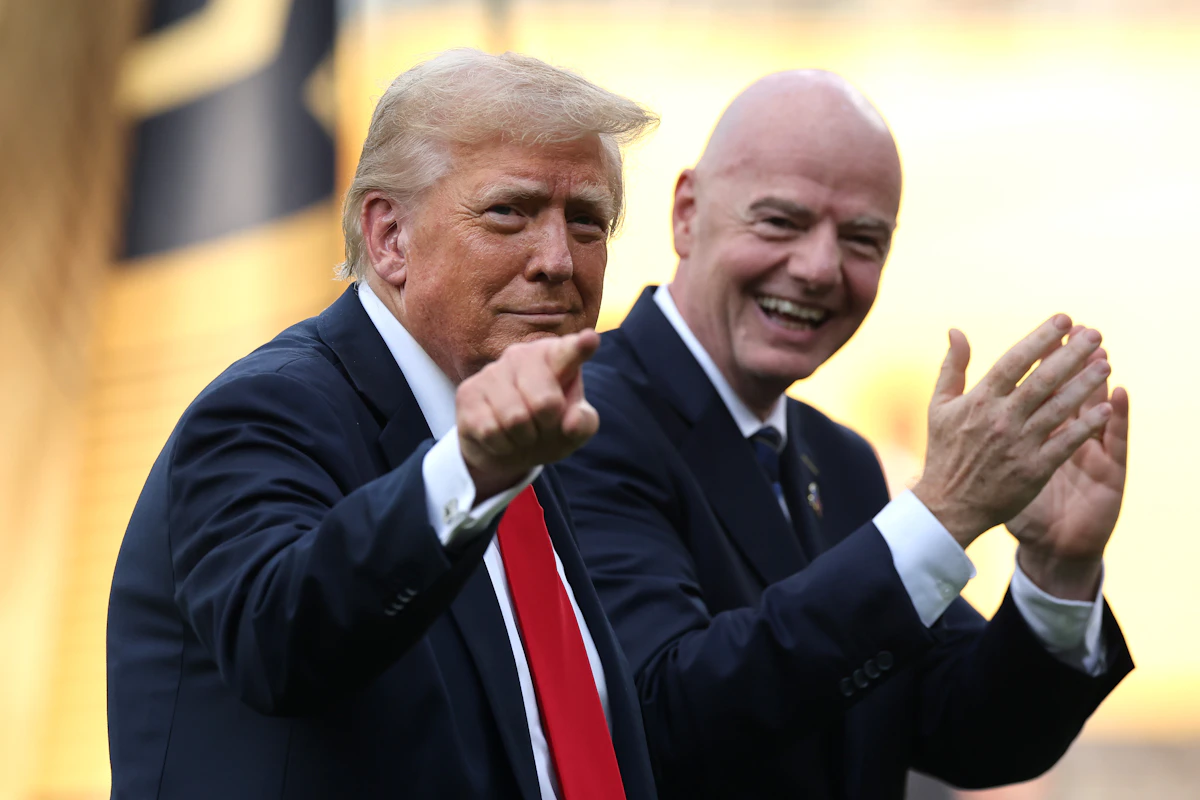
If you have followed U.S. politics in any capacity since Trump returned to the White House last January, you have probably spotted Infantino lurking. He was at the inauguration and has popped up at Trump’s side in the Oval Office and on state visits—he even donned a red Trump hat at a meeting of the president’s absurd, fantastically corrupt “Board of Peace”—where he pledged to spend tens of millions building soccer stadiums in Gaza, a tin-eared, inhumane gesture even by Infantino’s depraved standards.
The conventional wisdom at the time was that Infantino was playing the long game. Sucking up to Trump would be humiliating for most, but Infantino is a virtuoso at ritual self-abasement—indeed it might be his only real talent. The prevailing theory was that Infantino was attaching himself like a barnacle to America’s gormless and corrupt president for the sake of the World Cup. By June—which is to say by now—the effort would pay off in the form of a tournament that ran smoothly, the way he wanted it.
To accomplish this, Infantino went so far as to create the single dumbest and most ridiculous award in the history of humanity—the fantastically absurd “FIFA Peace Prize”—which he bestowed on Trump. A month later, Trump sent U.S. troops to kidnap the president of Venezuela; a month after that, he started a war with Iran, a World Cup qualifier. Infantino, of course, doesn’t care about national sovereignty or human suffering; he certainly doesn’t care what kind of a person leads World Cup host nations. He does care that he—and by extension FIFA—gets what he wants from the tournament. And if that requires a warmonger to be the first—and let’s face it, likely only—recipient of a FIFA-branded award, so be it.
It can be credibly argued that Infantino debased himself for little in return. The lead-up to the tournament has been pure chaos and dysfunction. FIFA has known—or at least should have known—that there would be travel issues related to the tournament from the moment Trump won the election in 2024. (In fact, some of these concerns were apparent when Joe Biden was president.) Infantino may have hoped that all of that face time with the president would smooth things over. They haven’t, and there’s clearly no plan B. Put Infantino down as another fool in a long line of them that gambled that the president might care about anything other than himself and lost.
That said, there’s really no evidence that Infantino is troubled by any of this. He doesn’t care if a Somali ref isn’t allowed to officiate for racist reasons or if the Iranian team isn’t allowed to stay overnight in the United States—its base camp is in Tijuana. He doesn’t care if tickets to even inconsequential group stage matches are going for $1,000 or more. In fact, the absurd cost of the tournament to fans is the other major crisis of the 2026 World Cup. But for Infantino, the checks keep clearing. So he’s not losing sleep.
It is scandalous all the same. Fans are being priced out of participation. Many fans who might be willing to risk the perils of visiting the United States right now are staying away due to the insanely high cost of tickets. Although FIFA has bent a little in recent days, releasing more tickets and allowing prices to fall somewhat, it’s too late for many fans from outside the U.S.
For Infantino and FIFA, that’s just fine. Their real goal is to rake in as much cash as possible from the 2026 World Cup, and that’s exactly what is happening: The organization is set to make as much as $14 billion from the tournament. And for Infantino, it’s crucial that it does. He is running for reelection, and his presidency is dependent on doling out tens of millions’ worth of boodle to each of the 211 national federations that make up FIFA. For Infantino, it doesn’t really matter if the World Cup is chaotic or controversial. He just needs that money pump to run thick and green.
And make no mistake, the cash is flowing. But very little of it is trickling downward. The money’s not helping players, teams, or officials. It’s not benefiting fans or lowering the cost of transit to the venues. It hasn’t created exceptions for people traveling from nations like Somalia or Iran. For a select few, this will be the most lucrative World Cup ever. The only cost to Infantino is that he had to spend 18 months fawning over a moronic president who doesn’t care a lick about soccer.
But for the World Cup, this isn’t novel. Mussolini’s Italy hosted the second tournament ever, after all. FIFA’s history of corruption and bribery is only slightly shorter than that of its ties to authoritarian regimes and states. The U.S. is hosting the 2026 World Cup more or less because an FBI investigation into the awarding of the 2018 and 2022 tournaments nearly destroyed FIFA—it’s basically a make-good, an apology for the fact that Qatar more or less bought a World Cup that had been earmarked for the United States.
What’s more is that the lead-up to the World Cup always tends to be the moment we choose to reflect on its flaws and the corruption of its governing body; when we have the opportunity to assess the often dire human cost of holding this tournament in the first place. The 2010 and 2014 tournaments, held in South Africa and Brazil, were riven by protests over the high cost borne by developing nations who spent billions to host a tournament while millions lived in poverty. The 2018 World Cup was a transparent soft-power plot devised by Vladimir Putin of host nation Russia, sandwiched conspicuously between its invasion of Crimea and, four years later, Putin’s attempt to seize all of Ukraine. The 2022 tournament in Qatar was marred by the host nation’s abuse of the migrant workers who built its stadiums, whom it essentially treated as slave labor, as well as its oppression of women and minority populations.
By now, the World Cup follows a recognizable pattern: a wave of controversy and media scrutiny in the weeks leading up to kickoff that ebbed the moment the goals started coming and the talented nations started advancing. The World Cup is so big—and still, in spite of everything, so glorious—that it’s hard to focus on anything else once it starts. The competitive narratives eventually overwhelm. It seems this familiar trajectory is once again locked in. World soccer’s biggest blackguards eventually benefit from the fact that the actual soccer is riveting.
Will this year’s tournament break the cycle? There are some reasons to believe it might. In addition to all of the issues we have heretofore covered, climate—Houston and Miami are both hosting several games—will certainly be an issue. And what happens if there’s an outbreak of measles or another preventable infectious disease, thanks in part to the policies of Health and Human Services Secretary Robert F. Kennedy? What if, God forbid, some kind of tragedy strikes? The English media, in particular, has latched onto a mass shooting in Kansas City that wounded nine because it occurred five miles from the team’s hotel. This is America, after all—there will undoubtedly be gun violence in host cities during the tournament.
Oh, and let’s not forget: Donald Trump is president of the United States. Past World Cup hosts have felt powerful incentives to keep controversy and chaos to a minimum during the tournaments. The leaders of South Africa and Brazil wanted to showcase their nations and their economies; Putin wanted to rehabilitate Russia’s reputation after Crimea; and the Qataris wanted to use the tournament to make powerful friends. They wanted something from the World Cup, in other words.
Naturally, Trump has the monomaniacal desire to be bathed in a positive light, but he doesn’t need anything specific from this tournament—no quid you could offer for him to stake pro quo of being on his best behavior. To expect a man who is so thoroughly in crashout mode to straighten up and fly right for a month and a half without doing something controversial, destructive, or stupid—maybe even from doing something that ticks every box at once—is to insist on the physiologically impossible. There is little to be done about the fact that the defining feature of this tournament will be a vainglorious and corrupt president.
But it’s still the World Cup. As embarrassing as it is to admit, I got goosebumps writing that sentence. When the tournament starts, many of us will remember everything we love about it. And there is a lot to love.
A (likely) last dance for the sport’s greatest ever player (Argentina’s Lionel Messi) and its, I don’t know, eighth or ninth best (Porgual’s Cristiano Ronaldo), the 2026 World Cup will feature wunderkinds like Spain’s Lamine Yamal and players currently playing at their peak, like England’s Harry Kane. Although the French arguably arrive with the best team for the third consecutive tournament, it also feels more open and unpredictable than recent World Cups. I think seven teams—an unusually high number—have a reasonable and more or less even shot of winning: France, Spain, Argentina, England, Brazil, Portugal, and Germany—roughly in that order. (If Yamal is fully healthy, I would flip Spain and France.)
Want a dark horse? There are plenty: Colombia, Norway, Ecuador, and (of course) Turkey come to mind. Feeling patriotic for some reason? The United States Men’s Team is not bad! Want to have fun picking a random country? FIFA expanded the tournament from 32 to 48 teams, mostly for craven profit-seeking reasons, but that also makes it fun! Uzbekistan, Haiti, Cabo Verde, even small but mighty Curaçao… take your pick.
Mostly though what’s to love is the World Cup. All of that soccer—104 games in 39 days—means that there will be a lot of joy and a lot of chaos (the good kind). Trump can ruin the Knicks. He can ruin the White House. He can ruin America. But he can’t really lay a glove on the World Cup. Over those 104 games there will be a lot of reminders that there are a great many things in the world that can’t be tainted, perverted, or corrupted by money and power. There will also be a lot of reminders that the world looks rather different from how he describes it. The diversity of the World Cup—which has only grown with the expansion of the tournament—is and always has been its real strength. The tournament is a celebration of what makes nations unique, just as it is a reminder that people from all over the world are basically and fundamentally the same. At its best, it’s a celebration of togetherness and diversity that undercuts every tenet of the president’s agenda.
There is no real way to separate the two facets of the World Cup, no way to celebrate its magic without coming into contact with its corruption. There’s no avoiding Trump or Infantino. But that is ultimately the tournament’s real power. It’s not simply a global pageant of diversity and togetherness, just as it isn’t simply an event wholly corrupted by autocracy and greed. The World Cup is, and always has been, a reflection of the world as it is right now. That world is, in many ways, broken. It’s hateful and mean. It’s ruled by those who pursue wealth and power and trample on anyone in their way. But it’s not wholly or irredeemably broken. That wealth and power only goes so far; try as they might, Trump and Infantino can only do so much to this beautiful game and the delight of watching this esteemed competition. The lion’s share of these rich rewards belongs to everyone else. It’s there for the taking, if you’ll have it.
Hence then, the article about can the 2026 world cup be rescued from trump and infantino was published today ( ) and is available on The New Republic ( Middle East ) The editorial team at PressBee has edited and verified it, and it may have been modified, fully republished, or quoted. You can read and follow the updates of this news or article from its original source.
Read More Details
Finally We wish PressBee provided you with enough information of ( Can the 2026 World Cup Be Rescued From Trump and Infantino? )


Also on site :
- A+E Global Media Backs Lifetime Korea Series ‘Oh! My Guard’ Starring K-Pop Performer Jung Yong-hwa & Hong Seung-hee
- Quote Of The Day By Tom Hardy: 'There's Nothing Worse Than Anticipation. It's Always The Killer Of Everything. The Actuality Of...'
- Iconic Revenge Song, Ranked Among ‘Best Breakup Songs of All Time,’ Was Originally Written for Gretchen Wilson