
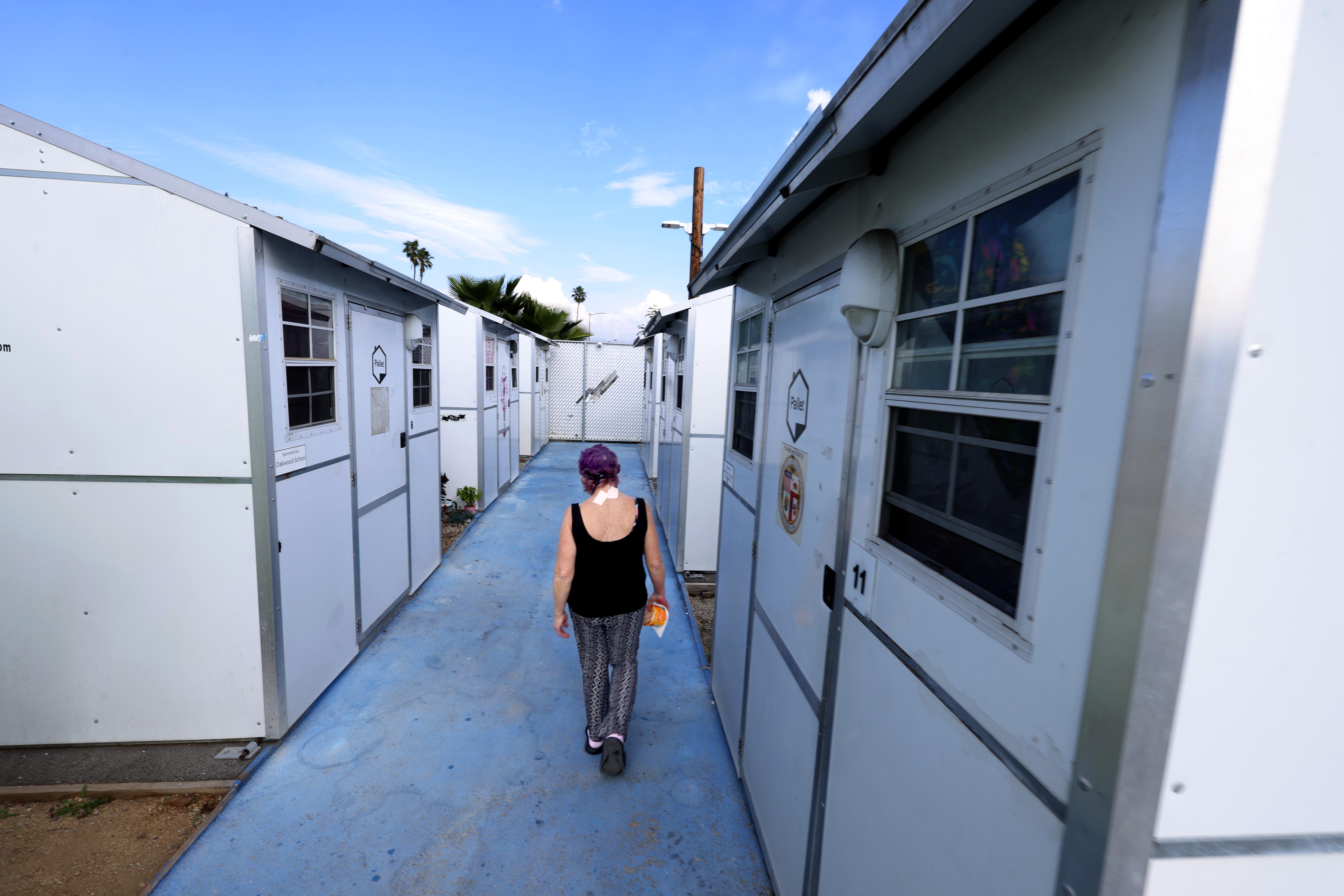
For years, California has been the epicenter of America’s homelessness crisis. Images of tents pitched in downtown areas of major cities have become a persistent conservative attack line and a defining issue for voters. But new federal data suggest California’s approach may finally be showing signs of progress.
Read more: What's Keeping Us From Fixing the Homelessness Crisis
According to a recent report by the Department of Housing and Urban Development, California saw a 2.8% decrease in its population experiencing homelessness year over year, marking the first decline since 2018 and one of the largest drops in the country. Although California still has the largest number of people experiencing homelessness in the nation, the state's rate dipped from 48 per 10,000 people to 46 per 10,000.
The decline appears to have been driven by a mix of policies, according to organizations that work closely with the state government to address the crisis: prevention programs, supportive housing and mental health services, and more aggressive encampment cleanup operations.
Read more: 4 Charts That Explain How People Slide Into Homelessness
The trend in California is part of a broader nationwide decrease in homelessness, with Illinois (44%), Hawaii (41%), Florida (11%), and New York (8%) seeing some of the largest declines.
One of the Californians who pulled herself out of homelessness was Satonna Ballard-DeBose, a former social service worker and mother of three children. She tells TIME that in 2018, she left her home after her husband physically assaulted her in public, despite having nowhere else to live.
“I was at work, looking at the ring that I got. I was flipping it around, and then I just took it off,” she says in a phone interview from Oakland. “I said to myself, ‘I can't do this. I'm more than this.’”
With no support from her family, what began as an emergency exit from an abusive marriage turned into seven years of living in her car in the Sacramento area.
During the day, she worked as a Lyft driver and a security guard, but still wasn’t able to find an apartment because of her low credit score. At times, she relied on credit cards to buy food for her children. Many shelters refused to accept her because of concerns over the spread of COVID-19, so she rented a storage unit to change her clothes every day and make sure her car stayed clean for her passengers.
It wasn’t until years later, after her story was reported by a local TV station, that she was connected to programs for victims of domestic abuse and finally able to move into a subsidized one-bedroom apartment.
“I'm just very grateful to God that I survived it, because I know for a fact that there are a lot of people who would not have survived what I've gone through,” she said.
Read more: What I Learned From 32 Years of Writing About Homelessness
Asked what is driving the change in California, many nonprofit organizations credited homeless prevention programs across the state. Like Ballard-DeBose, many people experiencing homelessness spend years trying to find stable housing, and social workers say the most cost-effective approach is to stop people from being evicted in the first place.
“The idea is that you subsidize the rent for a short period of time, and keep them housed, which is infinitely less expensive than them falling into homelessness,” John Maceri, CEO of The People Concern, a Los Angeles-based nonprofit organization that oversees more than 5,000 housing units, tells TIME.
About a third of the state’s population experiencing homelessness were long-term leaseholders who had been evicted, according to a study from University of California, San Francisco.
California launched the rent assistance program in 2019 and has kept funding at $1 billion a year since 2021, long after the peak of the COVID-19 pandemic. Previously, the state relied on a patchwork of federal vouchers and smaller, population-specific state or local programs.
Last month, Governor Newsom distributed more than $760 million to all 42 California regions to end homelessness, a sizable portion of which is dedicated to rental subsidies and relief programs. This is the sixth round the governor has kept Homeless Housing Assistance and Prevention grants funded since 2019, with the seventh round totaling $500 million planned for the coming budget year. In major cities like Los Angeles or San Francisco, eligible applicants can receive thousands of dollars in financial assistance on unpaid rent, mortgage, and sometimes future rent.
“You could probably spend about a third to keep somebody housed as opposed to what you would spend if they became unhoused and then they had to be rehoused,” Maceri explained. “If they have complex medical problems, the cost can go up substantially.”
Supportive housing with additional services
A second strategy adopted by California has focused on moving people into housing while pairing that housing with services intended to help them remain stably housed. More than 64,000 people in California are chronically homeless, with 71% of them living without a shelter, according to the latest HUD report.
“You offer them the opportunity to move indoors, and you wrap services around them, whether it's medical treatment, mental health, substance use treatment,” Maceri said. “That is a far more effective strategy. People are more willing to say yes—they're willing to come indoors.”
Anat Leonard-Wookey, vice president of programming and services at LifeMoves, a San Francisco-based housing nonprofit, said internal data showed that people experiencing homelessness who went through six or more sessions of behavioral therapy were twice as likely to move into permanent housing and to see an increase in income.
“It really does speak to seeing a client as a whole person, working to understand what their history is, and how to potentially move through things a little differently than they've been doing, and seeing that impact through a research lens is huge.”
Over the past five years, California has spent more than $3.8 billion on Project Homekey, a program that converts used motels and other buildings into interim and permanent supportive housing, according to analysis done by local outlet CalMatters. The idea was born shortly after the outbreak of COVID-19, when the state scrambled to house thousands of people living outdoors to curb the spread of the virus.
In 2024, California voters also approved Proposition 1, which issued a $6.5-billion bond that would expand the state’s mental health and drug addiction services by building more facilities. The state faces a severe shortage of mental health beds, as residents in 24 of the 58 counties do not have access to acute psychiatric hospital services, according to California Hospital Association.
But even as California has expanded programs aimed at helping people stay housed, Maceri said the state’s broader housing shortage continues to limit progress.
Research from the nonpartisan Government Accountability Office has also shown that a $100 increase in median monthly rent is associated with a 9% increase in homelessness. Major cities in California such as Los Angeles and San Francisco remain among the most expensive places to live in the U.S., but the supply of shelters and subsidized housing continues to fall far short of demand. Federal data show that California now has more than 76,000 beds for people experiencing homelessness in total, enough to house less than half of the state’s homeless population even at full capacity.
The consequences of encampment enforcement
A third policy pushed by Gov. Gavin Newsom to address the crisis has been stricter enforcement against encampments on the streets. Following the 2024 Supreme Court ruling that gave local and state governments greater power to criminalize sleeping and camping in public spaces, Newsom unveiled a model ordinance designed to require people living in public spaces to relocate or face arrest.
In 2025, San Francisco took an aggressive approach to clearing encampments, making 833 arrests, a 54% increase from the previous year, according to police statistics.
Officials have argued that encampment enforcement is necessary to address public safety and sanitation concerns. But the problem with this approach, advocates say, is that not only do the operations themselves fail to solve homelessness, but they can also undermine outreach programs that might otherwise persuade people to move into interim housing.
“To have your community broken up, to have your things taken and likely discarded, and to not have a next step identified in many situations really sets folks back and does not help them reach stability within our outreach programs,” Leonard-Wookey said.
Encampment sweeps can also sever the relationship between residents experiencing homelessness and outreach workers, particularly because many people living outside lack identification, phones, or other reliable ways to stay in touch. That disruption can matter, she said, because there is a 25% increase in people accepting shelter when outreach staff visit them twice or offer additional services.
Another key issue surrounding encampment operations is where people are housed temporarily. In most major cities in California, once tents are cleared, people who are arrested under public camping bans are detained for 20 to 30 days. But as Maceri explains, most cities and counties do not have the capacity to hold all people experiencing homelessness in these facilities.
“They're not being aggressive. They're not breaking any laws. They're just trying to survive. That tends to be a very large, invisible number of people experiencing homelessness,” Maceri said.
The tension between local strategies and federal priorities is now threatening to complicate California’s progress. The Trump administration has claimed that “Housing First” policies, which offer long-term housing to people who are chronically homeless without requiring them to first meet conditions such as sobriety or treatment, have failed to address the problem. Instead, the administration has pushed for programs that place greater emphasis on recovery before people are housed.
On Tuesday, HUD announced a plan to redistribute billions of dollars in homeless aid, putting people in interim and permanent housing programs at risk of becoming homelessness again. The new plan would shift 90% of the $4 billion federal funding meant to support permanent housing to other programs that require people experiencing homelessness to meet certain criteria, such as work requirements or substance-use treatment requirements, in order to receive care.
“The ‘housing first’ experiment failed Americans by warehousing the vulnerable without results,” HUD Secretary Scott Turner said in a statement. “Under President Trump’s leadership, HUD is making necessary reforms to put recovery first.”
For Leonard-Wookey, the debate over federal funding and “Housing First” underscores the risk of designing homelessness policy around ideology rather than the people it is meant to serve. Ultimately, she said, any policy should be centered on the people struggling to find a home and the providers trying to help them.
“There is no one-size-fits-all approach… Policies can easily have unintended consequences, and so to really be aware of whose voices and experiences are shaping those policies would be very, very powerful.”
Hence then, the article about homelessness is falling in california for the first time in years here s what changed was published today ( ) and is available on Time ( Middle East ) The editorial team at PressBee has edited and verified it, and it may have been modified, fully republished, or quoted. You can read and follow the updates of this news or article from its original source.
Read More Details
Finally We wish PressBee provided you with enough information of ( Homelessness is Falling in California for the First Time in Years. Here’s What Changed )


Also on site :
- How Kirsten Storms was written off ‘General Hospital’ after 21 years following ‘mental health crisis’
- Watch Rome Seymour Deliver First Message to Lyric's Famous Dad After 'Big Brother 28' Eviction: 'I Am Sorry' (Exclusive)
- Teen girl who died after being found unresponsive in hot tub in NW Indiana identified