
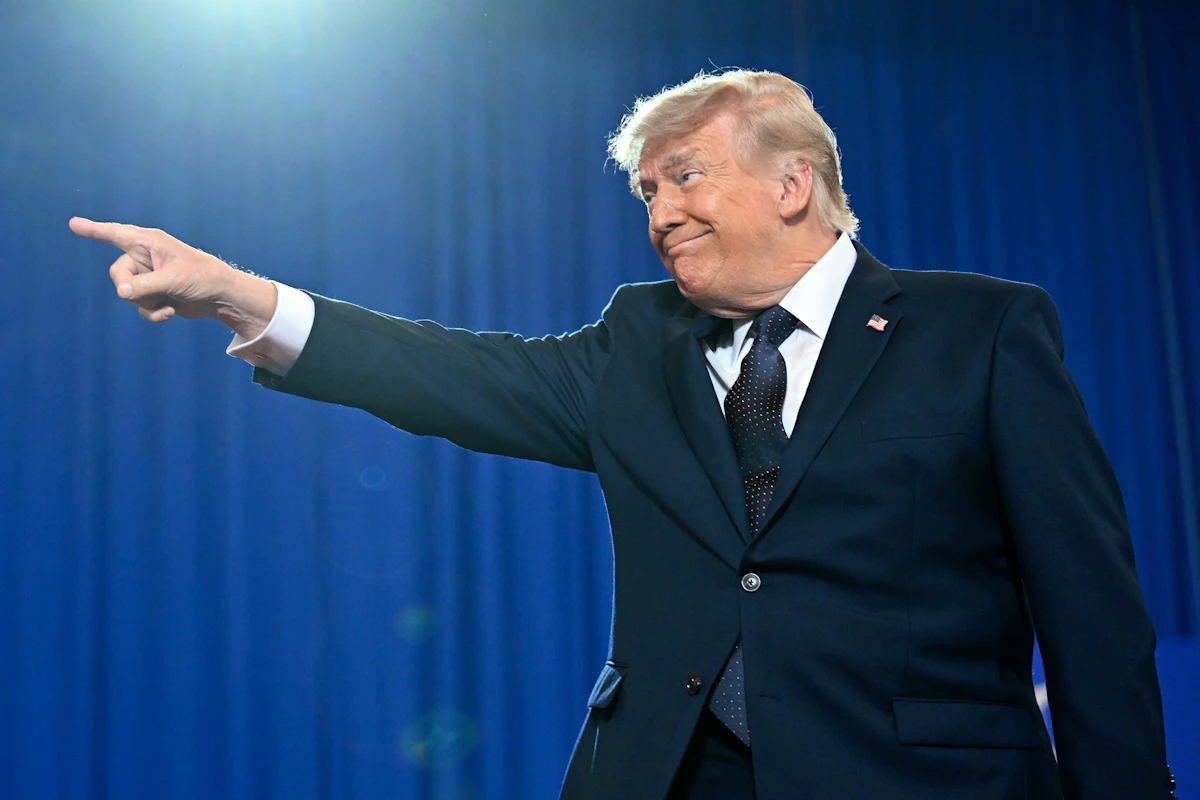
The following is a lightly edited transcript of the June 8 episode of the Daily Blast podcast. Listen to it here.
Greg Sargent: This is The Daily Blast from The New Republic, produced and presented by the DSR Network. I’m your host, Greg Sargent.
Donald Trump is desperately trying to salvage the concert series celebrating America’s 250th anniversary after a number of celebrities pulled out. He unleashed a weird tirade on Truth Social in which he basically declared, don’t worry, I’ll be there, so it’ll be great. But we think this whole saga illustrates something deeper about Trump and MAGA’s growing toxicity inside the culture. Indeed, another Trump tirade about all this was strikingly revealing on that front. And this is all becoming apparent to even some MAGA figures who have reacted to all of it in surprising ways.
New Republic senior editor Alex Shephard writes really well about Trump, MAGA, and cultural politics. So we’re asking him what gives about all this today. Alex, always good to have you on, man.
Alex Shephard: It’s great to be back.
Sargent: So the organizers of what’s being called the Great American State Fair, which is being produced by the Trump-backed group Freedom 250 to be held on the National Mall, recently announced the slate of celebrities and musical acts who are set to attend. But then people started pulling out—the rapper Young MC, Poison’s Bret Michaels, country music star Martina McBride, the Commodores, all out. Alex, can you recap what happened here?
Shephard: Well, I mean, it’s a little hard to figure out, but based on the initial announcement and statements from the artists, what it seems like happened is that this group that is organizing the Great American State Fair went to artists and seems to have maybe downplayed the political nature of this, a sort of pro-Trump rally, essentially. Since it sort of has fallen apart after it became apparent what this actually was, Trump has tried to step in and save it with his own star power, essentially.
Sargent: Well, Trump puts out this tirade on Truth Social in which he suddenly says, we don’t really want singers there. He goes on and he says, the “fabulous Lee Greenwood” will introduce me and the singer Christopher Macchio will sing, plus a few musical groups from the armed forces.
And then Trump hits his climax, saying that the event will be attended by, “a fine and highly dignified gentleman known as President Donald J. Trump.”
Boy, I don’t know, Alex, that doesn’t sound like a must-see, does it?
Shephard: I mean, I think I would still probably rather sit through a Trump rally than watch Vanilla Ice and Milli Vanilli perform. But no, it does not seem very good. I mean, this is a farce, right? Because how much can a concert featuring Vanilla Ice and Milli Vanilli really celebrate America?
But still, the idea here was to have some sort of event befitting of the country’s 250th anniversary, birthday, whatever you want to call it. And instead, we’re just going to get another Trump rally on the National Mall.
Sargent: Exactly. I just want to highlight one other thing Trump says here in this tirade. He says this: “We don’t want singers with no talent. We’ve told them all to stay home.”
I mean, Alex, that’s basically, you’re not breaking up with me, I’m breaking up with you. Your thoughts on that?
Shephard: Where’s the lie? I think he’s not wrong. But as with many of, you know, him calling out Omarosa or whatever, you’re like, you invited them to begin with. It’s embarrassing for you that you invited them. It’s even more embarrassing that they pulled out.
And it’s even more embarrassing than that that you’re doing a rally with Lee Greenwood, who, by the way—I had to look this up before—is even older than Donald Trump. He is at least three years older than Trump. And this guy who’s like an imitation of Pavarotti. It’s preposterous. But again, I think it does kind of capture where we are, less than two years into the second term.
Sargent: Well, let’s talk about that because you’ve written really well on it. You’ve written on the fact that after Trump won in 2024, there was kind of an opening for Trump and MAGA to really make inroads into the culture. It was like there was a little Trump boomlet.
There was sort of a passing sense—or at the time it didn’t even feel passing, it felt like scary, durable. At that moment it felt like Donald Trump has tapped into something that we didn’t know is there. And that was a scary feeling for a while there. Can you talk about that atmosphere at the time and what people kind of concluded about it?
Shephard: Yeah, I mean, it was something that I was writing about and reporting on a fair amount right after Trump won. But I think that there was a sense that for the first time since his movement really started in the summer of 2015, there was carte blanche to just love Trump if you wanted to, or to embrace Trump without repercussions.
People have obviously always embraced him, but there’s always been a sense that doing so would have professional, personal, familial, whatever repercussions you can think of. And I think what we saw immediately after—I wrote at the time about where you were just seeing the Trump dance at every NFL game, at U.S. men’s national soccer games. And it was this sense that the culture had just kind of said, this is who we are, this is part of where we’re going.
And I had felt like I missed that. And you saw this too—things like there was a UFC fight right after the election and Joe Burrow, the quarterback for the Cincinnati Bengals, embracing him. And it just kind of felt like something that wasn’t there before. And it felt alarming because it seemed like there were just inroads, particularly with, whatever we call it, the man-o-sphere now, but even bigger than that. NFL, U.S. men’s soccer, these kinds of things. And even some hip-hop music too.
And now it’s just all gone. None of it’s there. Again, Young MC, Martina McBride—that’s the best that they could do. Morris Day and the Time—that’s the best that they could do to start here. And when we got to the end of the road, it’s not even that.
Sargent: Yeah. I think another way to put this is that Trump and MAGA had this brief moment and this brief chance at winning the culture that was sort of created by a bunch of fluke conditions. Joe Biden’s age, Biden’s refusal to get out of the race in time, the post-COVID shock, inflation, and an information environment that was just so deeply screwed up that all these low-information voters—young people who were just starting to get into voting and into politics—made their decisions based on TikTok videos mocking Harris and TikTok videos just lying to them about Trump’s true agenda.
And that was a weirdly devastating moment. But Trump and MAGA just pissed away the chance that was created for them by this weird confluence of circumstances, I think.
Shephard: I think there are two other things that I don’t think you mentioned. One was the arrest and the mugshot in particular, and then also the assassination attempt and the photograph. And I think that there was a sense of there being a kind of transgressiveness, that this was edgy and it reflected something that was different than Joe Biden stumbling around or Kamala Harris’s carefully focus-grouped campaigning.
And I think that in a lot of ways, I was certainly alarmist about it, and I probably should have just looked at recent history when I was catastrophizing. Because I think what happened is what always happens. Which is that, one, you realize that this guy is completely incompetent, out of his mind, and he’s completely self-obsessed too.
So you don’t get to graft onto him. It always ends up the other way around. He always destroys anything that latches onto him. And ultimately, you have no choice but to separate yourself from it because it is an all-consuming blob, essentially, that just devours anything that gets close enough to it.
Sargent: Yeah, and I think there’s another thing about this as well that’s a little bit darker, which is that Donald Trump had this chance to really make these types of inroads, but then they decided to hurt the country instead in every conceivable way that they could. It’s not like all these artists who are pulling out are simply expressing their personal distaste for Trump.
It’s not like they have Trump Derangement Syndrome. It’s that they have these fan bases that hate Trump and MAGA—and for a reason. They hate Trump and MAGA because Trump and MAGA are hurting and fucking over a lot of people and wrecking our country and our common life together.
Shephard: Trump, when he came into office, was riding this wave and he loved it. He was finally getting the kind of adulation that he always wanted from the sources that he always wanted—not the dumb hicks that come to his events, but from the actual culture. And he could have continued to get that if he had tried to govern like a normal president. And again, he’s just not capable of it.
Instead, he’s governing like Donald Trump. And I think with this event, he’s been really kind of hidden from the public view in a lot of ways. But this event is going to be one of several instances in which he’s stepping out into the open, I think, between now and July 4.
Sargent: I think it’s also worth reflecting on the fact that MAGA is alienating the culture because of MAGA’s actual vision for the country. Let’s remember that the culture started to turn on them pretty rapidly after that brief moment they had, in large part because of the ICE raids, which ended up flooding people’s phones for months on end with searing imagery of Trump’s paramilitary armies terrorizing immigrants and Americans and shooting people in the head.
They threw away their chance to win the culture because they were so hell-bent on not just hurting as many people as possible, but also in service of this kind of vision of a whiter country with millions of people deported via violent ethnic purges and race war.
I’m sorry, I’m pissed about it. What can I tell you?
Shephard: No, I mean, it’s right. I think also there’s Trump’s own bizarre ideas and his efforts in this term to make himself a great president, whatever that means. The Liberation Day tariffs, the insane kidnapping of Maduro in Venezuela, the war in Iran, the Kennedy Center renaming.
All of this stuff is this sort of desperate legacy-building exercise that is backfiring tremendously. But again, it’s what happens when you have an old man with a broken ego running the country.
Sargent: Trump got annoyed by all these people pulling out of the show. And he tweeted this: “I am thinking about bringing the number one attraction anywhere in the world. The man who gets much larger audiences than Elvis in his prime. The man who some say is the greatest president in history, to take the place of these third-rate artists.” Alex, who’s he talking about?
Shephard: Well, he is talking about himself. And again, if Colonel Tom Parker had treated Elvis with the respect that his celebrity deserved, maybe he would have played to even larger crowds, but I digress. I think that this is the problem here, right, is that there’s nothing else.
And part of it, again, is if you look ahead—it’s hard to look ahead right now—but if you look ahead just a little bit to the future, it makes me wonder about Trump’s succession plans, because he can’t let anybody else take the spotlight. And so his only answer when there is a problem like this is to just say, I will fill it. My celebrity.
And one, I think that this is more of a risk than he’s considering. As is, I think, his plan to attend game three at Madison Square Garden of the NBA Finals. As is, I think, his probable appearance at least at the World Cup final in July. Because people hate him right now. Even his own supporters are turning away from him.
And his idea is always to just do the same thing, which is he’s got to go on stage and he’s got to ramble for an hour and a half. He’s got to read the snake poem or whatever and talk about Crooked Hillary and Jerome Powell’s mortgage application or whatever is bothering him at that moment.
There was a point at which, in the very early part of this, there was a kind of thrilling, what-will-he-say-or-do attitude here. That was 10 years ago or more now.
Sargent: So just in response to what Trump tweeted, that crazy thing about him being more popular than Elvis, we saw a MAGA figure, Matt Walsh, tweet something. He said this:
“I’m actually pretty pissed at how badly they bungled America 250. First, they tried to invite washed-up geriatric one-hit wonders. Then when that didn’t work out, they decided to convert the event into a Trump rally where Trump will talk about himself for 90 minutes.”
Alex, Trump’s megalomania has gotten so out of control that even MAGA figures can’t take it anymore.
Shephard: Even fellow megalomaniacs can’t take it anymore. I mean, I think that, as with a lot of criticisms of Trump, it sort of begs a question, which is, what was it supposed to be? There is a sober celebration of America’s culture. You can look, for instance, at things like the kinds of concerts that Barack Obama hosted in the White House throughout his presidency that were showcasing a diversity of American music and values, frankly, as well.
And that’s not possible here, because everything has to be made from whole cloth—or, to use the ballroom or arch as representative, it has to be this very rigid idea of America that’s either perfect classical architecture, which has never really been a through line in this country, or something that perfectly embodies the spirit of Trump himself. There’s just nothing that exists that fits that bill.
And again, we’re a year and a half in and gas costs $5 a gallon everywhere. So who really wants to participate in that anyway? But I think that this is not somebody, or this is not an administration, that is interested in honoring or celebrating American history or culture to begin with. So why would you expect that to even happen at all?
Sargent: Right. For them, the only thing that really is worth celebrating is the MAGA-adjacent stuff in the culture. And I want to close on that concept because Trump’s propagandists are very sensitive to this idea, to this hope that Trump can get penetration into the culture.
So during his first term, you might remember that anytime he went to a college football game in Alabama or in a red state or something and he’d get enormous cheers, his propagandists would plaster that all over Twitter, trying to show Trump’s penetration as this tribune of the people, as someone who was very deeply in touch with what’s going on, with the American public or the zeitgeist or whatever.
But the thing is, they can’t make much headway beyond the Trump-adjacent areas of the culture, the MAGA-adjacent areas of the culture. They consider sporting events to be kind of their part of the culture, but then they deliberately avoid bringing ICE to a Los Angeles baseball game because they know the fan bases there are heavily Latino and filled with a lot of liberals. So it’s almost like they run up against a wall when they try to get outside of the MAGA-adjacent areas of the culture. You know what I mean?
I think this almost speaks to a robustness in the culture, a diversity that they can’t steamroll. Does that make sense?
Shephard: Yeah, I mean, I think that part of it too is that so much of that is also limited to the celebrity and charisma of Donald Trump. I think he does still represent—and can still go to some places and get this kind of response—a metaphor for a pugilistic and nativist kind of American politics.
But people, when they see that politics in action outside of Donald Trump, they recoil. The movement, this MAGA movement, is limited to Donald Trump. It doesn’t have extensions in the culture really beyond a foothold in the UFC. It doesn’t even have extensions in American politics. He will be succeeded probably by Marco Rubio or JD Vance, but they will never have the kind of adulation or cultural resonance that he does.
And so you’re left with this kind of empty vessel, which is this soon-to-be-80-year-old guy standing up and delivering a 90-minute speech in place of C+C Music Factory and Vanilla Ice. And those are your options. And I think that if you’re looking for something to be hopeful about, it’s that. It’s that there has not been this kind of cultural resonance.
And again, with this concert, with probably Trump’s appearance in Madison Square Garden on Monday, with probably Trump’s appearance at a U.S. men’s national team game or several World Cup games—there’s going to be a real example of just what the American people think of him, and it’s not going to be pretty.
Sargent: I think that’s exactly right. I think what you’re really getting at there is that at the core of MAGA is this bizarre kind of howling emptiness. There’s just nothing really there except for Trump’s megalomania and his self-enrichment and his absolutely bottomless need for attention and adulation—and he never gets enough anyway. Alex Shephard, always great to talk to you, man. Thanks for coming on.
Shephard: Yeah, thank you.
Hence then, the article about transcript trump 250 turns humiliating as maga ally harshly mocks him was published today ( ) and is available on The New Republic ( Middle East ) The editorial team at PressBee has edited and verified it, and it may have been modified, fully republished, or quoted. You can read and follow the updates of this news or article from its original source.
Read More Details
Finally We wish PressBee provided you with enough information of ( Transcript: Trump 250 Turns Humiliating as MAGA Ally Harshly Mocks Him )


Also on site :
- 1976 Rock Song, Lasting Nearly 9 Minutes, Recorded in a Munich Basement, Is Still a Generational Hit 50 Years Later
- Glynis Johns Earned a Supporting Actress Oscar Nomination for This 1960 Outback Drama, Years Before Her Mary Poppins Fame
- Theme Song for 1970 Robert Altman Film, Ranked Among ‘Best Comedy Movies of All Time,’ Was Written by a 14-Year-Old