
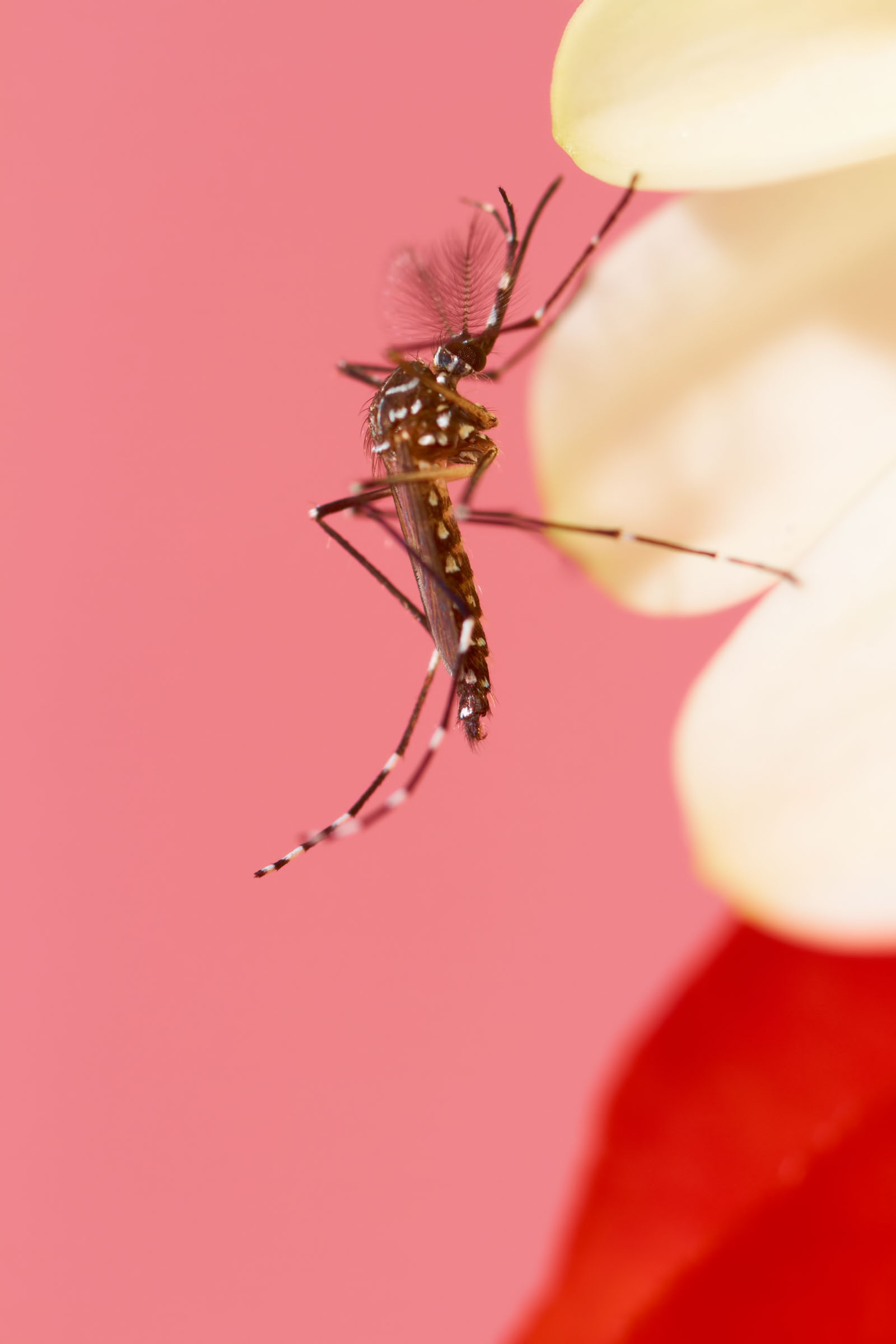
Nobody wants to do mosquitoes any favors. There are an estimated 110 trillion of the often-lethal pests worldwide, many of them spreading diseases including malaria, dengue, West Nile virus, chikungunya, yellow fever, and Zika. But according to a new study in the Journal of Experimental Biology, we may actually be training mosquitoes to bite us, thanks to a come-hither scent we’re emitting when we spray on DEET—an ostensible mosquito repellant that, in some cases, could actually be having the opposite effect.
It was in 1946 that a U.S. Department of Agriculture chemist invented DEET—short for N,N-diethyl-meta-toluamide—an anti-mosquito formulation that was soon adopted by the military for use in jungle and other tropical settings. The chemical is believed to work in a number of ways—jamming smell detectors so that mosquitoes cannot recognize a human or animal target, conferring a bitter taste that mosquitoes detect on their feet, or mimicking the smell of natural mosquito-repelling plants. However it works, it keeps the bugs away—until it doesn’t.
The problem, as found by a research team including Clément Vinauger, associate professor in the department of biochemistry at Virginia Tech, is that while mosquitoes are simple critters, they’re smart enough to learn. When a human freshly applies DEET, it repels the bugs for a while. As the scent starts to fade but doesn’t vanish entirely, however, mosquitoes will resume biting and will come to associate the presence of the chemical with a tasty blood meal. That actually draws them to some people who are wearing DEET.
Read more: What Experts Use to Repel Ticks and Mosquitoes
“Mosquitoes are very smart and can outsmart our control tools,” says Vinauger. “DEET is a molecule that can be interpreted by the mosquito brain, and mosquitoes can learn to like it.”
—Aldona—Getty ImagesIn the course of their studies, Vinauger and his colleagues exposed small populations of mosquitoes to various feeding trials, scheduled for the early morning and the early evening—the insects’ peak hours for seeking out blood meals. In the first trial, the mosquitoes were contained in a glass tube, and on the other side was a fine mesh was a vessel of blood, warmed to a body-temperature 98.6°F. After allowing the mosquitoes to feed on the blood through the mesh, the researchers exposed them to the smell of DEET—which did not deter their feeding behavior. The blood and the scent of DEET were then removed and the mosquitoes eventually abandoned the mesh. Next, the smell of DEET was reintroduced, but the blood was not. Nonetheless, even in the absence of the blood reward, more than 60% of the insects returned to the mesh, expecting a meal.
“By training them, we were able to demonstrate that they can assign value,” says Vinauger. “They can actually turn that molecule that innately is an aversive weapon into something that is attractive to them.”
In a second phase of the study, the researchers presented two populations of mosquitoes with two human hands—one of which had been sprayed with DEET and one of which had not. The mosquitoes that had been trained to recognize DEET as attractive attacked both hands. Those that had not been through the training were drawn only to the hand without the DEET.
To confirm their findings, the researchers repeated the experiment but this time with sugar—another mosquito food—instead of blood. Once again, the insects would avoid a sugar meal if it was pre-treated with DEET, unless they were first trained to associate the chemical with the meal, in which case the presence of DEET was the equivalent of ringing the dinner bell.
None of this means DEET does not remain a useful mosquito repellant—indeed it can be remarkably effective. It does, however, suggest different ways it should be used. Rather than applying a heavy dose of the chemical at once and expecting it to last the day, Vinauger suggests applying the recommended amount detailed in the directions on the DEET bottle, and repeating it throughout the day to prevent the concentration on the skin from falling below the level at which the scent is aversive.
“It’s the frequency of application, how often you need to put it back on the skin” he says.
There’s more to repelling mosquitoes than DEET, of course. Vinauger recommends the go-to strategies of installing well-maintained window screens and, in parts of the world where malaria is common, using bed nets. Eliminating standing water in such vessels as flower pots and wading pools reduces mosquito egg-laying. Octenol, a chemical that mimics human breath and sweat, can be used to lure mosquitoes to electronic bug zappers. And the simple expedient of wearing long sleeves and pants limits the parts of the body that are exposed to any biting insect. Still, if the new study shows anything, it is that we have almost as much to fear from the mosquito mind as we do from the mosquito bite.
“Mosquitoes are very plastic,” says Vinauger, “and the more we look at them, the smarter they appear.”
Hence then, the article about mosquitoes can learn to love insect repellant scientist reveal was published today ( ) and is available on Time ( Middle East ) The editorial team at PressBee has edited and verified it, and it may have been modified, fully republished, or quoted. You can read and follow the updates of this news or article from its original source.
Read More Details
Finally We wish PressBee provided you with enough information of ( Mosquitoes Can Learn to Love Insect Repellant, Scientist Reveal )


Also on site :
- 49 Years Later: The Most Heartbreaking Quotes About the Day Elvis Presley Died, From the Women Who Loved Him
- This Iconic ‘Old Florida’ Attraction Has Been Welcoming Families Since 1949—Here’s What Makes It So Special Today
- Pixar Announces ‘Cars’ and ‘Coco’ TV and Film Sequels, Video Games and Expansions Across Disney Parks at D23 2026