
5 min read
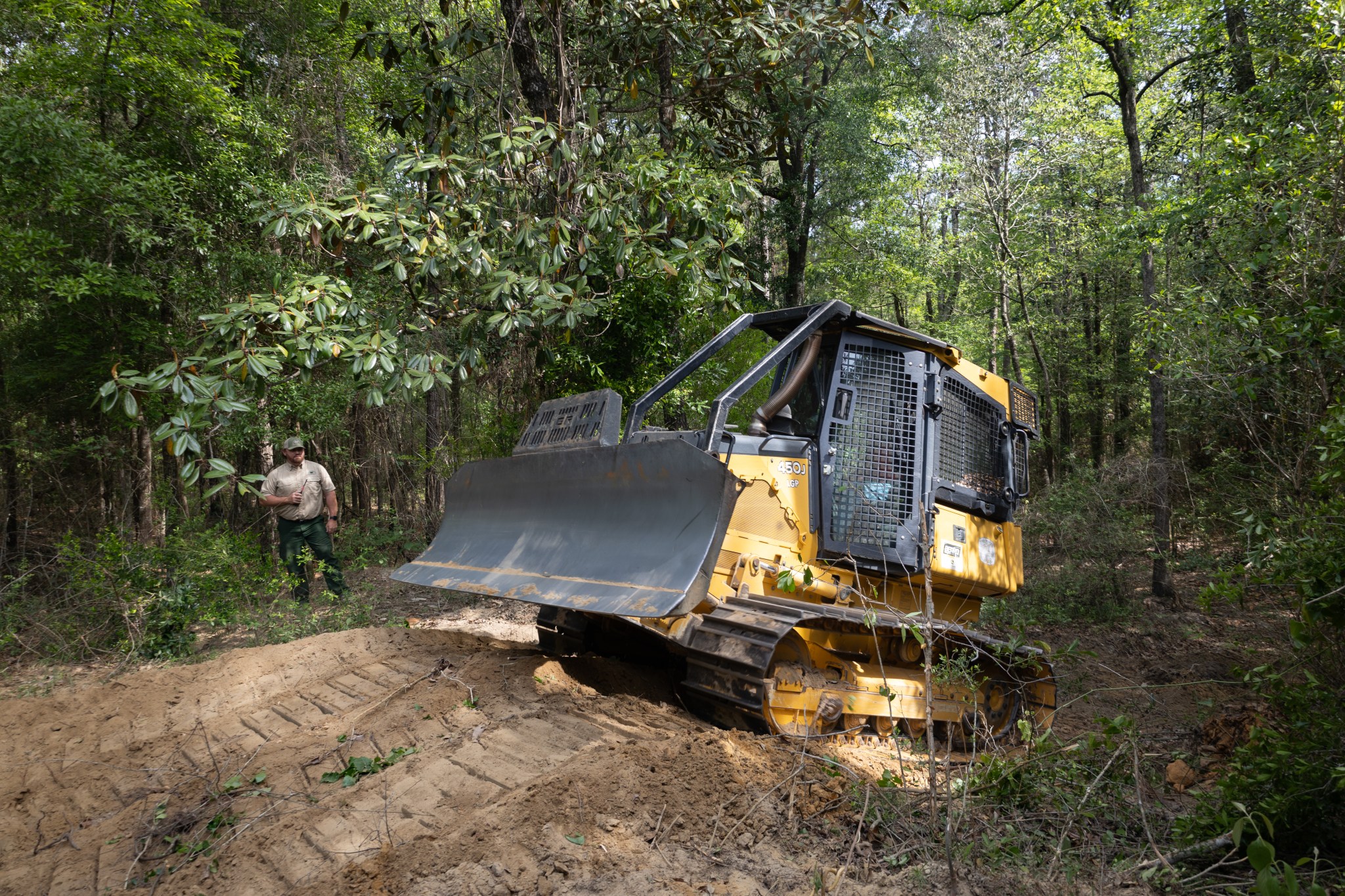
Preparations for Next Moonwalk Simulations Underway (and Underwater) Alabama Forestry Commission wildland firefighter Jason Berry teaches NASA Wildland Fires Technology Program Manager Teresa Kauffman how to drive a fire bulldozer during a stakeholder event April 23-24 in Andalusia, Alabama. NASA FireSense scientists have been working with the AFC to integrate thermal sensors onto these dozers, which notify the dozer operator if the radiant heat from a nearby fire reaches a dangerous threshold.NASA/Milan LoiaconoWith peak wildfire season approaching, scientists with NASA’s FireSense project have created low-cost thermal sensors to install on fire bulldozers that will alert firefighters when heat from a nearby fire reaches a dangerous level. The sensors also provide researchers with important data on what happens beneath the canopy during a fire.
In April, researchers and firefighters gathered in southern Alabama to discuss challenges and advances in firefighting, and to demonstrate the new technology. The event was part of a collaboration between NASA and the Alabama Forestry Commission (AFC). The goal: to make firefighting safer and gather critical data on fire behavior.
“As we try to develop technologies that allow us to understand and respond to wildfires with our partners, ground observations are vital to provide context for what we are seeing from space,” said Ian Brosnan, program manager for wildland fires at NASA’s Ames Research Center in California’s Silicon Valley.
To view this video please enable JavaScript, and consider upgrading to a web browser that supports HTML5 video
The Alabama Forestry Commission tests the new thermal sensor developed by NASA’s FireSense project for their fleet of fire dozers, during the initial integration in September 2025. After FireSense scientists installed the sensor, AFC operators drove the dozer next to a test fire, at the distance the dozers normally operate on a fire line. The thermal sensors performed as planned and have since been deployed on active wildfires. NASA/Ryan WadeDozers on the fire line
Firefighters nationwide use bulldozers, colloquially referred to as fire dozers, on the front line of a fire to clear vegetation and to create fire breaks, which slow or stop a wildfire’s spread. This often puts dozers and their operators within feet of the flames.
The AFC is switching its fleet to a model of bulldozer that has an enclosed cab called an “envirocab.” While envirocabs are safer for operators than open cabs, the enclosure makes it more difficult to gauge when radiant heat from the fire has reached a dangerous temperature.
Alabama Forestry Commission fire analyst Ethan Barrett gives an overview of fire dozer operations to scientists and researchers from NASA’s FireSense project and other university and commercial partners during the April event. NASA/Milan Loiacono“It’s not so much about what’s going to burn the tractor up as what’s going to shut the tractor down,” said Ethan Barrett, AFC fire analyst. The electrical wiring can short or even melt from high heat, stranding the operator in a dangerous environment.
That’s where NASA comes in. According to Brosnan, developing thermal sensors for the AFC was an opportunity to create technology that has immediate impact on firefighter safety, while also providing scientists with valuable information about what happens on the ground during a fire.
It’s not so much about what’s going to burn the tractor up as what’s going to shut the tractor down.
Ethan barrett
AFC Fire Analyst
How sensors work
The AFC’s requirements for a sensor were simple: it needed to be low-cost and easy to operate.
“We used commercial, off-the-shelf components to make this,” said Jennifer Fowler, science integration manager for the wildland fires program at NASA’s Langley Research Center in Hampton, Virginia. “The thermocouple that sits in the window to measure temperature, for example, is the same one used in an oven or a kiln.”
Jennifer Fowler, NASA Wildland Fires science integration manager (left) and Ryan Wade, research scientist with the University of Alabama, Huntsville and NASA FireSense (right) hold a version of the low-cost thermal sensor they developed to install on fire dozers. The sensor uses an off-the-shelf thermocouple, found in ovens and kilns, to read the radiant heat coming in from a nearby fire. When it reaches an unsafe temperature, the sensor triggers a blinking LED light on the dashboard (right), signaling the operator to move away from the fire line.NASA/Milan LoiaconoThat thermocouple is wired to a simple LED light attached to the dashboard that’s directly in the operator’s line of sight. When the thermocouple senses an unsafe temperature, the LED starts blinking. The whole system is powered by AA batteries.
“While installing the second sensor, we realized we needed an extra piece, so we just ran out to the local hardware store to grab it,” said Ryan Wade, research scientist with the University of Alabama, Huntsville and NASA FireSense. “NASA’s expertise in this case comes not in the novelty of the instrument itself, but in figuring out how to solve the problem quickly and integrate that technology into their existing system.”
Fowler installed the first of these sensors in September 2025, and Wade installed the second in March 2026.
“Since their installation, we have run them on wildfires and prescribed burns and they’ve been effective,” Barrett said. “They work exactly as intended, and the operators have said it leads to better situational awareness. Based on the success of this pilot, we are looking at outfitting all the dozers in our fleet.”
Driving fire science forward
Co-developing these thermal sensors is the latest milestone in a relationship the two agencies have been building for more than a year. NASA scientists led training classes on weather and soil moisture with the AFC last spring and worked with AFC ground crews to test airborne instruments on active wildfires.
Moving forward, NASA FireSense and the AFC are planning to integrate the Fire Thermal InfraRed Spectrometer, or FireTIRS, which will measure temperature, spread rate, flame length, fire convection, and gas emissions.
James Thompson, an assistant research professor at University of Texas at Austin and a principal investigator with NASA’s Earth Science Technology Office, tests out locations on a fire dozer where the FireTIRS thermal infrared imager could be mounted. Thompson was part of a stakeholder event held between NASA’s FireSense project and the Alabama Forestry Commission (AFC), which included demonstrating thermal sensors on the AFC’s fire dozers.Fowler is also evaluating anemometers and compact cameras for the dozers. Anemometers provide data on wind speed and direction, while compact cameras provide data on burn severity, rate of spread, and the type, volume, and consumption of fuels.
The data this suite of instruments can gather would fill an important gap in creating a well-rounded understanding of fire.
“This is the dataset that will get us to the next generation of fire models,” Fowler said. “It gives us the detailed understanding we need to create tools that can give firefighters more advanced notice of what a fire will do. On a wildfire, that extra time is everything.”
To view more photos from the FireSense campaign visit: nasa.gov/firesense
About the Author
Milan Loiacono
Science Communication SpecialistMilan Loiacono is a science communication specialist for the Earth Science Division at NASA Ames Research Center.
Share
Details
Last Updated May 27, 2026Related Terms
Wildland Fire ManagementAmes Earth Science DivisionAmes Research CenterAmes Research Center's Science DirectorateEarth ScienceEarth Science DivisionEarth Science Technology OfficeLangley Research CenterWildfiresExplore More
2 min readReleased: NASA Goddard Issues Draft Request for Proposal for the Landsat 10 Spacecraft
The Landsat 10 Spacecraft Draft Request for Proposal (DRFP) is available for review via SAM.gov.
Article 1 hour ago 5 min readNASA-European Sea Level Mission Homes in on El Niño
Article 6 hours ago 1 min readWebinar 6/17: Discover, Access, and Task Commercial Data with NASA’s Satellite Data Explorer
Learn how to use the Satellite Data Explorer to search, access, and task commercial Earth…
Article 7 hours agoHence then, the article about nasa develops sensor to improve firefighter safety was published today ( ) and is available on NASA ( Middle East ) The editorial team at PressBee has edited and verified it, and it may have been modified, fully republished, or quoted. You can read and follow the updates of this news or article from its original source.
Read More Details
Finally We wish PressBee provided you with enough information of ( NASA Develops Sensor to Improve Firefighter Safety )


Also on site :
- Sydney Sweeney Goes Viral for Racy New Ad Showing Off Nude Appearance: ‘She’s Got the Whole Internet Malfunctioning… AGAIN’
- Peso Pluma Leads 2026 Billboard Latin Music Awards Finalists: Complete List
- Giancarlo Esposito, Jinkx Monsoon & Debra Wilson Star Opposite Brandon Rogers In His Debut Feature ‘Weird Party’