
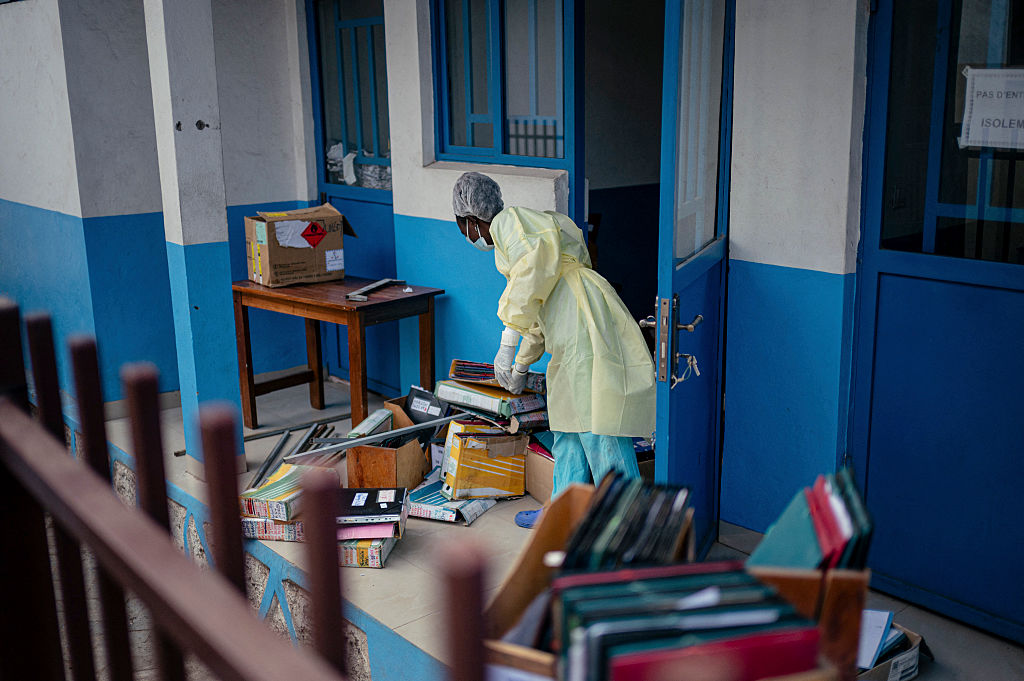
An American working in the Democratic Republic of Congo (DRC) has tested positive for Ebola and has symptoms, according to the U.S. Centers for Disease Control and Prevention (CDC). Six other Americans who are close contacts of the infected person, also in the DRC, are being monitored.
Captain Satish Pillai, incident manager for CDC’s Ebola response, said during a May 18 briefing that the CDC is working to transport all seven Americans to facilities in Germany where they will continue to receive care and be evaluated. He said the individual with the confirmed case was “exposed as part of their work in DRC” but would not provide additional details about how the person was exposed.
During the outbreak so far in DRC and Uganda, eight cases of Ebola have been confirmed with lab tests, and more than 250 suspected cases are being tracked; 80 people have died, according to the World Health Organization (WHO). Violence and political unrest in the region, as well as poor health care infrastructure and lack of proper protective equipment for health care workers, means the virus is spreading quickly, says Dr. Alan Gonzalez, deputy director of operations at Doctors Without Borders/Médecins Sans Frontières, which already had teams in the area providing a range of health services, from pediatric care to malaria treatments. On May 17, the director general of WHO declared the Ebola outbreak in DRC and Uganda to be a public health emergency of international concern, a designation that activates additional resources, personnel, and funding to address the public health threat.
Pillai said the CDC is working closely with health officials in DRC and Uganda to support them in containing the outbreak, including by providing technical experts on Ebola both in person and remotely. The U.S. government has issued health notices for DRC and Uganda, informing Americans who might be traveling to that region about the ongoing outbreak and advising them to purchase travel insurance, avoid contact with symptomatic people, and avoid visiting health care facilities for non-emergencies, since infected patients might be there. The advice also includes avoiding contact with animals and any raw meat.
On May 18, the U.S. restricted entry into the U.S. of anyone who has been in DRC, Uganda, or south Sudan in the past 21 days who does not hold a U.S. passport.
Read More: Inside America’s Only Federal Quarantine Unit for Hantavirus Cruise Passengers
Ebola outbreaks have been common in the DRC since the mid 1970s, when the virus was first identified, and the region has reported at least 16 outbreaks prior to this one in that time. But most have involved the Zaire strain, which has a high fatality rate ranging from 60% to 90% and causes fever, muscle aches, headache, and ultimately internal bleeding and organ failure.
The latest outbreak began with reports to WHO in early May of unexplained deaths, including among health care workers, in Ituri Province in DRC. In just over a week, lab tests confirmed the Bundibugyo strain of Ebola, which has a lower mortality rate of 30% to 50% than Zaire but still causes similarly serious and sometimes fatal disease. Because Zaire has been more common, several antiviral and monoclonal antibody therapies are available to treat it, but none currently target Bundibugyo, making control of the latest infections more challenging. "This is only the third time this Bundibugyo strain is causing an outbreak in recorded history," says Gonzalez. "So the vaccines that were developed before, the specific therapeutics that were developed before, and the testing capacity we developed before for Zaire don't work for this strain."
Ebola spreads through direct contact with infected body fluids, and health officials believe the virus spreads to people from infected bats or primates. Health care workers in parts of Africa are especially vulnerable since they often don’t have the proper personal protective equipment when caring for patients and aren’t always aware patients may be infected, since the initial symptoms are indistinguishable from other infections.
Since January, drastic cuts in funding—especially to programs like USAID, which has played a large role in supporting international efforts to address public health threats—have also impacted health care in the region. Pillai said the CDC has 25 people in the office the agency maintains in DRC, and that number “hasn’t substantially changed. Anything the country office and the ministry [of health] are requesting for support, we will be providing remotely as well as in the field,” he said.
Because there are no specific treatments for Bundibugyo, health officials are focusing on testing, contact tracing to identify people who might have been exposed, and isolation strategies to control the infection. Addressing other infections people may have and ensuring they have proper hydration are also important. Such approaches are critical to containing the outbreak, says Gonzalez, even in the absence of treatments. "We've seen in the last outbreaks that this has a massive impact on the outcomes for patients, even without specific therapeutics," he says.
So far, there are no cases of Ebola reported in the U.S. “The risk to the U.S. remains low,” Pillai said.
Hence then, the article about an american has ebola here s what to know was published today ( ) and is available on Time ( Middle East ) The editorial team at PressBee has edited and verified it, and it may have been modified, fully republished, or quoted. You can read and follow the updates of this news or article from its original source.
Read More Details
Finally We wish PressBee provided you with enough information of ( An American Has Ebola. Here's What to Know )


Also on site :
- Ageless Jane Seymour Takes Halloween Inspiration From 2 Iconic Roles—Dr. Quinn and ‘James Bond’s’ Solitaire
- Energy markets are adapting to the Iran war as a ‘forever conflict’ while oil producers keep supplies flowing and avoid ‘mutually assured destruction’
- Dow and Small Caps Climb Weekly While Nasdaq Slips on Megacap Earnings Charges