
The following is a lightly edited transcript of the May 18 episode of The Daily Blast podcast. Listen to it here.
Greg Sargent: This is The Daily Blast from The New Republic, produced and presented by the DSR Network. I’m your host, Greg Sargent.
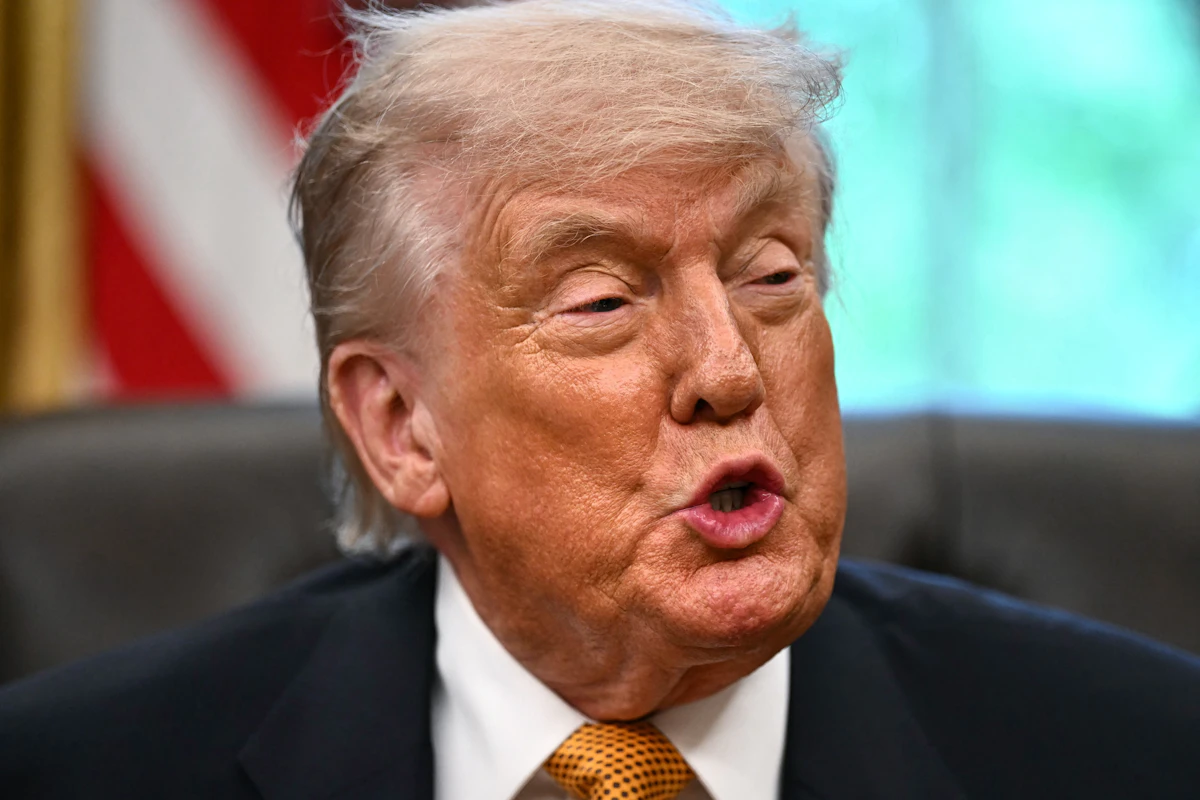
Donald Trump doesn’t understand why the world won’t admit that he’s won a world-historical victory over Iran. In one of his angriest rants ever, he berated a reporter at great length for questioning his success, even accusing the reporter of treason. It’s no accident that this eruption occurred on his flight home from China. The media coverage has been quite harsh, brutally revealing that he failed to make any real headway with China on Iran, among other things. We think there’s a through line connecting Trump’s accelerating authoritarianism at home to his worsening quagmire abroad—he compensates for the latter with more of the former.
So we’re talking today with political scientist David Faris, because he’s been writing well for The Nation on both those topics. David, good to have you on.
David Faris: Great to be on the show, Greg. Thanks for having me.
Sargent: So let’s start with Trump’s tirade. He was on Air Force One on the way back from China. And David Sanger of the New York Times asked him why all the bombing of Iran hasn’t forced the political changes he wants. Listen to Trump.
Donald Trump (voiceover): I had a total military victory, but the fake news, guys like you, write incorrectly. You’re a fake guy. Guys like you write about it incorrectly. We had a total military victory. We’ve had a total victory, except by people like you that don’t write the truth. You know, you should write—I actually think it’s sort of treasonous what you write. You and the New York Times and CNN I would say are the worst.
Sargent: David, has Trump won the resounding victory he claims?
Faris: I mean, obviously not. Right, Greg? The Iran war has not gone at all the way that Trump and his allies thought it would. They were expecting a quick victory, decapitation of the regime, and then replacing it with somebody more compliant—sort of the Venezuela scenario. In fact, they seem to have handed power to people who are even more hardline than the ones that they replaced.
And despite many decades of planning around the possible closure of the Strait of Hormuz, it doesn’t seem like anybody in the Trump administration thought for five seconds about what might happen if the strait was indeed closed for some period of time. Trump is in this pickle. He can’t get the Iranians to capitulate. He can’t change the regime without ground troops. And he can’t reopen the strait without a massive escalation that has no guarantee of success anyway. So he’s really between a rock and a hard place right now.
Sargent: Well, let’s listen to a little more of Trump. Here, he really turns up the heat on the treason charge.
Donald Trump (voiceover): I actually think it’s treason. When you write like they’re doing well militarily and they have no Navy, no Air Force, no anti-anything. Then I read the New York Times and they act like they’re doing well. Everybody knows that—that’s why your subscribers are way down. You know, the Times’ subscribers are way down because it’s—
Sargent: David, a couple things here. Note how angry Trump got when this reporter dared to talk back to him. Note how Trump raised his voice in calling the Times a failing enterprise at that particular point. It looks to me like this is someone who’s just desperate for his supporters to see him dominating some enemy, any enemy he can find. After his own submissiveness in China, the contrast is pretty jarring. Your thoughts on that?
Faris: Well, it’s very telling. I think there are a few things going on here. One is Trump has now become accustomed to speaking only to sycophants and lickspittles in the press briefing room. I mean, we’ve got press credentials going to the Gateway Pundit, people like that. And so he’s no longer really accustomed to fielding lots of hostile questions at once—or skeptical questions, or even questions that are just sort of like, can you please tell us what’s going on?
This has all become something that he doesn’t like, doesn’t want to experience, and refuses to countenance. And so playing this role of trying to dominate journalists is something he’s been doing the whole time that he’s been in politics and probably before he got into politics.
But the specific threat of treason here is part and parcel of a larger authoritarian project where you use the threat of investigations and prosecutions—and just throwing accusations of crime—to get people to self-censor, to ruin their lives, to upend their lives. Leveling a threat of treason at a New York Times reporter is not going to be very effective because the New York Times has a large institutional apparatus backing it.
But people who aren’t part of the New York Times—journalists who don’t want the IRS rifling through their tax records or something vindictively—that’s going to give them pause, right? People have to think twice before they ask these questions. They have to think twice before they write the stories because they know that the president commands an apparatus that can make them pay for it.
Sargent: Trump wants China to magically prevail on Iran. The media coverage has been pretty tough on Trump on this particular point. I’ll read a few. Reuters said he won no tangible help from China on the Strait of Hormuz and Iran. The New York Times said China is unlikely to use its influence with the Iranians for free and that China hasn’t named its price for this yet. And the Financial Times said China conceded little to Trump with no clear breakthroughs. David, what did Trump want China to accomplish here and why did he fail? Is it just that what he was expecting is impossible?
Faris: I mean, there are two reasons. One, Iran is a kind of client state of China at this point. They’ve been doing business—China has helped Iran evade various sanctions for many years, has become a major destination of its oil. And there are deals that take place for arms and other forms of influence. So Iran is essentially a Chinese client state. But what you find out when you think about client states is they don’t always do what you ask them to do. China cannot wave a magic wand and force Iran to capitulate to America’s terms.
The basic problem here, aside from China, is that Trump’s ask of Iran is beyond the bargaining window that he has. He’s asking Iran to accede to terms that Iran simply will not accede to unless you literally overthrow the regime and replace them with people that want to work with you. They’re not going to give up all of the enriched material and say we’re never going to do any nuclear enrichment and then get nothing else in return. I don’t think that they’re going to agree even to a phased system where this sanction is lifted and then this sanction is lifted.
There’s too much recent history of the Trump administration going back on its word or attacking Iran in the middle of negotiations. The demise of the Iran deal at Trump’s hands eight years ago is, of course, how we got here in the first place. There’s just so much mistrust between Iran and the United States.
It’s not even entirely clear that the people who are negotiating in Islamabad are the people running the country, because there’s so much uncertainty about who’s really running the show. We still haven’t seen the ostensible supreme leader, right? There’s a lot of things that we don’t know.
And Trump wants China to use its influence with Iran, which is considerable, to force them to accept America’s terms or something very close to America’s terms. It’s not possible to wave a wand and do that. The other problem is that China, I think very correctly, sees the predicament that the United States is in right now and wants to exploit it.
China’s a major geopolitical rival. The relationship between the U.S. and China has deteriorated, in large part because of a number of things that Trump himself has done. And they see this golden opportunity—like, America has gotten itself into this massive, disastrous, economy-wrecking fiasco that is, for the entire world to see, proving the limits of our ability to just use our military to get what we want.
We’re seeing the limits of a military strategy of having a military comprised entirely of $15 million-apiece weapons that can be taken out by a $7,000 drone. So there are all sorts of ways in which our geopolitical ineptitude and incompetence and weakness is on display. And if you’re China, are you going to go in and rescue Donald Trump from that situation after all the things that he’s done and said about China?
The trade wars, all of the rhetoric—remember during COVID, he kept calling it the “China virus” over and over again. There are reasons that the Chinese leadership would love nothing more than to see Donald Trump humiliated, at great length, very publicly, for as long as possible—up until the point where it might destroy China’s economy too. And we’re just not there yet.
Sargent: David, it occurs to me that both Iran and China see a golden opportunity with regard to the United States right now. Unintentionally, Trump has stumbled into a position where each of these powers has discovered this new leverage over the United States. And they’re both going to use it, right? Isn’t that the situation in essence?
Faris: Yeah, why wouldn’t they use it? I mean, if a new source of leverage has revealed itself to you—for you to achieve some sort of strategic aim—why would you leave that leverage on the table? Especially in a circumstance where we’re technically at war with Iran, or we paused the war—I don’t even know anymore. But the reality is the reason that Iran was putting the elements in place to pursue and build a nuclear weapon was precisely to protect the regime from being overthrown by the United States.
And what Trump has done inadvertently is he has showed Tehran another way to avoid having their regime overthrown. So in some ways they don’t even need a nuclear weapon anymore. The Strait of Hormuz has become the nuclear weapon here.
It has become the instrument by which the clerical regime in Iran—or the IRGC regime in Iran, whatever is actually going on there right now, we don’t really know—but it has become the instrument by which the regime can preserve itself. It has become the point of leverage by which you can say, we have this magical survival mechanism here. We thought it was a nuclear weapon, but it’s actually just the Strait of Hormuz.
Sargent: David, guess what? Somebody gave Iran a nuclear weapon. It was Donald Trump. Donald Trump gave Iran a nuclear weapon. That’s what happened.
Faris: Right, right. I mean, after all these years of saying Iran can’t have a nuclear weapon, they have something that is in many ways much better than a nuclear weapon, right? Because of course using a nuclear weapon would invite mutually assured destruction—would destroy Iranian society and whoever was targeted. Closing the Strait of Hormuz doesn’t physically harm anyone. It just harms the global economy. So in many ways it’s like a nuclear weapon you can actually use.
Sargent: Exactly. Well, to return to Trump’s tirade for a sec—this gives us an opening to do this. It occurs to me that it’s unintentionally revealing, the rant. Every time Trump boasts about the tremendous victory he won over Iran by pointing to all the stuff he’s blown up—he’s made things go boom, boom, boom, right?—he actually shows that he has no idea why this isn’t forcing Iran’s hand on the Strait of Hormuz. And that shows that he fundamentally doesn’t grasp the situation at the most basic level. That’s what these tirades actually reveal. Is that too harsh?
Faris: No, I mean, it’s exactly right. That’s what’s been really obvious since the day that he went out and announced that we were blockading the Strait of Hormuz. And everybody’s like, wait a second—call me crazy, I thought that the blockade of the Strait of Hormuz was the problem here that we are now trying to solve. And he’s like, no, I’m going to make it worse. And I think it really demonstrates his inability to grasp the basic disaster that he himself has unleashed by his own orders and his own actions.
He has brought the United States into this. It’s not—I don’t even know if I would call it a quagmire. It’s like we’ve created this massive economic problem for ourselves and for the world that we lack the ability to solve without such an enormous escalation that it would actually make his political position worse.
So there’s no politically viable or feasible way for him to get out of this other than accepting some demand from Iran that would have been unthinkable four months ago—such as Iran putting a toll on the Strait of Hormuz. There’s just nothing but bad options for him all the way down here.
And Iran probably sees finally a path to a place where they can maintain some semblance of a nuclear program, lift as many sanctions as they can get lifted by using this leverage that Trump just sort of dropped in their lap. And the IRGC, the Iranian Revolutionary Guard Corps, is probably all too happy to have had the supreme leader assassinated, honestly, because then it’s like you’ve got an internal power shift that they wanted anyway.
So it’s like he has just delivered one thing after another to the Iranian regime—that benefits this regime, which of course also doesn’t care about its own people at all. This has been a disaster and a growing disaster for the Iranian people. But for the regime, it’s just Christmas.
Sargent: Another point about his declining approval—G. Elliott Morris, the data analyst, had some really good and interesting data on this. He looked at the net approval for Trump and other presidents like Nixon and George W. Bush. And he found that the net approval actually maps very closely to where George W. Bush was after Katrina and is approaching Richard Nixon during Watergate.
And I think maybe another way to think about this—and another hidden problem for Trump—is that we know that the Iranians and the Chinese are both looking pretty hard at these approval numbers. The lower Trump goes, the more likely they’re going to be to hold out.
Faris: Both Iran and China are well aware that the United States is a democracy and they aren’t. The Iranian regime, whoever’s running it—they never really have to face the voters. The Chinese government doesn’t have to face the voters. These are authoritarian regimes.
And one of the benefits of authoritarianism from a kind of cold, hard political standpoint is that you can make big, sweeping decisions or you can inflict massive suffering on your own population and you don’t have any elections to lose because of it. You have other fears about being dislodged in other ways by other centers of power in the country, but you don’t have a midterm to worry about. Only we have a midterm to worry about.
And Donald Trump decided to launch this war seven months before the midterm elections in which his party was already facing a pretty significant repudiation. And now from the perspective of the Iranians and the Chinese, the more damage you can inflict on Trump in these midterms, the better. The more leverage they will have going forward, right? The relationship with China is not something that’s going to be resolved by whatever happens with the Strait of Hormuz. This is a long-term geopolitical competition that’s happening here.
The issue of Taiwan is coming into play here. And nobody could be happier to see the limitations of American power than China. I think it’s become pretty clear over the course of the past three months that there’s absolutely no way that we could defend Taiwan. China now knows this. And yeah, they must be very happy that we’re about to have an election, that’s for sure. Because the basic dynamics of democracy are: if you screw up, you’re going to get tossed out of power.
And lucky for Republicans, it’s not a presidential election year that he did this in. But when your approval ratings go down like this, it puts a whole other set of seats in the House in play. It puts seats in the Senate in play that wouldn’t have been in play if he was in the low to mid-forties. And so they see this potential catastrophe coming. They want to exploit it. And honestly, who can blame them?
Sargent: Right. Well, I’ll tell you—the 50PlusOne website, which does polling averages, now has Trump’s approval in the polling averages down to below 37 percent, and his disapproval at almost 60. So it’s around a net disapproval of 23 points. That really gets into territory where you start to see that House map broadening out, right?
Faris: Right. I mean, if the only people left in your corner are the one third of the country that has become sort of hardened MAGA cultists—that’s not enough to win the House. That’s not enough to keep the Senate. That’s not enough to win a presidential election.
A lot of the softer supporters in 2024 have drifted away because they don’t like what’s happening. This is not what they voted for. If they’d been paying closer attention, they would have known that this was in fact what they were voting for. But from their perspective, they were electing someone to bring prices down. And not only has he not done that, he’s made the problem much worse. And there’s just no political upside there whatsoever.
It’s not even like, if he got the victory that he wants, it’s really not going to benefit him that much, because people didn’t care about this to begin with. He stakes his entire presidency on an issue about which most Americans do not care. And in fact, by losing that confrontation, it’s really the worst of all possible worlds for him.
Sargent: There’s a way to tie all this together to close this out, which is—Trump is facing an election. China and Iran are watching this very closely. But the truth is Donald Trump really has kind of a case of dictator envy, right?
I don’t know if you saw this, but he tweeted—I think it was in the early morning—something about China has a ballroom, so the U.S. should have a ballroom too. And then in another tweet, he tweeted about his big golden statue. Clearly he’s looking at Xi and looking at the stuff in China and saying to himself, man, there’s a lot of pomp here. They really know how to treat a dictator here. Why can’t I get that? So let me just remind everybody about my golden statue.
But in all seriousness, Donald Trump would like to respond to his failures abroad with more authoritarianism at home. And I think rants like that one at the reporter David Sanger really show that. But here again, he can’t, because he is in a democracy and he’s done a ton of damage to it, David, and you’d probably be the first to talk about that. But he cannot do what Xi and the Iranian clerics can do. Right. Or can he?
Faris: No, he can’t. Not right now. I mean, he can’t just roll tanks through the street. That’s not going to work. And throughout his entire career, he has made it very clear that he envies the unaccountable power of dictators all over the world. There’s a reason that he took one of the signature authoritarian spectacles—which is a massive military parade through the capital—and appropriated it for himself on his birthday last year.
Because fundamentally, he wants to be these people. He wants to be able to order someone to be jailed. He wants to be able to order people to be executed. He wants to be able to make decisions without ever having to face the consequences of those decisions. He hates democracy, right? Loathes and despises democracy.
Sargent: And he hates accountability, I think, is the real crux of it too.
Faris: And that’s a personal thing—this is one very special boy who has never been held accountable for anything in his entire life. And here along comes a problem of his own making that could be his undoing. I’m sure that he knows that on some level, even though he’s created this information bubble around himself with only quislings allowed in the room.
Yet this must be breaking through to him—that his approval ratings are slipping, that Republicans’ political prospects are slipping.
And the only thing that he really can command is his own repressive apparatus. He can still go out and order more investigations of opponents. He can make the lives of journalists hell. He can launch investigations. He can’t necessarily get the outcome that he wants. But the fact that he can do that is concerning.
I think the worse things get for him, we can expect that the abuses coming out of the DOJ and the FBI are only going to get worse, until someone or something is able to really hold him accountable domestically. And we’re not really there yet.
Sargent: I think I know who that’s supposed to be. It’s the voters in the midterms, David.
Faris: That would be nice, wouldn’t it? If the voters properly understood the assignment this time, I would be very happy.
Sargent: Yes, we’re all working toward that right now. You are, I am, everybody is. David Faris, really awesome to talk to you, folks. If you enjoyed this, check out David’s work over at The Nation. He’s a great political scientist who actually was quite prescient way back in the day. He said that we had to fight a lot dirtier against Republicans, and boy was he right about that. David, great to have you on.
Faris: Great to be on the show, Greg. Thanks so much for having me.
Hence then, the article about transcript trump rages wildly at journo and exposes big iran blunder was published today ( ) and is available on The New Republic ( Middle East ) The editorial team at PressBee has edited and verified it, and it may have been modified, fully republished, or quoted. You can read and follow the updates of this news or article from its original source.
Read More Details
Finally We wish PressBee provided you with enough information of ( Transcript: Trump Rages Wildly at Journo—and Exposes Big Iran Blunder )


Also on site :
- Olympic Figure Skater Joining ‘Dancing With the Stars’ Had Her Best-Ever Performance to This ’80s Classic
- KATSEYE Fans Are Lighting Up Their Wildworld Tour With Official Lightsticks — Here’s Where to Get Yours
- Feminist Icon Gloria Steinem Remembered by Madonna, Olivia Rodrigo, Jennifer Lopez & More Musicians: ‘The O.G. Baddie’